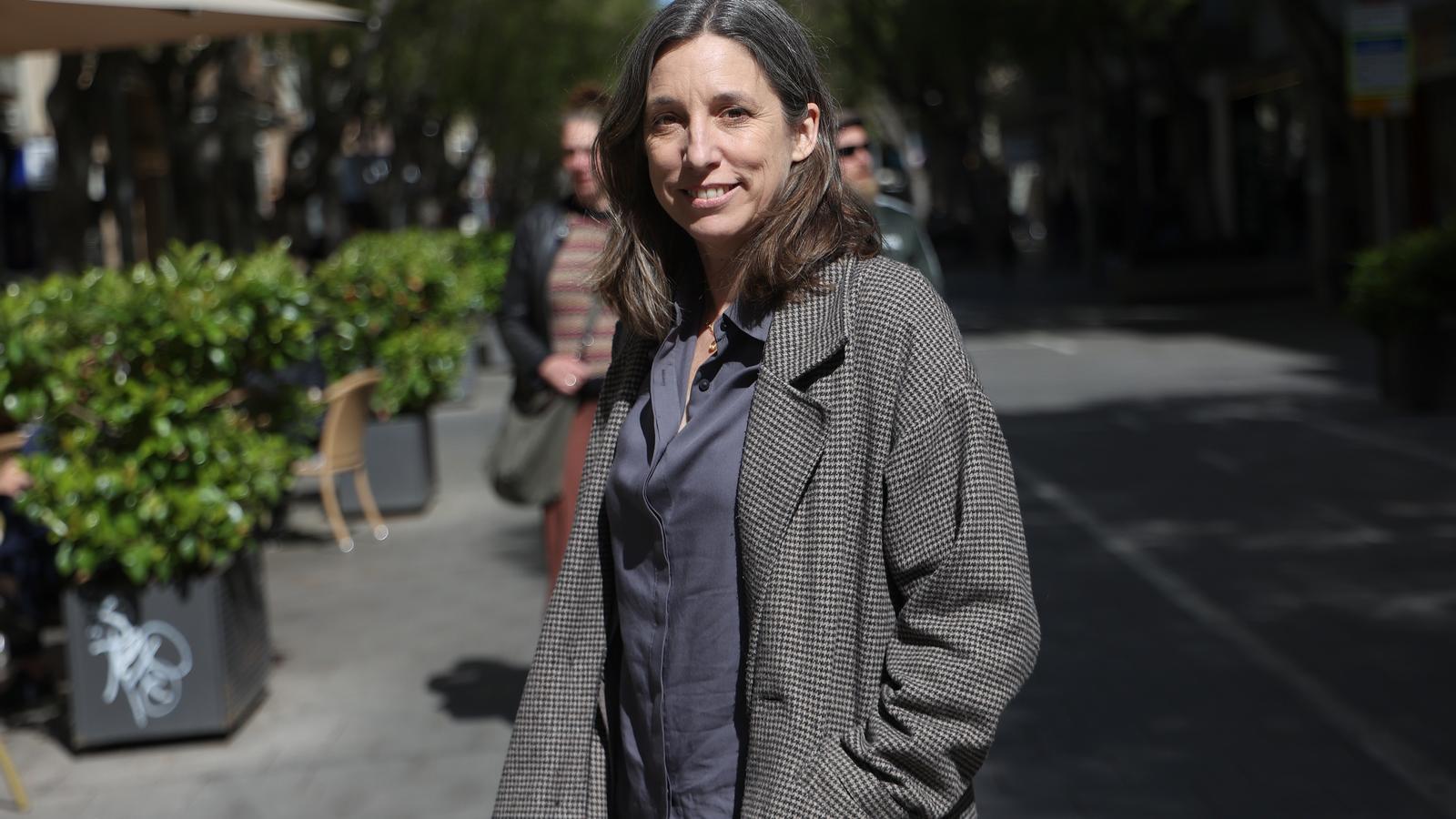
Llucia Ramis: "If you have more money than me can you decide where I can live? Why?"
Writer
-
CAT -
CAST -
DE
PalmBetween an essay and some memoirs and halfway between an allegation and a question, with as much rigor as personal perspective. This is the ground where Llucia Ramis's (Palma, 1977) latest book, Un metro cuadrado, written and published thanks to the No Ficció award from Libros del Asteroide, is situated. In it, the return to all the houses where she has lived serves the writer and journalist as a common thread to delve into all the ingredients with which the current housing crisis has been cooked. The Catalan version, published by Anagrama, will go on sale on May 13.
How did you decide to return to the houses where you have lived?
— There are several reasons. One was to explore the sense of belonging we have with regard to places that do not belong to us. I also wanted to know who lives there now, what relationship they have with the house, how the neighborhood has changed... And then there was the whole issue of housing and how this insecurity then applies to all areas of life. Not having a place that is yours creates an unease that affects everything else: work, relationships, and life.
How did you manage not to be buried by the avalanche of data, information, and news on the matter? There is a very important job of synthesis and putting order to it all.
— I didn't feel I had the heart to do an investigation. There are very capable people who have already done them, and also journalists who do a great job on this topic, and what I wanted was to find a balance between chronicle, autobiography and journalism.
At the beginning of the book, you already warn: the reader will not find a solution to the current situation. But yes, an analysis of many of the causes. The main ones, what are they?
— Partly, from the Franco era, when they wanted to create a society of owners and property was confused with housing. That is why at the beginning of the book I include the two articles of the Constitution, the one on private property and the one on housing. People confuse the right to have housing with having property and doing what you want with it. And with all this, there is a social perception that is very dangerous.
Which one?
— That the owner has more rights than those who are not. That they can do whatever they want because it is theirs. And here we forget two fundamental parts of the Housing Law: that you cannot speculate and that it speaks of decent housing. But what does dignity mean? When they kick you out of your home, they expel you from your neighborhood and your city, we are even seeing how they expel us from islands like Ibiza and Mallorca. Where is the dignity? This feeling of exodus is real and leads to a collapse of the social fabric, which is what creates culture, belonging and identity.
One of the protagonists of the book is Ca’n Garruví, the estate of your Belgian godparents in Mallorca. Its sale already motivated you to write Les possessions,and now you have returned to find yourself with Casa Mariposa, which has little or nothing to do with your memories. The history of this estate could serve as a summary of the island's history.
— It took me 10 years to be able to go back there. And when I went there I found a wall, a very high wall around the house, which forced me to ask myself what the people who lived there then were protecting themselves from. It is on an unpaved road, in the middle of nowhere, without any signs. What are they protecting themselves from? From the islanders? Why do they lock themselves in? Why do they want to act as if the rest of the world didn't exist?
In the book they say that Mallorca is perhaps nothing more than literature, an imaginary territory. The winner of the last Sant Jordi prize, Carles Rebassa, has also recently spoken about this disappearance of the island as we knew it.
— In the 70s there were authors like Maria Antònia Oliver, Guillem Frontera, Antònia Vicens and Biel Mesquida who already noted a transformation. Perhaps there was not yet talk of loss, but of transformation. And now we have tended to note the loss. I also think of Melcior Comes and Sebastià Alzamora, who have also lamented all that we have lost. I believe it was Laura Gost who said that a day will come when more will be written about Mallorca from outside the island than from the island. And it is true, soon it will be so difficult to live there that it will be impossible to write about Mallorca from there. Guillem Frontera defended it, that at least we should be allowed to explain our extinction. We will not avoid it, but we will explain it.
And this is what you've tried to do at Un metro cuadrado.
— Well, for me it's a book that wants to talk about humanity. There is nothing more human than a home, nor anything more inhuman than being thrown out of your home. We are dispossessing homes of humanity. Homes are now assets, intelligence is artificial, and tourism is selling everything that isn't yours. We turn everything into products, everything has to enter the logic of the market, and when it does, it ceases to be human, it becomes only money. With the book I wanted to reclaim this idea of humanity, of thinking collectively, and also talk about something that perhaps isn't explained in the book, but which I believe is implicit.
Who is it?
— That many people say, as a complaint, that everyone wants to live in the center. But don't we have the right to live in the center! What do you mean I can't live there? That because you have more money than me you have the right to decide where I can live? Why? Think of places like Santa Catalina, in Palma, where the idea has been generated that everything in those streets is no longer aimed at the people who live there. They expel you from where you live, they make you feel like it's no longer for you.
We have come to normalize that there are people with jobs who live in caravans. The role of administrations, in all this, how do you value it?
— It has not been of interest to do anything. It is better to generate a discourse that makes tenants distrust landlords who rent and vice versa. This way everyone has an enemy nearby, with a face and eyes, and no one has to come out to claim rights that belong to everyone. That's why I also wanted to include in the book the story of Alfons, who lived in an ATM in Barcelona. They are people we no longer even see. We act as if they didn't exist because if we looked this reality in the face, we would be forced to react. We are closer to these people than to the multimillionaires, but we act as if it were not true.
