Not even with 30 years of career: Balearic teachers have to allocate more than 100% of their salary to living in the Islands
STEI warns that the cost of housing and the loss of purchasing power make it difficult to retain teaching staff and put the stability of educational staff at risk

-
CAT -
CAST -
DE
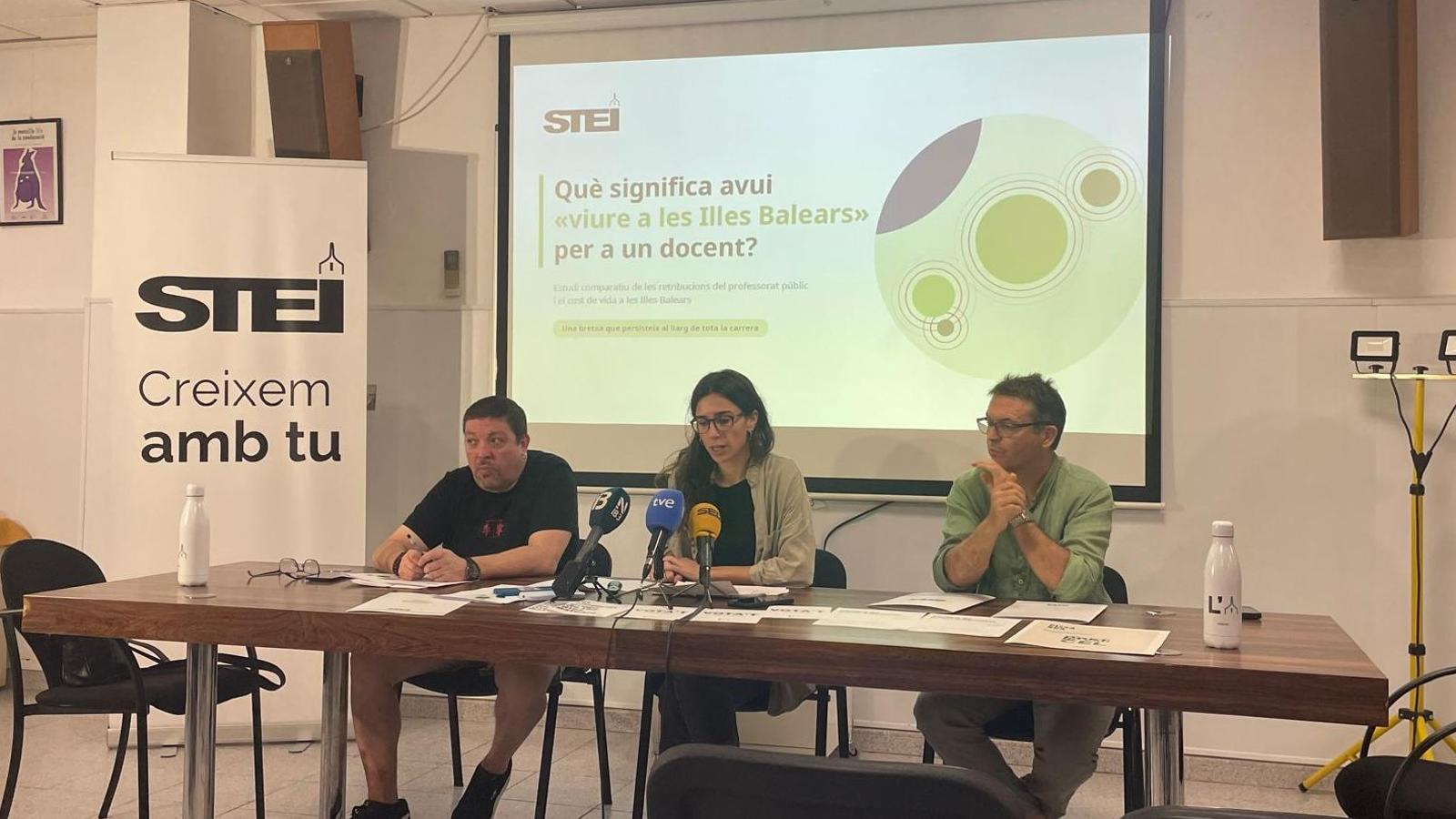
PalmaLiving and working in the Balearic Islands has become an exercise in economic resistance for teachers. The cost of living, especially that of housing, has skyrocketed the effort teachers must make to maintain a home to the point that, in some cases, annual expenses exceed the net salary they receive. This is one of the main conclusions of the study What does it mean to live in the Balearic Islands for a teacher?, prepared by the STEI, which warns that this situation not only compromises the living conditions of education workers, but also the capacity of the educational system to retain teachers and guarantee the stability of the centers.

The data are especially compelling when comparing teaching salaries with the cost of living. A teacher or professor in group A1 with no seniority must make an economic effort equivalent to 103.82% of their net salary to support a three-person household, according to the study's calculation model. This figure exceeds the national average, which stands at 79.32%, by 24.5 points. In the case of group A2 teachers, the effort reaches 114.89%, almost 26 points above the Spanish average, which is 88.91%.
The study, presented by STEI Menorca economist Rafel Carretero, calculates the economic effort based on 27 expenditure items, including housing, utilities, and food. To make the comparison, it takes as a reference a three-member household—a couple with one child—in which the teacher is the sole income earner, and applies a standard 25% personal income tax (IRPF) withholding to the gross salary. The Balearic Islands are the second autonomous community where teachers have to make the highest economic effort, behind only Madrid. The situation is especially serious in Ibiza and Formentera, where the cost of living is even higher.
Seniority does not solve it
Seniority and salary supplements partially alleviate this pressure, but not even a 30-year professional career allows for equating the economic effort of Balearic teachers to that of the rest of the State. With the maximum number of six-year periods, teaching staff in the A1 group must still allocate 75.39% of their income to the expenses calculated by the study, compared to 58.02% of the national average. In the A2 group, the proportion is 82.91%, while at a national level it is 64.94%. Thus, a teacher from the Balearic Islands who has accumulated three decades of experience must make an economic effort equivalent to that of a professional who has just begun their teaching career and lives in a community with an average cost of living. The salary difference and the additional cost of residing in the archipelago are therefore maintained throughout the entire professional trajectory.
The price of housing is one of the elements that best explains this situation. The average annual rent in the State is 12,964 euros, while in Ibiza it rises to 22,800 euros and in Formentera it reaches 25,200. The difference means that, for many teachers, accessing housing on the islands where they work is becoming increasingly difficult. The shopping basket also contributes to widening the gap. Compared to the 4,165 euros per year national average, all the islands exceed this expense and Formentera reaches 4,980 euros.
This reality has direct consequences on educational staff. The STEI warns that there are fewer and fewer young people who want to dedicate themselves to teaching and that many of the professionals who arrive in the Islands only stay the essential time to obtain a permanent position. Afterwards, a portion chooses to move to other territories where the salary allows for assuming the cost of living more easily.
This rotation makes it difficult to cover leaves and substitutions, causes educational projects to lose continuity, and increases the instability of teaching teams. The problem, therefore, goes beyond working conditions: it directly affects the centers' ability to maintain stable teams and guarantee pedagogical continuity. Furthermore, professionals who reach the end of their career and can take retirement at 60 choose to do so.
Compensations for insularity
Given this situation, the union is calling for a package of measures to compensate for the extra cost of living on the Islands and to prevent economic conditions from driving away teaching staff. Among the demands are increasing the residence indemnity, linking salary increases to the CPI, recovering the extraordinary payments cut in 2010, and renegotiating the supplements for difficult-to-fill positions.
It also requests declaring Mallorca an island of very difficult coverage, bringing forward the payment of the outstanding part of the residence indemnity to January 2027, and equating the professional teaching career with that of the rest of the civil servants in the autonomous community. In the latter case, it denounces that teachers receive about 120 euros per month, compared to amounts that can reach 1,000 euros in other groups within the Administration.
Another proposal is to create a single teaching body for group A1, as the union considers it unfair to maintain a differentiation between professionals who possess a university degree. It also demands the elimination of the five-sexennium cap. The demands go beyond remuneration. The STEI points out that the Balearic Islands have spent approximately 3% of GDP on education for decades and calls for increasing this investment to 6%, as established by the Education Law of the Balearic Islands. The union believes that the underfunding of the educational system exacerbates the difficulties in responding to the needs of the centers and guaranteeing adequate conditions for students and teaching staff.
