The battle for the last seat in the Balearic Islands: Ara Més-Broad Front challenges the useful vote discourse
The CIS attributes to it options of obtaining a deputy, but the projections disagree about who would dispute the last seat with the eco-sovereignist candidacy
-
CAT -
CAST -
DE
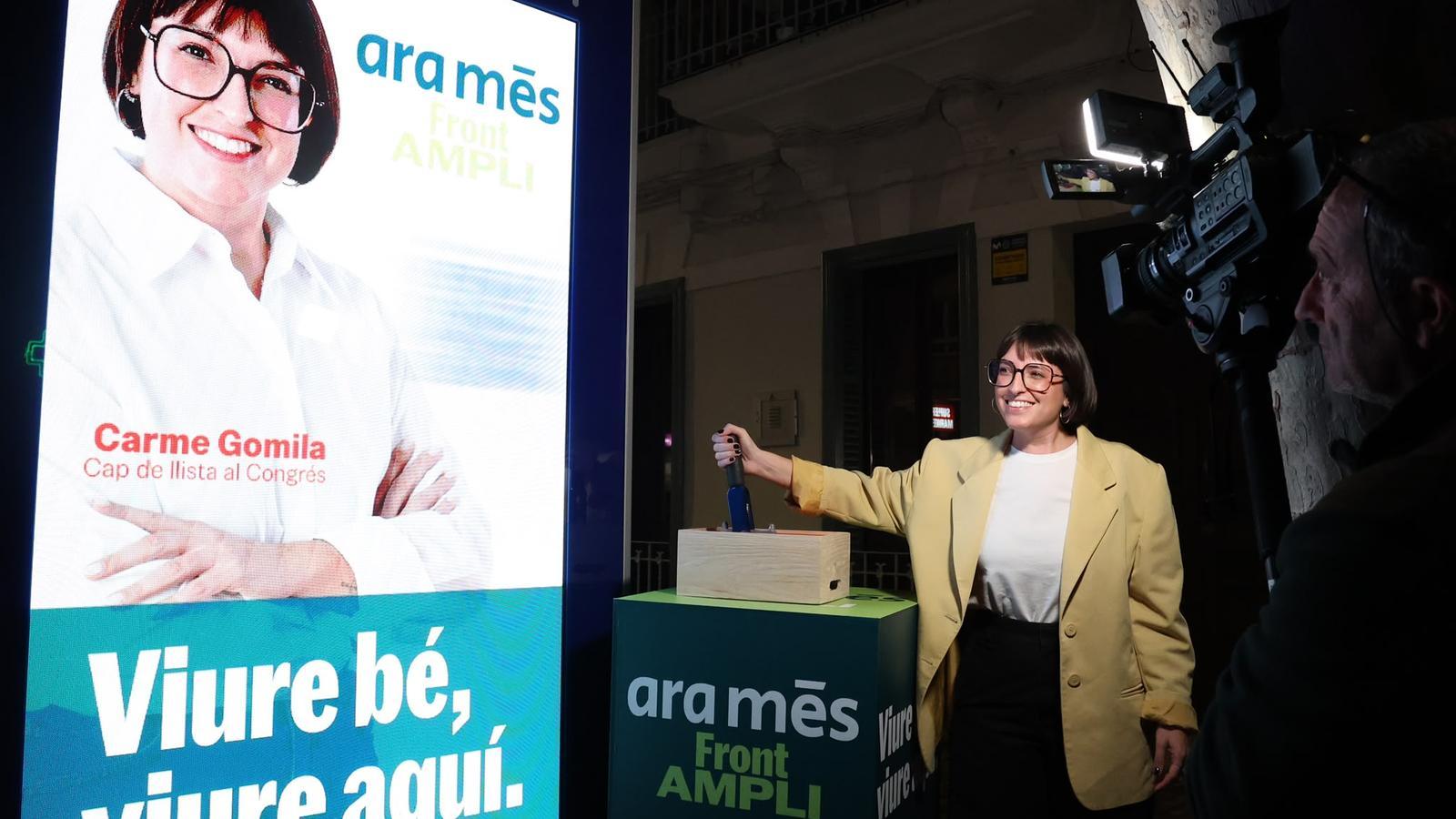
PalmaIf there is any candidacy in the Balearic Islands that needs to scrutinize every vote, it is that of Ara Més-Front Ampli. There are few days left until the elections and there is still a game to be played. For the sovereignist left-wing candidacy, the narrative is that, once the seats are distributed between the PSOE, the PP, and Vox, the final seat will be contested between Carme Gomila and a second seat for the far-right.
It is not the only possible scenario, considering the various polls and projections published, and in an election of maximum polarization, the so-called 'useful vote' is what will end up conditioning the entry of the only candidacy with its own Balearic Islands brand or will give more deputies to the national parties.
At this moment, the distribution of the seats is uncertain and the rival of Ara Més-Front Ampli changes according to the model, and the projections do not agree on who is fighting for the final seats.
How the eight seats are distributed
In the Congress elections, each province is a constituency. The Balearic Islands form a single one and distribute eight deputies: the votes obtained in the Balearics are the ones that count for awarding these seats, not the national result. Before the distribution, candidacies that do not reach 3% of the valid votes in the constituency are excluded. Afterwards, the votes of each candidacy are divided by 1, 2, 3 and so on successively, and it is the eight highest quotients that obtain the seats.
In the general elections of July 23, 2023, in the Balearic Islands, the PP and the PSIB-PSOE each obtained three deputies, while MÉS-Sumar and Vox achieved one. The third seat of the PSIB was the last one to be awarded, with a quotient of 50595 votes. MÉS-Sumar was 17704 away from taking it and achieving the second deputy. The eco-sovereigntists achieved one deputy with 83487 votes, but the second seat would have cost them 41744 votes. Vox finished in last position in number of votes, with 76547 votes in the Balearic Islands and one deputy. In their case, they were 24644 away from being able to obtain a second one.
The 2023 distribution of the Balearic Islands constituency illustrates this:
- PP: 179303
- PSIB-PSOE: 151786
- PP: 89652
- MÉS-Sumar: 83487
- Vox: 76547
- PSIB-PSOE: 75893
- PP: 59768
- PSIB-PSOE: 50595
Thus, the third seat of the PSIB was the eighth and last to be awarded. The first candidacy that remained out was the PP, with a quotient of 44826; the second quotient of Més-Sumar was 41744 and the second of Vox, 38274.
Why is it called “the last seat” and why it might be the most affordable
The “last seat” is, simply put, the eighth highest quotient. And, because it is the lowest of the quotients that have won, it is usually the seat closest to changing hands, which is why the candidate who remains immediately below it can surpass it with a relatively small increase in votes.
There is no fixed quantity of votes to obtain it, but rather it depends on the votes of the other candidacies and the divisor that corresponds to each seat. In 2023, for example, if the rest of the votes had remained the same, Més-Sumar would have needed 17704 more votes to obtain the second seat; Vox, 24644 more to achieve a second one.
Regarding participation, it does not distribute the seats directly, but what counts are the votes that each candidacy obtains in the Balearic Islands. If there are more voters but the percentage of votes for each party remains the same, the distribution might not change. On the other hand, if the new voters lean more towards some candidacies than others, the D’Hondt quotients also change and some seat may end up going to a different list.
Now Més-Front Ampli demands its own voice in the dispute for the last seat
While it is true that in 2023 Vicenç Vidal achieved the historic milestone for sovereignism of being the first deputy in the history of democracy to obtain representation in the Congress of Deputies with an island-based candidacy, the current situation does not make it so clear that Carme Gomila can follow the path opened by the man from Esporles. In elections marked by polarization, this uncertainty fuels the debate over the useful vote. The polls and projections paint an open scenario, but they do not agree on the distribution of the eight seats. The CIS places Ara Més-Front Ampli between 0 and 1 deputy, and gives Vox a range of one or two seats, which reflects this uncertainty. Its macro-survey includes 981 interviews in the Balearic Islands, with a theoretical margin of error of 3.2 points. Faced with this, the eco-sovereigntist candidate, Carme Gomila, speaks of contesting “the last seat with the far right”.
On the other hand, the average of polls from Mapa Electoral, a model that applies the average of national polls to each province and simulates the distribution 2,000 times, leaves Ara Més-Front Ampli without a seat in the central scenario, while the PP, the PSIB-PSOE, and Vox would obtain three, three, and two respectively. However, it is not a poll conducted in the Balearics.
Other models offer different scenarios. Sondagio, which applies the average of 25 polls to the 2023 Balearic result, projects one seat for Ara Més-Front Ampli and places the last one between this candidacy and the PSIB-PSOE. AltNalysis, on the other hand, gives as a central scenario three seats to the PP, three to the PSIB-PSOE, and two to Vox, but points to Ara Més-Front Ampli as a possible contender for the third socialist seat. The Objetivo176 model also attributes one deputy to them, but places the dispute for the last seat between Vox and the PSOE. These, however, are projections made with different methodologies and not direct polls of the Balearic electorate.
Ara Més-Front Ampli insists that voting for the PSIB-PSOE is not the only way to stop the far right. In fact, the system does not distribute seats on a national scale, but within each constituency, and each candidacy competes with its own quotients. In this case, the projections do not draw a single head-to-head: Sondagio and AltNalysis place Ara Més-Front Ampli as a contender for the third seat of the PSIB; another projection gives one seat to Ara Més and places the eighth seat in dispute between the PP and the PSIB for the third deputy.
As a guide, to have solid options of obtaining a deputy, Ara Més-Front Ampli would have to aim for about 50000 or 60000 votes, approximately 10–12% if the turnout is similar to that of 2023, which was 61.3% in the Balearic Islands. However, there is no fixed threshold, as with the D'Hondt law the result depends on the turnout and the votes of all other candidacies.
Why are so many calculations circulating for the last seat
In the final days of the campaign, maps, calculators, and posts about the last seat have become a graphic way to defend messages of tactical voting, which differ in each territory. The political dispute is also visible in the parties' messages: the PSOE has called for concentrating the progressive vote in 17 constituencies, while the Broad Front maintains that in seven places this call may favor the right because their candidacies compete directly for the last seat. These are campaign arguments based on projections, not guaranteed results.
Historical examples make this phenomenon easier to understand. The website www.elescanoquebaila.es explains how in Lleida, in 1977, 35 more votes would have been enough for the PSUC to surpass the quotient of the Democratic Pact for Catalonia and obtain the fourth seat; 34 would not have been enough, because they would have tied and the tie-break favored the Pact, which had obtained more total votes. In Zaragoza, in 2019, Citizens would have needed 54 more votes to obtain a second seat and take one from the PSOE.
These are cases that explain why, for the last seat, a small difference in votes can decide a deputy.
“I want a PSOE subjected to the left”
Gomila does not deny the fear that the right might govern, but rejects that the only answer is to concentrate the vote on the PSOE. "The Ara Més-Front Ampli vote serves to combat fascism, question the PSOE's immobility, and transform our islands," she argues. The candidate maintains that having a force of one's own in Congress can pressure the Socialists to implement measures that, according to her, they have not promoted with enough courage. "I want a progressive government, but I want a PSOE subjected to the brave and transformative left," she states. She also reproaches the Socialists, saying they "are only brave during the electoral campaign" and that they appropriate victories that, in her view, have been possible thanks to a strong left.
The candidate says she understands the fear of progressive voters, but asks them not to give up on having their own voice for fear of "wasting the vote." "We must look people in the eyes, acknowledge this fear, and tell them that we are here to defend them," she explains. For Gomila, the useful vote does not only consist of preventing a right-wing government, but also of ensuring that the decisions made in Madrid take into account the needs of the Islands and that the PSOE does not govern without pressure from its left.
During the campaign, she asserts that she has found signs of enthusiasm that have reinforced this message for her. One day this week, when she returned to Manacor, before arriving home she went shopping at a supermarket. There, the cashier recognized her after the IB3 debate and told her: "You did very well in last night's debate." She also explains how Ramon, a man from Maria de la Salut with whom she spoke in a bar, confessed that he had been disillusioned for years and had already decided not to go vote. After listening to her, he told her: "Damn it, you've convinced me." Both, she remarks, were Spanish speakers.
These are two individual conversations that Gomila uses as examples of moments from a campaign that, she says, has brought back the desire to go vote for some people. "There is a spark of enthusiasm," she asserts.
On the table at this moment is what seems to be the biggest uncertainty of this unexpected electoral campaign: whether the eco-sovereignist candidacy will once again win the seat. It is in this context and in the final stretch of the electoral race that Ara Més-Front Ampli has intensified the discourse on the useful vote to take the eighth seat.
