83% of the solarized roofs in the Balearic Islands belong to private individuals, while industrial estates and large parking lots remain underutilized
The Secretary of State for Energy, Joan Groizard, states that it is necessary to accelerate solarization in already urbanized places and has explained that the State plans to invest 2,886 million euros in the Balearic electricity grid

-
CAT -
CAST
PalmaThe implementation of solar panels in the Balearic Islands continues to advance at two speeds. While private individuals have assumed a large part of the photovoltaic energy installation on roofs, industrial estates and large parking lots still have thousands of square meters available to generate electricity without the need to occupy new rustic land. The Secretary of State for Energy, Joan Groizard, acknowledged this Wednesday in Palma that 83% of the solarized roofs in the Islands correspond to private individuals and that there is still a lot of work to do in the large, already urbanized spaces.
In a conversation with ARA Balears following his speech at the energy debate organized this Wednesday by the Climate Academy, he admitted that it is important to take into account the territorial model of the energy transition in the case of the Islands, where the proliferation of photovoltaic parks on rustic land has caused controversy. Groizard has focused on large, already humanized areas, such as industrial estates and commercial parking lots, where there are "thousands and thousands" of square meters capable of hosting photovoltaic installations. He also recalled that there is legislation that specifically aims to guide the deployment of the panels towards these spaces.
More panels without occupying more territory
The figures presented by Groizard highlight the leading role of individuals in the deployment of photovoltaic self-consumption. But they also show that a significant part of the solar generation potential remains untapped in spaces where the installation of panels would not involve transforming new agricultural land.
The issue is especially relevant in Mallorca, where large photovoltaic park projects have sparked neighborhood mobilizations and debates over the occupation of rustic land. The need to move towards a less polluting energy system coexists with the demand to preserve the territory, on an island subject to high urban pressure.
In this context, the roofs of industrial warehouses, large surface car parks, and other existing infrastructure appear as strategic spaces to increase renewable energy production. The challenge is to accelerate their use and prevent the growth of photovoltaic generation from depending mainly on new installations on rustic land.
An investment of 2.886 billion to transform the grid
One of the most prominent topics explained by the Secretary of State is the investment of 2.886 billion euros to renovate and expand the Balearic Islands' electricity transmission network with a 2030 horizon, which the State is preparing. This is the highest investment planned for an autonomous community in the new state planning.
A significant portion of the resources will be allocated to submarine connections, especially to complete the second link with the Peninsula and strengthen the interconnection between Mallorca and Menorca. These infrastructures are expected to improve supply security, increase electricity transport capacity, and facilitate the integration of renewable energies.
The planning also provides for the construction of eleven new substation parks, the deployment of 150 kilometers of new lines, and the expansion of the capacity of 72 kilometers of the existing network. Furthermore, it expects to increase the capacity intended for incorporating new renewable generation projects by 1.2 gigawatts.
According to calculations by the Ministry for the Ecological Transition, these actions will allow for an annual saving of 460 million euros in the Balearic electricity system. “For every euro we invest in the electricity networks of the Balearic Islands, through this planning, society will benefit from a return of almost two euros,” stated Groizard, who highlighted the positive impact that the investment may have on the competitiveness of businesses and the quality of life of residents.
The Secretary of State has described the plan as “ambitious” and argued that it has been widely reached by consensus with the territory. Its final approval is expected in the coming days.
Electrifying ports to reduce ship emissions
Another of the priorities of the new planning is the electrification of the ports of the Balearic Islands. Groizard has highlighted that significant investments will be made there so that large ships can connect to the electricity grid when they are docked and do not have to keep their engines running.
This practice generates polluting emissions that could be reduced with the availability of adequate electrical infrastructure. “Electrification is a priority,” asserted the Secretary of State, who insisted on the need to also transform large energy consumption centers.
The planning includes actions to meet the new supply needs at the ports of Palma, Alcúdia, Mahón, and Ibiza. The goal is to facilitate the port activity so it can progressively reduce its dependence on fossil fuels.
Transport continues to increase emissions
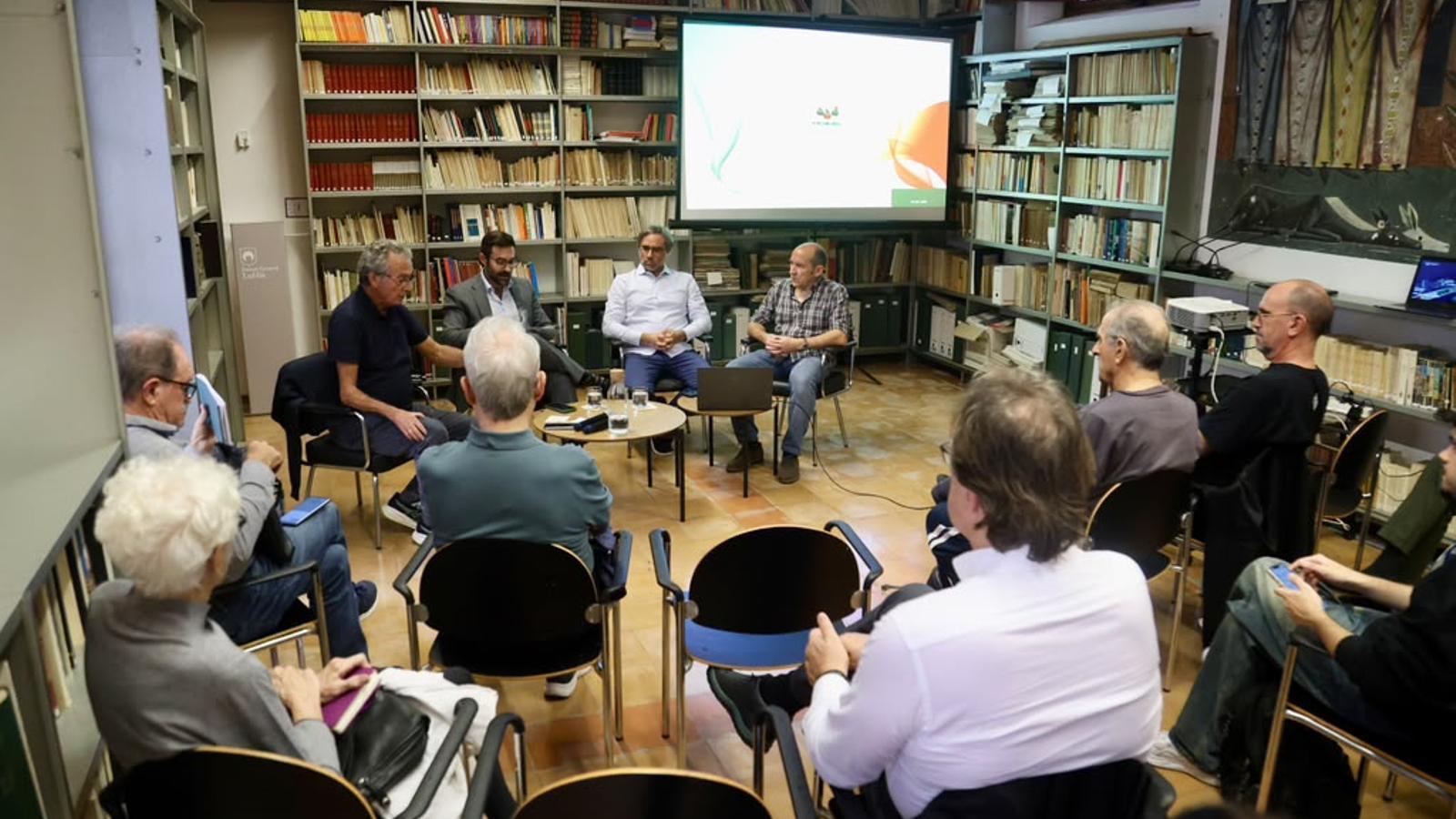
The conference held at the Estudi General Lul·lià also served to highlight that the energy transition in the Balearic Islands presents very different rhythms depending on the sector. Physicist Damià Gomis, director of the Interdisciplinary Laboratory on Climate Change at the University of the Balearic Islands, and engineer Ramon Pujol have agreed on the need to accelerate measures to transform the energy model and reduce emissions. "Right now, transport is not capable of reducing emissions, but rather it increases them," warned Gomis, who contrasted this situation with the evolution of energy production, which he considers better steered towards climate goals.
The specialists' reflections bring to the table one of the main challenges of decarbonization in the Islands: while electricity generation is advancing towards a model with a greater presence of renewables, transport continues to be strongly conditioned by the consumption of fossil fuels. Thus, the transformation of the electrical grid, the installation of solar panels, and the electrification of ports are pieces of the same process, but they do not solve by themselves the set of emissions associated with economic activity and mobility in the Balearic Islands.
More than ten million in aid pending to be announced
The electrical planning joins other measures from the Ministry for the Ecological Transition, such as the PREE program grants to improve energy efficiency and climate control in educational centers, healthcare facilities, and establishments in the tertiary sector.
According to information provided by the Spanish Government Delegation, the Ministry has already transferred 100% of the more than ten million euros allocated to the three lines of aid to the Balearic Islands. Now it is up to the regional government to call for them so that the resources can reach the beneficiaries.
The set of actions highlights the economic dimension of the energy transition that the Archipelago is facing. But, beyond the announced investments, Groizard's statements once again place the debate on an essential question: it is not just about producing more renewable energy, but also about deciding where it is produced and what impact it has on the territory.
Taking advantage of industrial roofs and large, already urbanized spaces remains one of the pending tasks of this process, especially on islands where the protection of rustic land and the reduction of emissions must advance in a compatible manner.
