The Vi de la Terra Mallorca harvest exceeds 6.5 million kilos of grapes
The manto negro, with almost 950,000 kilos, heads the production, followed by the merlot and the premsal blanc
-
CAT -
DE
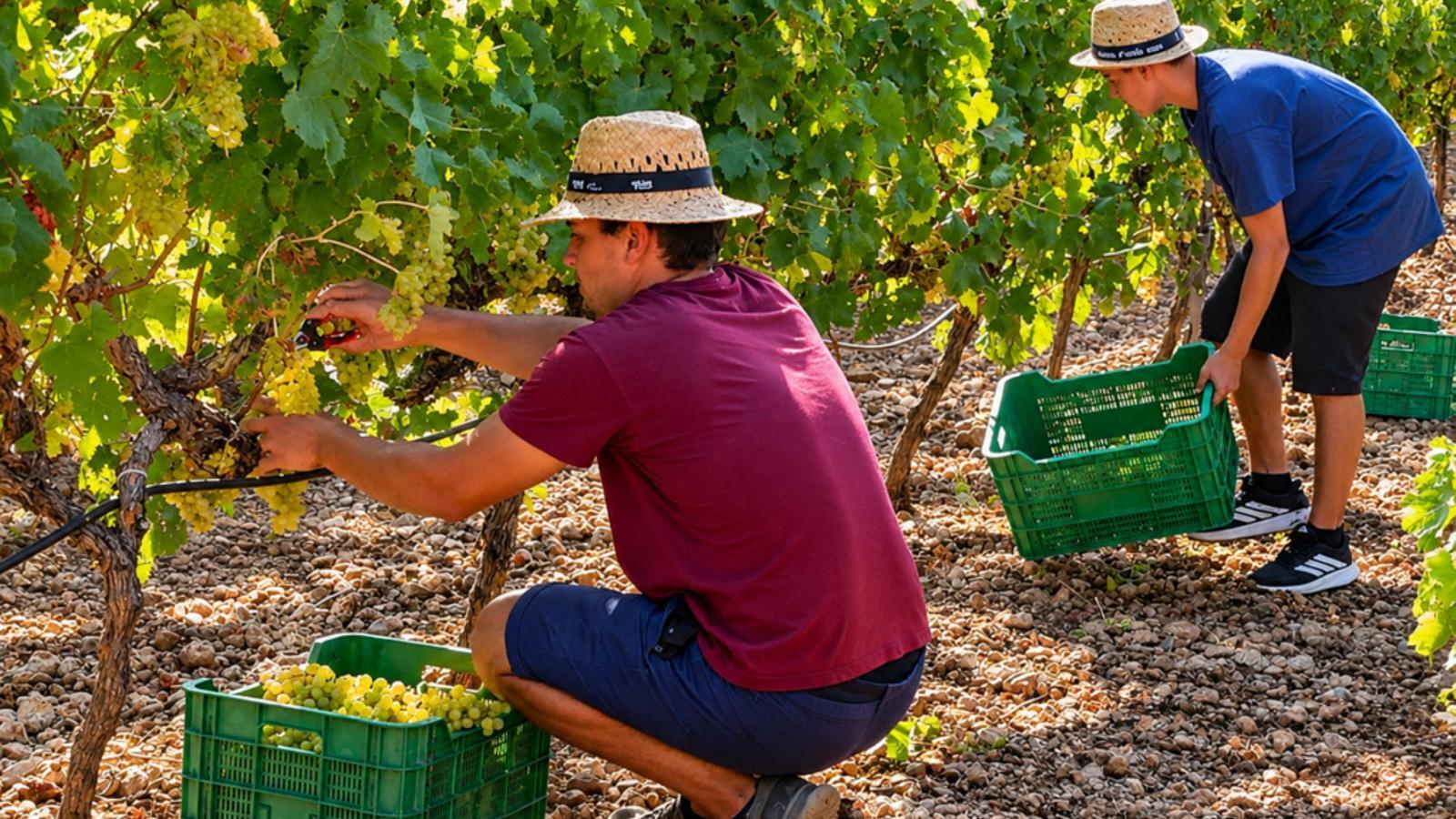
PalmaThe 2026 harvest of the Protected Geographical Indication (PGI) Vi de la Terra Mallorca has closed with a total of 6,541,123 kilograms of registered grapes, a figure that represents an increase of 23.14% compared to the previous campaign, when 5,312,046 were recorded.
The data from the Regulatory Council, which it made public in a statement, “confirm a significant increase in the volume of grapes covered by the geographical indication, in a campaign marked both by the evolution of production and by the expansion of the base of registered wineries and vineyards”.
Thus, of this year's total production, 4,020,332 kilograms correspond to red varieties, which represent 61.46% of the incoming grapes, while white varieties total 2,520,791 kilograms, the remaining 38.54%. Compared to 2025, red varieties have experienced a growth of 30.59%, while white varieties have increased by 12.87%.
Regarding the varieties with the highest production volume, the manto negro leads the classification, with 949,868 kilograms, followed by merlot, with 887,547; premsal blanc, with 756,414; syrah, with 687,015, and callet, with 614,908 kilograms. Also notable are cabernet sauvignon, with 555,328 kilograms, chardonnay, with 483,463, and giró ros, with 480,988 kilograms.
More premsal blanc, callet and merlot
The evolution of the varieties that were already part of the PGI during the previous campaign allows us to observe which grapes have contributed most to the increase in the harvest. 243,502 more kilos of Premsal Blanc have been collected, which represents an increase of 47.5% compared to the year 2025. Meanwhile, the Callet has increased by 236,419 kilos (+62.5%). In absolute terms, the Merlot is the variety that has grown the most, with 279,831 additional kilos compared to the previous harvest, an increase of 46%.
Manto Negro has also registered notable increases, with 188,394 more kilos (+24.7%); Giró Ros, with 148,873 more kilos (+44.8%), and Syrah, with an increase of 117,471 kilos (+20.6%). On the other hand, the Chardonnay has experienced the most significant drop in absolute terms, with 99,432 fewer kilos than the previous year, a decrease of 17.1%. Inputs of Muscat, Pinot Noir, Viognier, Riesling, and Parellada, among others, have also decreased.
This year's campaign has also incorporated three varieties that have entered the PGI production data for the first time after their inclusion in the registry during 2026: Escursac, with 37,831 kilos; Esperó de Gall, with 5,649, and Giró Negre, with 5,351 kilos. Overall, these new varieties have contributed 48,831 kilos of grapes.
More vineyards and five new wineries
The Regulatory Council points out that the overall increase of 23.14% must be interpreted taking into account the changes that have occurred in the productive base of the geographical indication. One of the main factors is the increase in the registered vineyard area, which has gone from 1,908.32 hectares in 2025 to 2,130.35 hectares in 2026. This represents 222 more hectares and an approximate growth of 11.64%.
In addition to this expansion, five wineries have been incorporated that until now were producing under another quality brand and which this year have declared their entire production under the PGI Vi de la Terra Mallorca. According to data from the Regulatory Council, this incorporation explains a significant part of the increase in grape intake registered during the campaign.
For this reason, the increase in the total figures cannot be attributed exclusively to higher production from vineyards that were already registered the previous year. If the effect of the new incorporations to the geographical indication is discounted, the initial forecasts pointed to a production growth of between 5% and 10% compared to 2025.
Conditioning factors
Among the factors that have conditioned the campaign, Vi de la Terra Mallorca especially highlights the productive recovery of the Premsal Blanc. This variety had experienced a very significant decrease during the 2025 harvest and this year it has registered a considerable increase in inputs, although it has not yet fully recovered the usual volumes.
The behavior of the Premsal Blanc shows a certain alternation between campaigns, with years of high yields and others of more moderate production. This phenomenon may be related to physiological regulation mechanisms of the plant and to the environmental conditions that affect the development of the vine throughout the vegetative cycle.

This evolution has also taken place in a demanding climatic context. The last two campaigns have been marked by high temperatures and recurring heatwave episodes. 2026, in particular, was notable for high temperatures both during the day and at night. Elevated nighttime temperatures can limit the plant's physiological recovery and increase accumulated thermal stress, with possible consequences for vegetative development, grape ripening, and the productive capacity of the vineyards.
Regarding precipitation, the year began with a winter with rainfall that allowed for the maintenance of a certain water reserve in the soil and favored water availability during the early phases of the vegetative cycle. This situation, however, was not homogeneous throughout Mallorca, as differences were recorded between areas depending on the distribution of rainfall and soil characteristics.
The Regulatory Council considers that “the interaction between the partial recovery of certain varieties, especially the Premsal Blanc, and increasingly demanding climatic conditions will continue to be a determining factor for the sector”. In this sense, it highlights “the importance of maintaining the monitoring of the vines' physiological evolution and progressively adapting viticultural practices to the new climatic conditions”.
