CECEIB and PIMEM block the regional agreement for nurseries from 0 to 3 years: "It was a slip"
They reject for the third time to constitute the negotiating table and block the start of the negotiation, despite admitting the need to improve the working conditions of the workers
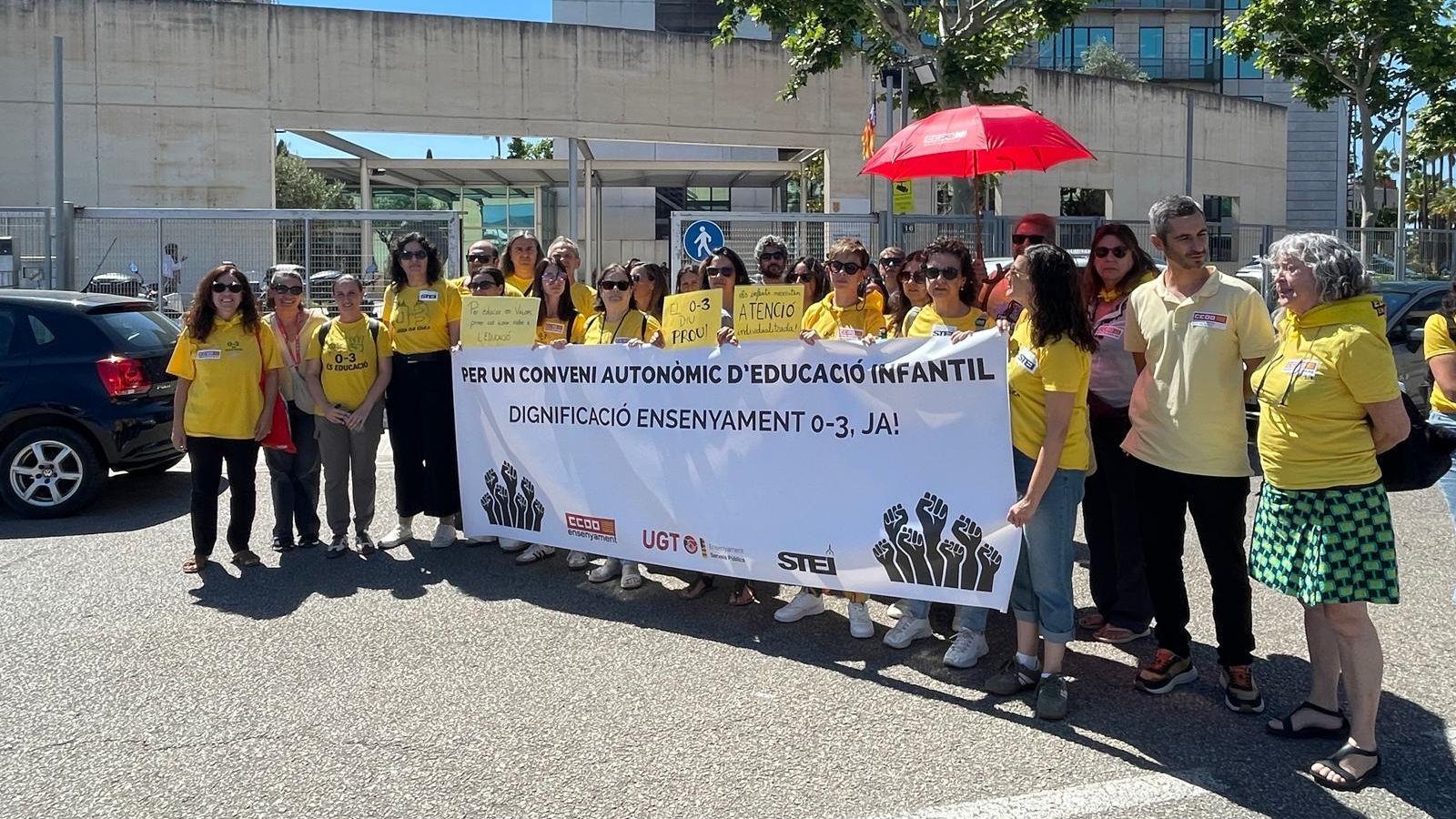

PalmaThe first regional agreement for the education sector for 0 to 3 year olds in the Balearic Islands continues to be further away than ever. The employers' associations CECEIB and PIMEM refused this Monday, for the third time, to sign the document necessary to formally constitute the negotiating committee, an essential step to begin talks for an agreement that has been demanded for years by unions and early childhood education workers. The deadlock keeps alive the strike called for next June 16, which worker representatives anticipate will have significant participation. The employers' refusal clashes with the proposals agreed upon in July 2025 during the resolution of the conflict of the outsourced early childhood education centers in Palma, when a salary improvement was agreed upon and the door was opened to the negotiation of a regional agreement.

Now, however, the second vice-president of CECE, Juan José Ferrando, has downplayed that agreement and assured that the reference to the agreement "was a slip". The parties will meet again in the coming days to try to bring their positions closer. Although employers' associations and unions agree on the need to improve the sector's working conditions, the possibility of promoting the regional agreement demanded by STEI, UGT, and CCOO remains, for now, paralyzed.
According to the unions' denunciation, this is the third time that employers' associations have rejected this procedure, which prevents the effective start of negotiations and keeps a historical demand of the sector blocked. The union organizations consider this new obstacle particularly serious because it comes after, just two weeks ago, all parties involved had announced an agreement to unblock the conflict. Before the frustrated meeting, held at the Ministry of Labour, the minister Catalina Cabrera had called for responsibility from the parties: "We call for maturity and responsibility. The interests of the workers are at stake".
Two weeks ago, at the end of May, union, business, and government representatives staged the recovery of dialogue after months of paralysis. That meeting, driven by the departments of Education and Labor, served to set a calendar and establish the commitment to constitute the negotiating table on June 8: it has not been constituted.
Union criticism
The spokesperson for CCOO, Pepa Ramis, was blunt about the employers' position: “There is no will to build a first agreement. The two employers' associations do not want to start negotiating the regional agreement for the 0-3 sector. They consider that a national agreement already exists, albeit precarious, which suits their workers”.
Ramis also expressed disappointment at the repeated deadlock: “This position disappoints us. It is the third call and, to this day, there has been no initial approach nor a real opening towards future negotiation.” In this regard, she argued that “we demand an agreement that truly protects the workers” and added that “we are calling for our own framework for the 0-3 sector.” The union representative also insisted on the sector's structural problem: “Currently there are up to seven different salary scales, and only one is needed, which is one of the main reasons for the strike.” She also recalled that the conflict “affects two departments.”
On behalf of STEI, Maria Camps lamented the lack of institutional support: “It would have been positive if the Administration had accompanied us and built bridges.” In this regard, she pointed out that “it has done so in the area of subsidized nursery schools, but it should not exclude the workers of public nursery schools.” Camps expressed hope for possible mediation: “We hope that in the TAMIB meeting there will be a redirection of the conflict and that the involved departments will act as mediators.” She also remarked that “the cooperative employers' association of Menorca has attended all meetings.” On behalf of UGT, Azahar Tortonda said she hopes the TAMIB meeting will allow for establishing links, but that "prospects are not positive".
Employers: improvements yes, agreement no
On behalf of PIMEM, its representative José Lluís Picó defended their position: “We already explained why we did not attend the last two meetings”. As he detailed, “last Friday we sat down to agree on improvements in the area of subsidized nursery schools with USO”, and added that “employers' associations, unions, and the Ministry participate in this forum”.
Picó questioned the composition of the negotiating body promoted by the unions and argued that it does not represent the entire sector. “The proposed body is missing employers' associations, unions, and also the Ministry”, he stated. Furthermore, he warned that this forum would exclude indirectly managed nursery schools, which are governed by an agreement signed in 2015 and which continues to apply to new tenders, recalling that the Ministry has shown itself willing to integrate them into this framework. The PIMEM representative also claimed the progress made following the 2025 agreement, which, as he explained, is already allowing for the improvement of working conditions for employees incorporated into new tenders. The pact foresees monthly salary supplements of between 200 and 400 euros depending on the professional category, an additional 60 euros for tutors, and 100 euros for educators with university degrees, in addition to annual increases in supplements of 6% in 2026 and 2% in 2027. The implementation of the improvements must be completed in all centers in the Balearic Islands before August 1, 2028.
On behalf of CECEIB, its second vice-president, Juan José Ferando, agreed on the need to improve the sector, but rejected the current approach: “We all agree that conditions need to be improved”. However, he qualified that “we do not agree on the creation of an autonomous collective agreement because it would affect a small sector. Conditions must be improved, but we need to see how to do it”. Fernando argued that “the conditions of subsidized schools must be improved through agreements in which the Administration has been involved”. He himself said that it is not only the workers who are suffering, but also "there are small businesses that are having a very hard time”.
A deep-rooted conflict
The deadlock comes in a context of accumulated tensions and after months of intermittent negotiations. Unions insist that the creation of an autonomous agreement is key to ending the wage and labor inequalities in the 0-3 sector, while employers consider that the state framework is already sufficient. With the strike on June 16 on the table and a new preliminary meeting scheduled at TAMIB, the conflict remains pending whether the parties are capable of redirecting a negotiation that, for now, remains stalled.
