
In 1990, in the midst of the canyellisme era, the Manacor group Ocults released the song ‘Jo tenia una caseta a Mallorca’ (I had a little house in Mallorca), included in the album Pa amb oli nacional (National bread with oil). “Enough is enough, enough is enough, enough is enough,” the chorus declared, alluding to the rampant construction of hotels. ‘Ecological’ music was reactivated in 2003, after the electoral defeat of the First Pact of Progress. The popular Jaume Matas took office at the Consolat de Mar with the support of Maria Antònia Munar’s Unió Mallorquina. He quickly forgot his previous role as Minister of the Environment under José María Aznar. He was delighted to open the doors of the Balearic Islands to the businessmen he had met in the stands of the Santiago Bernabéu stadium. Among them was the president of Real Madrid, Florentino Pérez, owner of the construction company ACS, the contractor for many highways and the Son Espases hospital. In the same year, 2003, the Plataforma Autovia NO (Highway NO Platform), formed to reject the planned stretch between Inca and Manacor, released the album Ja n’hi ha prou. Autovia No! (Enough is enough. Highway No!). The project brought together songs from peninsular and, above all, Mallorcan groups. One of them, ‘Mallorca podrida’ (Rotten Mallorca), included one of the most memorable verses from a term marked by megalomania and corruption: “Cañellas, Fageda, Matas and Munar... We know where you live! We know where to go [...] Someday you will have to pay!”That experience would inspire the irreverent band Rock & Press, led by journalists Carlos Garrido, Miquel Massutí, Gabi Rodas, and Joan Frau, and musicians Carlos Grauches and Mané Capilla. In 2005, after livening up an evening for the Sindicat de Periodistes de les Illes Balears (SPIB) (Union of Journalists of the Balearic Islands), they debuted with Cemento (Cement). “It was,” says music researcher Tomeu Canyelles, “a satire made up of twelve unfiltered songs that aimed to denounce both the mismanagement of the right and the fierce urban speculation that was devouring Mallorcan land.” Rock & Press continued their critiques in subsequent works: Korrupción (Corruption) (2007) and Krisis (Crisis) (2010). The group even received a threat of legal action from Maria Umbert, Matas's former cabinet chief and the first director of IB3.Another group that strongly supported the environmental struggle was Oprimits (Oppressed), who had already distinguished themselves in the cause since 1996. In 2006, they achieved great success with the song ‘Salvem Mallorca’ (Save Mallorca), included in the album Tolerància zero (Zero Tolerance). The title was in line with the demonstration that on February 14, 2004, marched through the streets of Palma with the slogan ‘Whoever loves Mallorca does not destroy it.’ The initiative, which gathered about 50,000 people, had the support of various musicians such as Tomeu Penya, Maria del Mar Bonet, the band Antònia Font, and Biel Majoral. This far surpassed the 4,000 attendees of Mallorca's first environmental demonstration, ‘Salvem la Dragonera’ (Save Dragonera), on February 3, 1979.
Tomeu Penya: "I am very sad. I would never have imagined that the future of Mallorca would be like it is now"
The singer is considering recovering this summer 'Trenc', the song with which forty years ago he denounced the destruction of the Campos sandbank
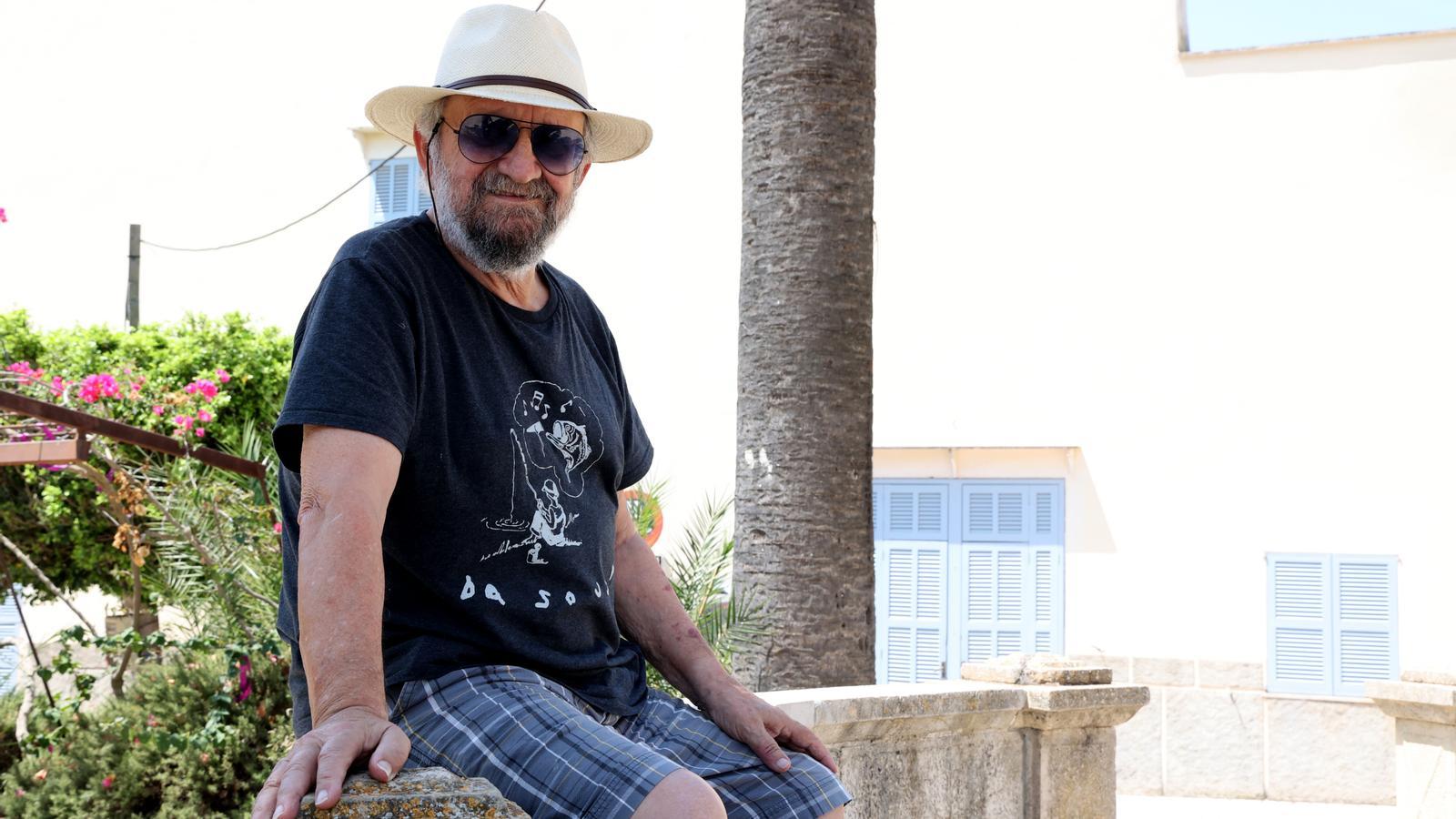

PalmaTomeu Penya, 77, speaks candidly to ARA Balears: “I want my current state of mind to be very clear. I am very sad. As a young man, I would never have imagined that Mallorca's future would be like it is now, an island full of cement and tourists, with saturated roads and residents who cannot afford housing. For this summer's concerts, I'm considering singing ‘Trenc’ again, which I dedicated four decades ago to the emblematic beach of Campos that now, unfortunately, is once again under threat”. ‘Trenc’ was the debut of the country singer from Vilafranca as an environmental activist at 35 years old. It is one of the most outstanding songs from his third album Coverbos (1984).
Having played for hotels with different groups, Penya had made a name for himself as a solo artist in 1979 with Tomeu Penya canta a la Vila. At that time, Mallorca was experiencing the blossoming of the 'green warriors'. Since 1973, the GOB had not stopped raising the alarm about the rampant construction fever unleashed by the tourist boom of the late 50s. In July 1977, the first 'toponymic struggle' had already occurred with the peaceful occupation of the islet of Sa Dragonera (Andratx), threatened by a luxury development. In May 1978, it was time to mobilize for El Trenc, a sandy stretch four kilometers long. About 500 people gathered on its dunes to denounce the project to build a restaurant, complete with parking and camping.
"We don't want shoddy roads"
The evolution of that citizen movement can be traced in the study 30 years of ‘Salvem es Trenc’, which in 2008 was published by the Campaner researcher Montserrat Alcaraz, along with Francesc Xavier Mas. “During the postwar period – says Alcaraz –, thanks to agriculture, Campos had been one of the richest towns in Mallorca and the local authorities wanted it to continue to be so with tourism. If it hadn't been for some activists who were then considered the bad guys in the movie, today Trenc would be like El Arenal on Palma beach”. In May 1983, Gabriel Cañellas, from Alianza Popular, the embryo of the PP, presided over the first Balearic Government of the autonomous era. On September 30, the great demonstration in defense of Trenc already took place, which gathered nearly 10,000 people in Palma. Spirits were very high with the latest proposal from a Swedish developer that planned to build a colossal urbanization for 6,000 people on the Campaner sandbank.

Tomeu Penya could not attend that historic demonstration because he was on tour in Catalonia. He had already positioned himself, however, in favor of the cause. "Through some friends - he assures - I learned about the atrocities that they wanted to project on Campos beach. It was clear to me that I also had to get involved in those protests, since my songs have always spoken of the land. To be able to inspire myself, I visited Es Trenc twice, which I had never set foot on before." The first words that the muses whistled to him were: "We don't want fake paths, / nor typewriters. / We don't want cement or silk, / nor glass houses." And the last ones would be: "We want the wind to play among the pines. / We want birds to build their nests there." The lyrics at no time mention the name of Es Trenc, which only appears in the title.
Political anthem?
Before Penya, a friend of his, the Palma native Toni Morlà (1945-2014), had already sublimated the Majorcan landscape in the albums With his feet on the ground (1977), First poems by Miquel Costa i Llobera (1981) and So (1983). In Ibiza, in 1976 Isidor Marí sang ‘Flors de baladre’ for UC's second album On this poor island. The resistance of the simple and characteristic island shrub symbolized the love for the land. That year, in Menorca, the group Traginada also debuted with a handful of 'environmentalist' songs, which kept alive the fight for the protection of the Albufera del Grau (Maó).
The one from Vilafranca recalls the difficulties there were in the 70s and 80s to make songs in Catalan and to defend the territory. “When I started my career in Catalan, I met people who laughed at me. In some performances, they even threw me cubalibres and orange and lemon peels. Later, with ‘Trenc’, I had another surprise. I started singing it in the summer of 1983 before it came out on the album Verbs, from 1984. At the festivities of the Mare de Déu d’Agost in Campos, when I announced it, a crowd of young people came up on stage to sing it with me. I was worried the stage would collapse. The next day I was in the newspapers. I learned that the mayor [Guillem Mas Vinyola, from Unió Campanera], present at the concert, had gotten very angry”.
Faced with that 'slight', the bell tower town hall refused to pay for Penya's performance. “My manager didn't get paid until much later. That animosity would repeat itself in other places in Migjorn. I remember one evening I was having dinner in a restaurant, a gentleman approached me and told me, in kind words, that he didn't want his town to also benefit from tourism with hotels on the beaches like Llucmajorers and Santanyiners had already done. I told him that I was not against tourism, that the only thing I wanted was for our landscape not to be touched”. Little by little 'Trenc' became the soundtrack of the green movement. “As I sang it at the summer festivals, I saw that the audience already knew the lyrics. And this was even though the album hadn't been released yet. Coverbs. He was quite happy about it. However, at no point did I intend for the song to become a political anthem. My music does not belong to any political party.
In 1984, with the echo of the iconic song, the Balearic Parliament declared s'Arenal an Area of Special Natural Interest (ANEI) with the votes of UM, PSOE, and PSM. This did not prevent the Campos City Council from granting a license in 1992 to build 68 apartments, a bar-restaurant, and a swimming pool on a supposed urban plot in Ses Covetes, near the protected area. However, in November 2012, the Superior Court of Justice of the Balearic Islands accepted the appeals filed by GOB and PSM and ordered the demolition of that illegality. In 2017, the Government already declared El Trenc-Salobrar de Campos Natural Park, with a total area of approximately 3,768 hectares.

‘Mallorca sinks’
In 1987, three years after singing ‘Trenc’, Penya would again exhibit his ecological streak. It was with the track ‘Cabrera’, included in the album Take. Then the GOB was fighting to put an end to the maneuvers of the Spanish army in the Palmesan archipelago, located about 15 kilometers from the bell tower's sandy beach. The man from Vilafranca described it “like a naked virgin in the sea” and insisted “don't hurt her”. “It was a place – he assures – that he loved very much because he had done his military service there”. The following year, the Balearic Chamber already initiated the process of declaring Cabrera a Maritime-Terrestrial National Park, which became a reality in 1991.
While Penya limited itself to crying over the loss of paradise, the Palma-born Raphel Pherrer dared to openly criticize the islands' tourism model. He would do so with the albums Denormalization (1986), Sir Tomasseta Superstar (1989) and Mallorcatur (1989), the latter in collaboration with Carlos Garrido and Toni Miranda. His songs fought, in a satirical tone, against political corruption, linguistic diglossia, the folklorization of traditions, and the waste of natural resources. In 1992, the Vilafranca native would also raise the tone of his lyrics. It was with ‘L’Estalella', appearing on the album Mermaid. It refers to a property located in the coastal area of l’Estanyol de Migjorn, in the municipality of Llucmajor, where GESA had planned to install a thermal power plant. “What a shame it would be – he sang – for the town of Llucmajor, / s’Estanyol full of coal, to burn it and make energy. / No power plants, no chimneys, enough of making dirt, / because the people of Llucmajor have very clear ideas [...]”.
The researcher Tomeu Canyelles has analyzed the impact of ‘L’Estalella’ in the book L’esperit elèctric (Illa Edicions, 2026). “It was – he says – an unexpected blow to the consciousness of the island society. Even other artists who until then had never taken a stance made their ecological aspirations public. This is the case of Llorenç Santamaria, who that same year declared that ‘Mallorca must be green and beautiful’”. The man from Vilafranca would continue to incorporate explicit ecological messages in other songs. In ‘Mirau-me, mirau-nos bé’, from the album Anuats (1995), he denounced that “if we don't pay more attention / we will end up walking / surrounded by cement / we won't even see the sea”. In 2018, on an island already swallowed by turbo-capitalism, Penya directly criticized mass tourism in ‘Mallorca s’enfonsa’, included in the album R.D.I. Comunitat des Pla”. “If we don't impose order – he warned – we will all have a breakdown”. In 2026, order has not arrived and the island's reality is even more desolate. “I am very saddened by what we have”, emphasizes one of the first voices that sang about environmentalism 43 years ago.
