The summer school that also educates: "They don't just play with water"
The Espiral spaces this year serve 384 children and almost triple the scholarships thanks to the Corresponsables program, while maintaining a pedagogical commitment that goes beyond leisure.

-
CAT -
CAST -
GER
PalmaWhen Mari Carmen starts her shift at the supermarket first thing in the morning, she knows her five-year-old son Enzo, who has autism, is in good hands. At 7:00 AM, he is already at the early care program of thesummer school from Algar, where a counselor accompanies her specifically throughout the day. "If there were no summer schools, I would have no alternatives. I would have to work only in the afternoon or evening, because I cannot stop working," she explains. "The children are much better here than with their grandparents. They do activities, they continue learning, and they are among other children. The children are ours, not the grandparents'," she explains.
His experience sums up the reality of many families who this summer have opted for Espiral's Open in Summer programs. The social entity has registered 384 children enrolled this year, 8% more than the 355 last year. The growth has also been reflected in scholarships: if 90 were granted in 2025, this year the provisional figure already reaches 249, almost triple thanks, above all, to the incorporation of the Corresponsables program, which provides aid for reconciliation and allows many families to only have to bear the cost of meals. This has made it possible for children who under other circumstances would have had difficulty participating in a summer school to be able to join.

For Xavier Torrent, director of Espiral, this double reality is precisely the entity's main challenge. "We want to offer a space with educational content, but also a place where children have a good time and where families can reconcile work and family life. We have to align two complex needs," he explains.
Increasingly diverse children
After more than two decades working in neighborhoods like El Jonquet, El Coll d'en Rabassa, El Molinar, Els Tamarells, or L'Algar, Espiral has seen the profile of families diversify. While it continues to serve children referred by social services and beneficiaries of programs like CaixaProinfància, more and more families are choosing these summer schools because they value the educational project. "We have children who come with a scholarship or because the family cannot afford the cost of the summer school, but also many families who simply need a childcare solution and like our project," summarizes Torrent.
This change has also been evident at L'Algar. Elena Soler, the program director, recalls that when she started, almost all participants came from vulnerable families. "In the first few years, we were about 30 children and practically all of them came with scholarships from social services. This year, however, we have almost 80 children and most of them come voluntarily, paying the fee, because other families have recommended the summer school to them," she explains.
According to Soler, this change shows that the project has been gaining prestige among families in the area. Word of mouth has led many to enroll their children not only because they need to balance work and family life, but because they are looking for a quality educational space during the holidays. Despite this, the social reality remains very present. Among the families using the service are seasonal workers, especially those linked to the hotel sector, households with modest incomes, and children who need specific educational or emotional support during the summer months.
The increase in users has not altered the project's philosophy. Unlike other summer schools, Espiral maintains that each activity has an educational intention. "We don't just want children to be entertained. Through play, we work on autonomy, social skills, and many other learnings," states Torrent.
One of the tools we use is emotional management. Every morning the children share how they feel before starting the activities. "We do a lot of emotional work. We start the day by seeing how each child is and we adapt the activities to their needs," points out Soler. "In other summer schools, the planned program is often maintained regardless of how the children are feeling".
Pedagogical will
The organization also seeks to give continuity to the work developed during the school year, maintaining contact with educational centers and families, especially in the case of the most vulnerable children. The objective is that summer is not a parenthesis, but an opportunity to continue strengthening social skills, autonomy, and bonds with the environment. The teams combine educators who work all year round at the organization, permanent seasonal workers, and students of Teaching, Social Education, Psychology, Medicine, and Pharmacy, all with specific training before joining. "We don't just want monitors; we want people who share a way of understanding education," summarizes Torrent.
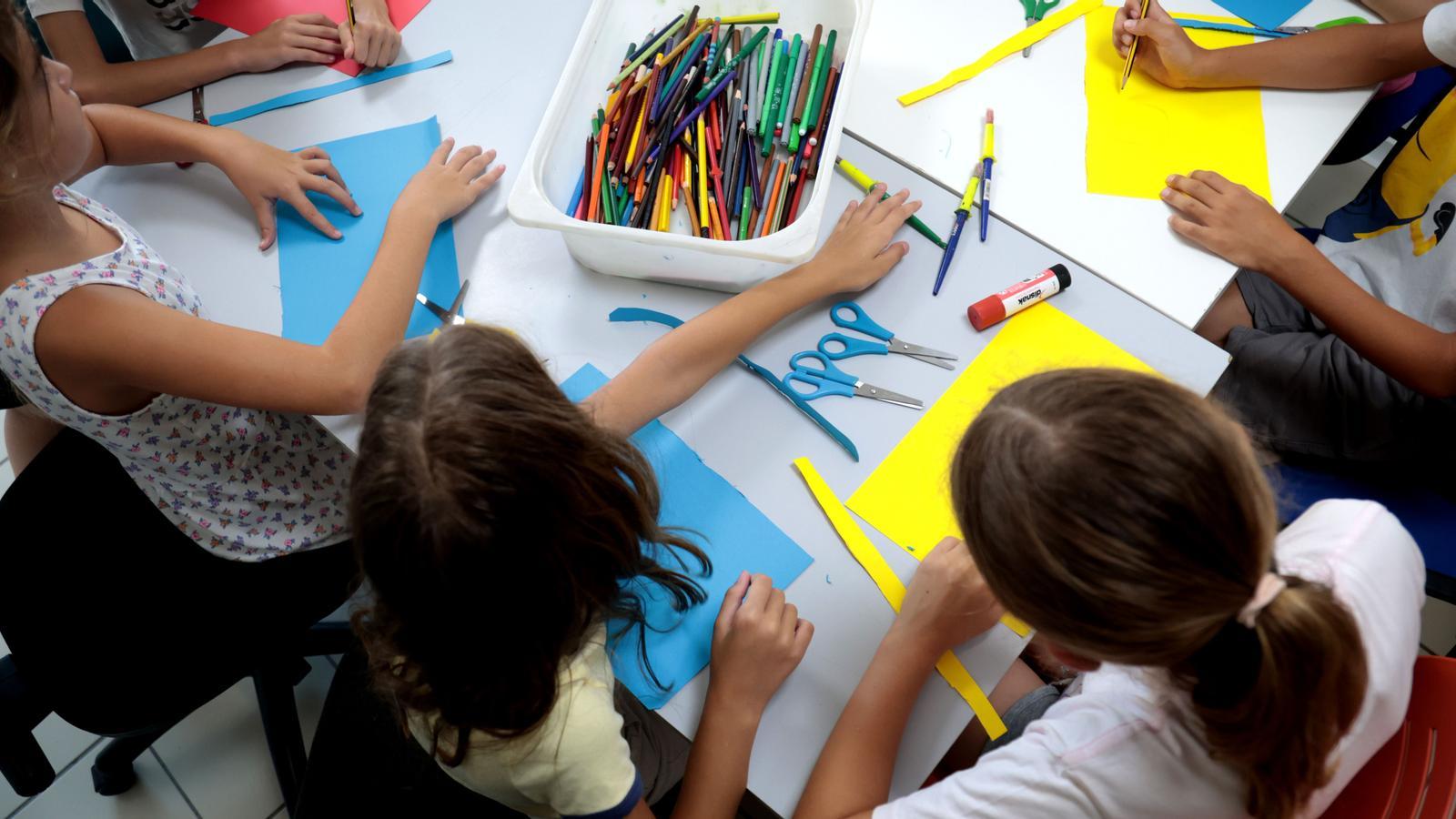
Therefore, Mari Carmen assures that the difference compared to other summer schools is evident. "Here I see more professionalism. There are trained monitors, with experience and many more ideas. They don't just play with water; they do crafts, group dynamics, olympiads, and many activities. Besides, my son has a monitor who is attentive to him, because he is autistic".
The director of Algar herself highlights that many families repeat year after year. If last summer there were about fifty children, this year thirty have returned. The group of the youngest, between three and six years old, has also grown, but there are increasingly more participants between eight and twelve years old who decide to remain linked to the project, a fact that, according to the entity, shows that children find an attractive space there, even when they get older. This bond is also worked on with families. During the week they receive photographs and a summary of the activities, so they know what their children are doing. "Before, many parents didn't know what they had done during the day. Now they are part of the project," explains Soler.
