Prohens' last (failed) attempt to distance himself from Vox
The PP takes advantage of the last moments of the parliamentary course to close the pending loose ends of the agreement with its partner and seek support from the left
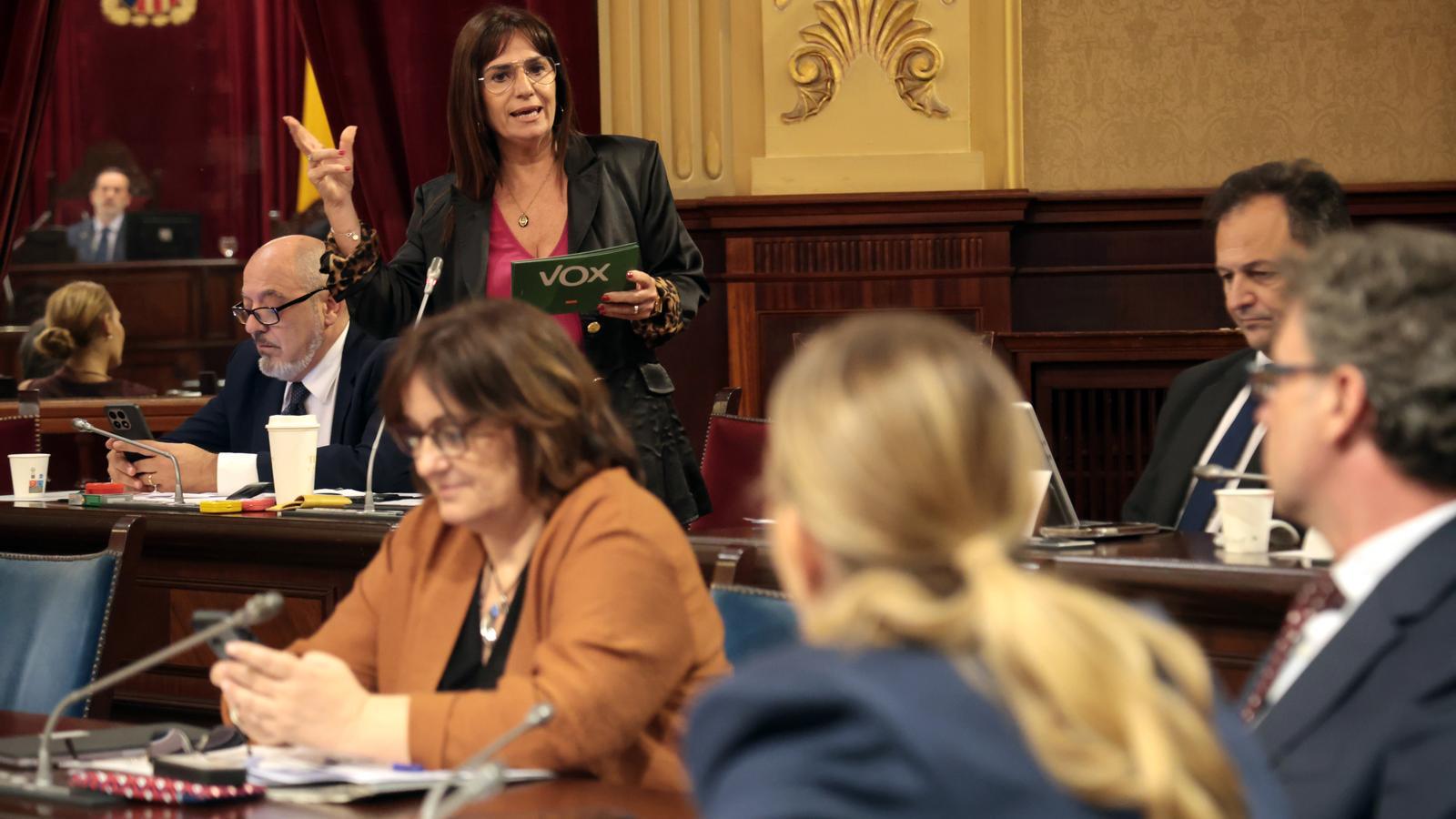

PalmaThe parliamentary session period closes after some tactical moves. The PP has maneuvered to stage a distancing from Vox. With the approval of the Omnibus Law, the popular party considers the debts of the budget pact settled and believes they no longer have to pay further tolls on sensitive issues, such as language. This was made clear with a decision that is a message in itself: approving the limitation of vehicles in Mallorca with the left-wing party in the Council without waiting for Vox, to send the text to Parliament the very next day. The decision caught the far-right off guard, and they ended up abstaining, seeing that otherwise, they would be alone in voting against it. The Government has warned that it will do the same with the agricultural law, the coastal law, and the budgets. But Vox is not losing its composure and interprets the PP's gestures in an electoral context. "They want to appear as moderate centrists now that the legislature is ending, but it's a lie," criticizes a Vox source.
In the first half of the year, the PP has been finalizing the loose ends of the agreements with Vox that remained to be formalized. It repealed the Democratic Memory Law and introduced the rest of the concessions to the far-right in exchange for the budgets through numerous amendments to the strategic projects law. The text of the law was amended so much that the name of the regulation had to be changed, which has finally come into effect as the Omnibus Law. "We have complied with the budget agreement," claimed the first vice-president, Antoni Costa, during the plenary session. Government sources insist that they feel free from the far-right's demands. "Vox's votes will not be rejected, but no new agreements with significant concessions from the PP in exchange for approving future laws will be seen," they defend.
“The PP cannot agree on the budgets, the coastal law, or the agrarian law with the left,” warns a Vox source. “It is in their interest to make it seem like they have not depended on Vox, when it is false; they have needed us throughout the legislature, except for a couple of trivial matters,” he continues. He refers to the Law regulating megastructures that the PP negotiated with MÉS, but ended up approving with Vox, and to the initiative to defend airport co-management in Congress, which was also promoted with the eco-sovereignists. The PP, moreover, has tried to make visible an approach to the left through the validation of the anti-crisis Decree-Law with the support of the PSIB, the abstention of the rest of the left, and the contrary vote of Vox. These occasional pacts have displeased the far-right, which on several occasions throughout the legislature has blocked initiatives – such as the law on strategic projects – to remind the PP that it is still decisive.
The limitation of vehicles, a turning point
The PP has also used the scarecrow of reaching possible agreements with the left to generate a reaction in the far right. "Vox has played at making it seem like the PP belongs to them and we cannot understand each other with the left, and the left has sometimes supported us so that Vox gets angry. And we say... We negotiate initiative by initiative, why not?", say PP sources.
However, on this occasion Vox has not entered into the dynamic. The spokesperson for the parliamentary group, Manuela Cañadas, accused the PP this week of deliberately seeking her anger. After the PP announced that it would proceed with the limitation of vehicles in Mallorca without Vox, the party internally debated whether to punish the Popular Party by blocking the agrarian and coastal laws, pending processing. But, finally, the party has decided not to engage in a direct confrontation with the Government. “I wonder if it is the PP itself that is interested in this distancing and provokes these situations of making it seem like they will register [these laws] to see how Vox positions itself,” Cañadas snapped. Therefore, the political struggle around these norms is postponed until autumn.
“Vox started the year on a roll, but little by little it has been seeing that people vote for it to have a practical translation,” considers a source from the PP. It says this in reference to the regional elections that have taken place in recent months in Extremadura, Aragon, Andalusia, and Castilla y León, where the far-right has been progressively negotiating to re-enter regional executives after opting to leave all governments in 2024. “Vox has perceived that, if they are seen as a block to the PP being able to govern, it could end up penalizing them electorally,” insists this source from Prohens' Government: “For this reason, in the last two months it has made a certain turn and goes less for frontal shock.” Regarding the limitation of vehicles in Mallorca, another voice from the Executive considers that the far-right has been a victim of its own ideology. The party, which champions a single discourse in all autonomies, has encountered the fact that opposing the limitation of vehicle entry by arguing that it harmed Spaniards from other autonomous communities could make it lose points among Balearic voters. “Road congestion does not only concern environmentalists, it is a transversal issue that affects citizens,” she points out. A source from Vox admits it: “It is true that Mallorca is saturated, and to say otherwise is to not want to see reality.” This justifies the fact of having moved from a contrary position to abstention to “improve the law with amendments when it is processed in Parliament”.
With this initiative, the PP has caught Vox off guard. There is one parliamentary year and a seat left, and Prohens wants to present himself as a centrist option to the electorate. The objective of the popular party is to achieve an absolute majority and free themselves from their partner. However, this forecast is complicated. The far-right will condition the Government until 2027 and, if the electoral results in the Islands confirm the trend in the rest of the autonomies, everything suggests that it can continue to do so even further.
