Vox manages to eliminate the Mallorcan Solidarity Fund item from the Council's budgets
The PP guarantees, however, 1.8 million for the entity through a credit modification, while the accounts maintain the linguistic cuts and increase the subsidies for hunting
-
CAT -
CAST
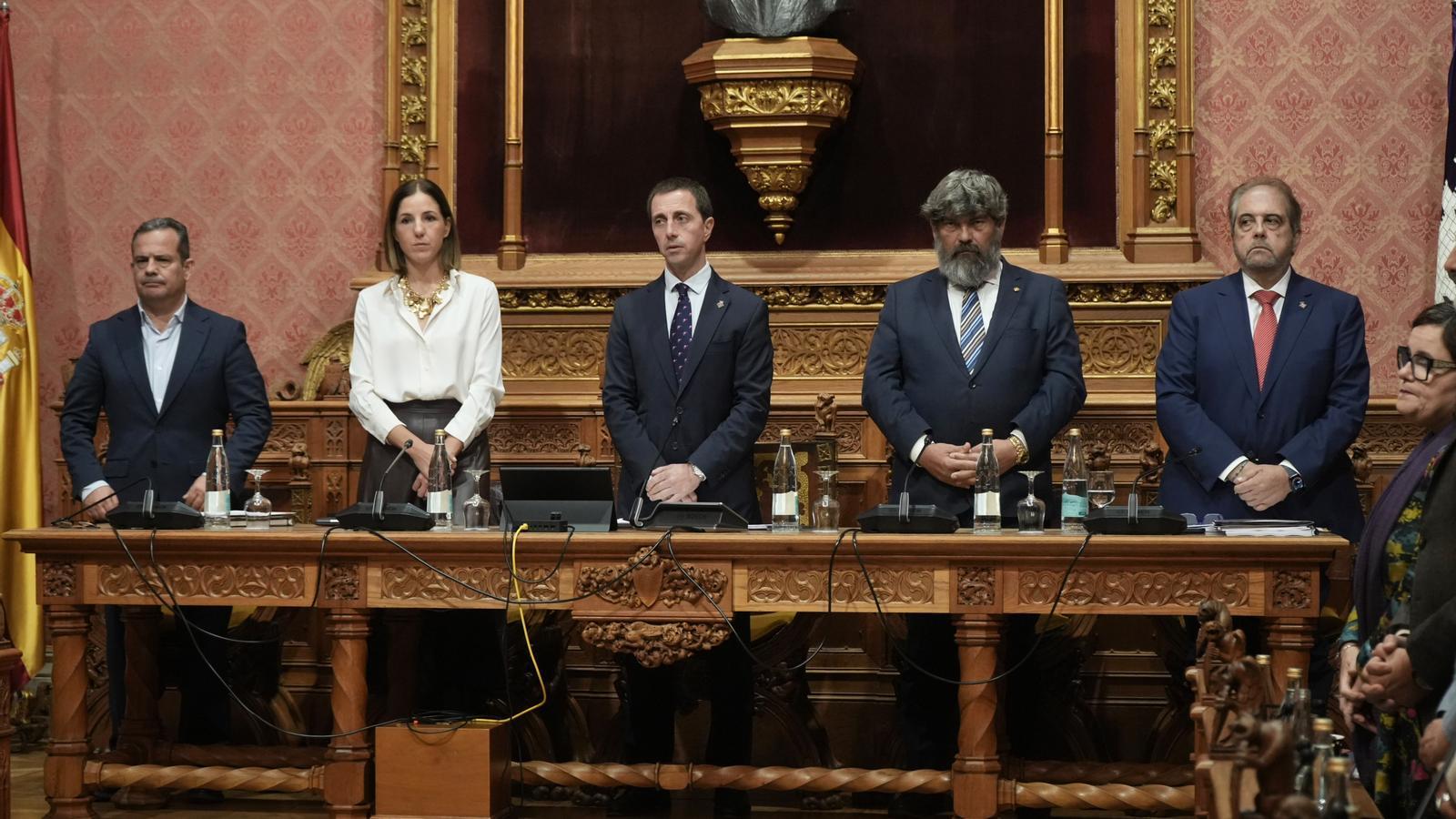
PalmaThe 2027 budget of the Council of Mallorca, the “highest in history” in the words of its president, Llorenç Galmés, does not include any provision for the Majorcan Solidarity Fund. This was a demand from the Popular Party's government partners at the island institution, Vox, and the conservatives have included it as such in the public accounts, which were initially approved with the votes of both government partners and the opposition of all opposition parties.
Vox had already demanded the freezing of the ordinary contribution in 2026 as a condition for approving the current budget. Using the argument of “national priority,” the far-right party justifies not allocating public funds to international solidarity and development cooperation in countries of origin, which the Majorcan Solidarity Fund has been promoting for years in collaboration with municipalities. During the plenary session, spokesperson Toni Gili claimed credit for halting resources for cooperation and maintained that solidarity must first focus on the people of Mallorca. Last March, he had already proposed reformulating the Fund so that it would “first serve Spanish families.” In 2025, when the contribution to the 2026 budget was frozen, Gili justified it by saying that it was time to stop “sending more money outside our borders while there are families here who cannot make ends meet.”
The issue returned to this Monday's budget debate, and while opposition groups had demanded the restoration of the funding, the amendments were rejected. The PSIB reproached the PP for yielding to Vox's demands and argued that the entity should receive two million euros. In the debate on the partial amendments, MÉS representative Joan Llodrà stated that Vox wants it to “not be recorded anywhere that the Fund has the support of this house, even though it really does.” Llodrà was referring to the balancing act the Popular Party is performing once again to avoid displeasing its government partner. The fact is that, despite the elimination of the budgetary line item, the Fund is not left without funding, as last October, the Council plenary approved a credit modification of 1.8 million to ensure its availability for next year. It did so with the votes of the opposition parties, a fact that during that same plenary session sparked harsh words from Abascal's party toward their PP partners. Sources from the Council Presidency point out that this credit modification “corresponds to the 2027 annual period” and represents “an increase of nearly 12.5%” compared to 2026.
The Majorcan Fund for Solidarity and Cooperation was established on October 19, 1993, driven by the Council, eleven city councils, and the organization Justice and Peace. It was born to coordinate the contributions of Majorcan administrations to cooperation and solidarity projects. Currently, the Council, the Government, 52 city councils, the Commonwealths of El Pla and El Raiguer, and the University of the Balearic Islands are members. Although it is not an organization dependent on the Council, it is an entity shared by institutions that contribute to it. The Fund channels these contributions toward cooperation, emergency aid, and awareness projects, among other areas. It works in countries such as Bolivia, Peru, Nicaragua, Burkina Faso, Ethiopia, Mali, and Senegal.
Subsidies for hunting increase and the Environment budget decreases
A climate change denier placed at the head of the Environment department of the Council of Mallorca with the approval of the PP, Pedro Bestard presided over the Balearic Hunting Federation from 2016 until 2023, and had also been vice-president of the Royal Spanish Hunting Federation. When he entered the Council government as vice-president and councilor, he had to leave the presidency of the federation due to incompatibility. Now, he has the Hunting Service under his area, which has 1.8 million euros at its disposal in the 2027 budget.
The Council has allocated 220,000 euros each year in subsidies to the hunting sector in 2024, 2025 and 2026, an amount that in the 2027 budget is increased and will reach 260,000 euros. The subsidies are intended to finance the promotion of traditional hunting, or the acquisition of goods and equipment related to hunting management, among others.
Between 2024 and 2027, the Council of Mallorca will have allocated nearly one million euros in subsidies to hunters. Since the beginning of the mandate, the second vice-president and insular councilor for Environment, Rural Environment and Sports, Pedro Bestard (Vox), has placed hunting at the center of his 'environmental' policy with highly controversial actions such as the opening of public estates in the Tramuntana mountain range to hunting activity. The controversy began in 2025, when the Council, at the request of Pedro Bestard, de-registered five public estates as wildlife refuges (la Mola de Son Massip, Son Fortuny, Tossals Verds, Son Amer and la coma d’en Vidal) and declared them hunting reserves. Bestard justified the change as a tool to control the wild goat population and conserve the Balearic goat. After a pilot project in Son Fortuny and Tossals Verds, the Council has regulated ten hunting days using blinds with shotguns and pointer dogs for the 2026-2027 season, in addition to recovering traditional net trapping in Tossals Verds. MÉS and the PSIB questioned whether this opening responds to a conservation need and warned of the effects on public use and the safety of hikers.
The increase in the allocation for one of the grant lines contrasts with the 11.4% reduction in the overall budget for the Environment, Rural Environment and Sports area, which will go on to manage 47.4 million euros in 2027, compared to the 53.5 million in 2026. The Council of Mallorca attributes this reduction to the extraordinary allocation of 14.6 million from European Funds for the Llucmajor composting plant. However, PSIB-PSOE and MÉS per Mallorca have criticized this reduction during the extraordinary session in which the Council's public accounts were initially approved this Monday and accuse it of not allocating resources to the fight against or mitigation of the climate emergency, in a context with increasingly intense and frequent heat waves and drought episodes that have already become structural.
Against the Catalan language
For the second consecutive year, the budgets also do not include nominative subsidies for the Obra Cultural Balear (OCB) and Joves de Mallorca per la Llengua. The measure was introduced in the 2026 accounts, after Vox demanded it during the negotiation with the PP, and it remains in those of 2027. The Minister of Finance, Rafel Bosch, defended in the plenary that the competitive concurrence model “works better” and that the entities can opt for the calls on equal terms with the others. Vox has claimed the withdrawal of the aid and has described the policies to promote the Catalan language as “unnecessary and discriminatory”.
The three opposition groups have demanded the recovery of the subsidies for the OCB and Joves de Mallorca per la Llengua. El Pi has described the withdrawal as “one of the most important injustices of the term”; MÉS has denounced that the support structure for the Catalan language has been dismantled.
In this debate, Bosch and Vox also defended literary awards in Spanish. The Council added these modalities to the Mallorca Awards starting in 2024; the awards, created in 2005, had been born with the goal of promoting literary creation in Catalan. The opposition criticizes that the expansion to Spanish is taking place at the same time that direct support for the entities working to normalize the own language is disappearing.
MÉS has accused the PP of having turned Catalan into a “bargaining chip” and of having broken “consensus that had taken decades to build”. “Language is not a problem that must be managed, but our heritage,” it defended. The MÉS councillor, Joan Llodrà, also compared the creation of literary awards in Spanish with giving public support to large retailers: “It is legal, but they do not need it,” he said. Llodrà thus reproached the Council for expanding the awards to this language while eliminating the nominative subsidies for the entities that promote Catalan.
