The small houses by the sea that the Coastal Authority wants to demolish
Sant Lluís opposes the demolition of one of the 177 buildings on the coast cataloged in Menorca, while the Government tries by law to bypass the State's guidelines against the Constitutional Court, which has already prevented it in Valencia

-
CAT -
CAST -
DE
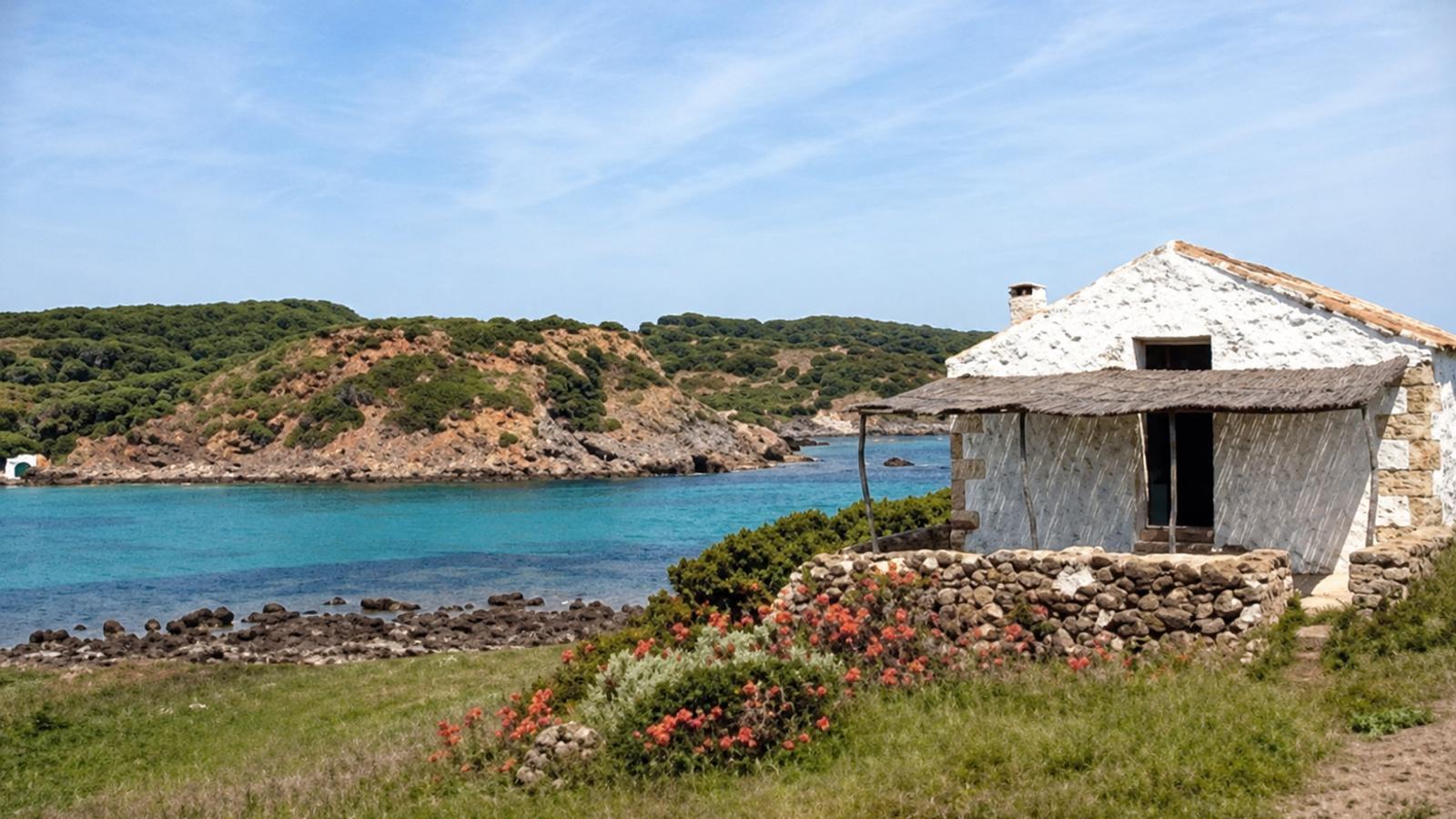
CitadelThe ballad of Lucas, one of the best-known tunes of the Menorcan popular songbook, reflects a reality that is increasingly far from the island's day-to-day life. The traditional small seaside houses mentioned in the song composed by José Luis Ortega Monasterio (1918-2004) are constantly threatened by the Coastal Law, without their preservation having yet been guaranteed. The recent demolition order for the Jaume d’Alcalfar small house, disobeyed by the Sant Lluís City Council, has brought this to light once again.
The heritage legacy left by the buildings constructed by the sea at the beginning of the 20th century, which used to be used as fishermen's shelters and for spending time with family or friends, is in danger. This has been understood by the mayor of the municipality, the popular Loles Tronch, who the day after receiving the ministerial notification ordered the order to be halted, even though the Coastal Authority had already awarded the demolition work for just under 45,000 euros. The mayor's argument is that the Historical Heritage Law is being breached and that the small house appears both in the municipal inventory and the island catalogue.
However, that is not actually the case. Although it committed to it—with a prior plenary agreement—in 2024, the Council has not updated the inventory and the Jaume d’Alcalfar small house does not appear in the island catalogue. "Otherwise, the Ministry would not be asking for it to be torn down," points out the socialist deputy Marc Pons.
Demolition orders
Demolition orders for this small house, built in 1926, have been reiterated over the last decades. In 1975, it was temporarily authorized, but only for a period of 15 years and in exchange for paying 100 pesetas for each of its 57 registered square meters.
In 2006, after more than 30 years had passed and with the new Coastal Law already in force, a reversal act for the building was initiated in order to recover it and incorporate it into the maritime-terrestrial public domain. The former head of the Coastal Demarcation in the Balearic Islands, Celestí Alomar, signed a provision for it in 2010, when the small house already measured 87.54 m2, but its user, Bernardeta Stevens, did not heed it either. Now, 20 years after the start of that procedure, the Coastal Authority has ordered its demolition once again, and once again the request has not been met.
The Council, also governed by the PP, has reacted and will bring an urgent proposal to the plenary session this month in defense of the seaside huts and to ask the Coastal Authority and the Ministry for the Ecological Transition to stop the demolition process initiated against the coastal construction of Sant Lluís. The Minister of Culture, Joan Pons Torres, argues that the seaside huts are “one of the most characteristic and unique elements of the ethnological and maritime heritage of Menorca” and are part of its collective memory. The goal of the island government is to ensure that “a path of dialogue is opened” to make the management of the public domain compatible with its preservation. In 2024, it already approved a unanimous agreement that urged the government of Spain to modify the Coastal Law to preserve those cataloged under any of the figures provided for by the 1998 Historical Heritage Law of the Balearic Islands.
The citizens' association established in 2023 in defense of the seaside cabins of Menorca is not aware of any other case of imminent demolition, "but it is aware of files that have been open for years" and others that are at risk due to the upcoming expiration of their concessions. This is stated by the president, Gonçal Seguí, who fears that, without regulations to protect them, other seaside cabins will also be threatened in the near future by the state administration.
The draft law that the Minister of the Sea, Juan Manuel Lafuente, requested from them to be able to legislate from the Balearic Islands without contradicting the Coastal Law and thus advance their protection "has been in Parliament for months now".
These days, in fact, the consideration of the new law for the spatial planning, protection, and integral management of the coastline has been brought to the chamber for approval, which in principle should guarantee the seaside cabins forever, but it is not certain that it will be approved in time before the legislature ends. In this sense, the Popular Party deputy Sebastià Mesquida has accused the left of "opposing a law that seeks to protect elements as representative of our identity as the seaside cabins. They deserve to be preserved and not condemned to disappear".
But the precedents do not invite optimism. The Constitutional Court has just approved the appeal filed by the government of Spain against the Valencian law that sought to protect certain traditional constructions on its coastline that the Coastal Authority wants to demolish. The judicial resolution, made known this October, invalidates the regional regulation that the Valencian government had approved in order to provide legal coverage to the ethnological centers of the Colonia Babilonia, in Guardamar de Segura (Alicante). These constructions have been left exposed to the advancing sea and the Coastal Authority has ordered their demolition within the public domain.
Inventory of seaside cabins on the coastline
In Menorca, there are 177 shoreline huts, but not all of them are cataloged. The majority, 75, are located in the municipality of Maó; 32, in Sant Lluís; 26, in Es Mercadal; 18, in Ciutadella; 17, in Es Castell; 5, in Alaior; 3, in Es Migjorn Gran, and 1, in Ferreries. In addition to creating the inventory, a unanimous agreement was also approved in 2024 urging the Spanish government to modify the Coastal Law in order to preserve those cataloged under any of the figures provided for by the 1998 Balearic Historical Heritage Law. But the State has not done its job.
In 2022, two shoreline huts were demolished, the last ones on record to have had to be torn down on the island. The Ministry refused to renew the concession because they had been converted into homes, a use that is not permitted on the coastline, but it did extend the authorization for others, with concession titles dating back before the 1988 Coastal Law, which are still used to store boats or maintain some activity linked to fishing or shellfish harvesting.
The alarm went off a little earlier, in 2021, when the Coastal Authority notified the concessionaires of the shoreline huts in Cala Sant Esteve (Es Castell) that it was revoking the extension they enjoyed and ordering the demolition of the buildings. This event mobilized the then-Minister of Culture, Miquel Àngel Maria (PSM-Més per Menorca), concerned by what he understood to be “a full-blown threat against the historical and ethnological heritage of Menorca”.
Thanks to this concern, the Island Council and the City Council of Maó – both institutions then governed by the left – stopped the demolition of two huts that the Port Authority had planned in the port of Maó. These are ‘na Nena’, cataloged in the cove of Fonduco, and the one that was owned by the businessman Santiago Pons Quintana in the Solana area, in the port of Maó.
Now it is the PP, at the gates of the general elections, that has made a move in this regard. It will be necessary to see if, after the elections, the issue returns to the agenda of the major parties and, above all, if the legal obstacles with the Coastal Authority are overcome to finally succeed in guaranteeing by law the protection of this patrimonial and identity asset of Menorca.
