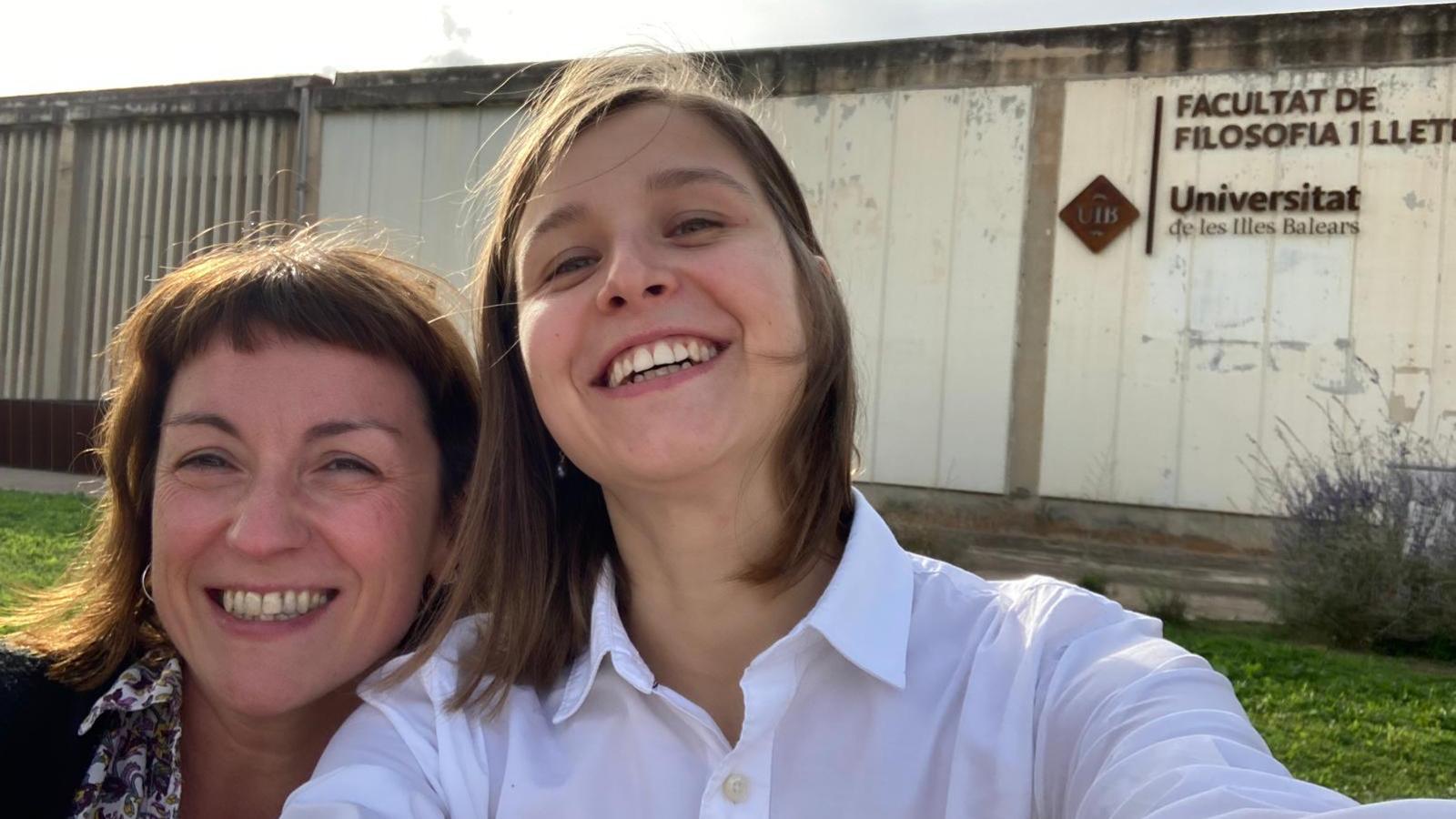
Maria Pronina i Maria del Mar Vanrell: "Mockery can make children have less desire to speak their language"
Linguists of the University of the Balearic Islands
-
CAT -
CAST -
DE
ManacorHow does a heritage language sound when a child grows up in a different linguistic environment? And how can we prevent accents or differences in the way of speaking from being perceived as a shortcoming? Based on the article they published in The Conversation about a Catalan-speaking child in New York, we talk to UIB linguists Mariia Pronina and Maria del Mar Vanrell about heritage languages, identity, school, and the situation of minoritization of the Catalan language. Their research observes Russian-speaking children living in Catalan-speaking territories and analyzes how contact between languages is also reflected in intonation.
What is a heritage language? Is it enough that it is the language spoken at home, or should we also consider how the child experiences and uses it?
— Heritage language is the language spoken at home, but which is not the majority language of the society. Often, a heritage language is a diasporic language spoken by immigrants, which is used to communicate with family or members of the community, while in other social spheres the dominant language or languages of the society are spoken. It is enough for there to be at least one person at home with whom the child speaks it. That is to say, in mixed families—for example, a Catalan mother and an American father in the USA—children also grow up acquiring the heritage language of only one parent. What we observe, however, is that there are very different trajectories of learning and maintaining heritage languages; some use it more, others less, some have only passive competence—that is, they understand it but do not speak it—others have both passive and active competence, and in some cases, the heritage language can even be lost entirely, a phenomenon that is usually preceded by linguistic erosion, that is, by the loss of competence or mastery in that language.
In your article, you pose the question of what happens to a Catalan-speaking child growing up in New York. On the other hand, the research you explain there observes Russian-speaking children in a Catalan-speaking environment. What do these two cases have in common and how do they differ?
— Both cases help us to understand the common challenges of heritage speakers, regardless of the language they speak. Both Catalan-speaking children in New York and Russian-speaking children in Mallorca grow up in an environment where the family language is a minority one and they must use the majority language in many areas of daily life. This can limit their vocabulary and the use of the heritage language to more familiar contexts, to the detriment of more abstract or specialized registers. The main difference is the size of the linguistic communities: the Russian-speaking community in Spain is large enough to offer more opportunities to practice the language, for example, in weekend schools where children can learn to read and write in Russian. Conversely, although the Catalan community in New York is one of the largest outside of Catalonia, these opportunities may be more limited. Another important difference is that, while in the case of New York there is only one societal language, in the case of the Catalan-speaking environment there are two languages, Catalan and Spanish. This makes our project especially interesting, because it deals with children who are growing up with three languages.
Which children and what situations have you studied? What do your data allow us to affirm and what can we not generalize yet?
— We have studied Russian-speaking children living in the Balearic Islands and in Catalonia, both those born here and those who arrived during childhood, the so-called generation 1.5 speakers. As we mentioned before, it is an especially interesting context because three languages coexist there: Russian in the family sphere, and two languages of the society, Catalan and Spanish. Since it is a poorly studied situation, we cannot yet generalize the results to all heritage language contexts. However, we have observed that children who have Russian as a heritage language incorporate characteristics of Catalan intonation into their speech. This influence of the society language on the heritage language has also been observed in other aspects of language, such as morphology and syntax, in contexts of bilingualism. This suggests that some of these patterns could go beyond our specific context, although further research will be needed to confirm this.
Language, accent and identity
Why have you focused on intonation? What can it reveal about language acquisition that might not be as perceptible in vocabulary and grammar?
— Intonation is especially interesting because it is one of the first elements we perceive when a child begins to speak. Unlike vocabulary or grammar, which can be very accurate even in speakers who still have a different accent, the melody of speech often reveals traits of linguistic origin. Furthermore, intonation and prosody seem especially sensitive to exposure to other languages: they can vary before the specific sounds of vowels or consonants. In fact, even people who have grown up speaking a language from birth can end up modifying its intonation after living for a long time in another linguistic environment. Therefore, studying prosody allows us to observe aspects of acquisition and language contact that may not be as evident if we only look at vocabulary or grammar.
In the title you speak of a home language that can "sound foreign". Who might perceive it that way and what consequences can it have for the safety of children when they speak?
— The perception of an accent depends, in part, on who is listening. Previous studies with adult heritage speakers have shown that people who have always lived in a monolingual environment can be more demanding when assessing whether an accent sounds native, while heritage speakers tend to accept a wider variety of accents. Thus, a language that a child has learned at home may sound foreign to native speakers, even if it is their family language. This can have consequences for their confidence: unpleasant comments or mockery can make children feel insecure and less willing to speak it. Therefore, it is important that families also take care of how they react to mistakes. Instead of constantly correcting, it is preferable to offer correct models in a natural and respectful way, to help children maintain their confidence and desire to use the language.
How can we avoid that differences with respect to monolingual speech are presented as shortcomings or as a sign that the child 'speaks poorly'?
— To avoid this, it is necessary to start from the idea that there is no single correct way to speak a language. In fact, there are not always differences between heritage speakers and monolinguals, and, when there are, they may reflect different learning trajectories, not shortcomings. Therefore, it is important that teachers and speech therapists have training on multilingualism and know the diversity of linguistic profiles, so as not to confuse the particularities of a bilingual experience with a language difficulty. This training would help to avoid unfair judgments and to ensure that children can speak their language with confidence.
The situation of Catalan in Mallorca
Mallorca has a very high migratory index and a linguistic reality in which many languages coexist. At the same time, Catalan is a minoritized language compared to Spanish. How does this double reality condition the adoption of Catalan as a social language?
— This double reality can condition the adoption of Catalan as a language of social interaction by the newly arrived population, since Spanish too often becomes the shared language of communication between people of diverse linguistic origins. Furthermore, the linguistic accommodation practices of Catalan speakers can reduce the opportunities to learn and use Catalan. However, the fact that newcomers find themselves in an environment where a minoritized language, but one with significant institutional recognition, and a dominant language coexist can also foster awareness about the value of their own languages and the importance of maintaining and transmitting them, instead of abandoning them in favor of Spanish. This phenomenon can be related to the so-called 'mirror effect', through which the sociolinguistic situation of the host society invites speakers to reflect on the situation and value of their own languages.
Catalan can be both a language of schooling and a minoritized language in many social uses. How does this situation affect children from migrant families who learn it at school? What helps them to incorporate it into their daily lives as well?
— For children from migrant families, learning Catalan involves incorporating an additional language, in a context where they also have to learn Spanish. However, we have observed an interesting phenomenon: some Russian-speaking children who begin their schooling in Catalan have this language as their second strongest language, ahead of Spanish. This is reflected in linguistic transfer: expressions or constructions from Catalan that children carry over into Spanish when they speak that language. It is an indication of the extent to which Catalan influences their linguistic repertoire, even when they are expressing themselves in Spanish. For Catalan to also be incorporated into daily life, however, it is not enough to learn it in the classroom: one must have opportunities to use it, interact with friends who speak it, and participate in social environments where it is a living language.
How can the learning and use of Catalan be promoted without conveying the idea that the native languages of migrant families are an obstacle? And how can these languages be recognized without losing sight of the vulnerable situation of Catalan?
— The key is to train teachers and speech therapists so that they understand the different realities of multilingualism and do not perceive heritage languages as an obstacle. Research shows that acquiring a language well provides an important foundation for cognitive development and for learning other skills necessary at school. In this context, Catalan must play a central role as the language of the school, of social cohesion, and of participation in the host society, without this implying renouncing family languages. Promoting Catalan and valuing heritage languages are not contradictory goals, but rather complementary ones: languages can coexist, develop different functions, and mutually reinforce learning processes.
Is there a risk that, in a multilingual society like the Mallorcan one, Spanish might become the default common language among children of diverse backgrounds, while Catalan remains more restricted to school or certain spheres?
— It is a question that we cannot yet answer with certainty, because it is a relatively new sociolinguistic situation and we do not yet have enough data to know how it will evolve. However, we do not believe that this scenario is inevitable. In a multilingual society like the Mallorcan one, where several languages coexist, there are more possibilities to recognize and value the linguistic repertoire of children. This contrasts with contexts like that of the United States, where English has a very dominant position and other languages often have less presence and social recognition. Therefore, we believe that an environment that values multilingualism can favor Catalan maintaining a space in the daily life of children, beyond school.
School, family and transmission
What usually changes when children start school and spend many hours with their friends in the majority language? What factors help to maintain the home language?
— When children start school, exposure to the dominant language of society increases significantly: it is the language of learning and also the one they use with many of the friends they make at school. It is a common pattern in very diverse linguistic contexts, but it does not mean they have to lose their home language. With enough exposure and support, they can develop both their heritage language and the surrounding languages. The key is to use the native language regularly in the family environment, with parents, siblings, and, especially, grandparents. They often play an important role in maintaining the heritage language, because they may not speak the language of the society where the children live. In these cases, the native language becomes the only way for children to communicate with their grandparents and to maintain a close relationship with them. Thus, the need to communicate with this generation can become a very significant motivation to continue using the family language.
— Daily activities such as reading stories, playing board games, watching television, and listening to the radio in this language also contribute, as they offer more opportunities for exposure and use. Reading stories, in particular, is a very valuable practice: in addition to promoting the development of literacy, it can become a very special moment to share as a family. For example, reading a story before going to sleep is a routine that creates emotional bonds, generates shared memories, and associates the language with a pleasant and intimate experience. In this way, the heritage language is not only developed through exposure and learning, but it is also kept alive in the daily and emotional experiences of the family.
— Finally, formal education plays an important role: schools and extracurricular activities in the heritage language allow for its development in a more systematic way, including skills such as reading and writing.
What effects can the loss—total or partial—of a heritage language have on communication with the family, the sense of belonging, or the well-being of children?
— The loss of a heritage language, especially if it is total, can have significant consequences because it can lead to the loss of a bond with the family. As we have discussed, some relatives, such as grandparents, may not speak the language of the society where the children live, so the heritage language may be the only way of communicating with them. Maintaining it fosters intergenerational relationships, a sense of belonging, and emotional well-being. In fact, we often find heritage speakers who, when they are adults, enroll in courses of their family language. Although they already speak it, they feel they lack mastery in some areas, especially in reading and writing, and they seek to acquire these skills. This shows to what extent the language is part of their identity and how there may be a need to recover or complete a learning process that they did not have the opportunity to acquire during childhood. That is why it is important to encourage the maintenance of the heritage language, not only as a tool for communication, but also as part of each child's identity and personal history.
What can families do to pass on a language without turning it into an obligation or a source of pressure? What role do reading, activities, friendships, and contact with a community of speakers play in this?
— It is a very good question, because many families feel frustrated when they see that their children do not speak their language or that they speak it with a foreign accent. This frustration can generate anxiety and lead parents to pressure children to speak better, but this dynamic can end up demotivating them and making them lose the desire to continue learning the language. It must be kept in mind that there are very strong emotions linked to language, identity, and family bonds. For this reason, our advice is to transmit it naturally and avoid correcting constantly. Instead of telling a child that they have made a mistake, we can repeat what they have said with the correct form, offering them a model without making them feel judged. It is also important to propose activities that are interesting, such as reading books or watching movies related to their tastes. Finally, it is fundamental that they can interact with other children who speak this language, and if it cannot be in person, it can also be done through online chats. Thus, the heritage language will not only be the language of the adults in the family, but also a tool to make friends and share interests with other boys and girls. The more opportunities children have to use it in diverse and pleasant contexts, the easier it will be for them to maintain it and continue developing it.
Should school do some kind of work to include and validate heritage languages?
— Yes, without a doubt. The school can do a lot of work so that heritage language speakers, who often come from migrant families, feel welcomed and understand that their language also has value. Very simple activities can be organized, such as learning to say 'hello' in the languages spoken by the students, sharing stories and traditions, or giving them the opportunity to present some aspect of their language and culture to the rest of the class. These are good initiatives to carry out, but they can significantly transform the school environment. Furthermore, they allow all children to learn from each other and understand that linguistic diversity is a wealth. Above all, they contribute to creating an environment in which boys and girls do not feel they have to give up a part of their identity to feel accepted and integrated at school.
