Palma becomes a cry for a dignified life
Thousands of people have gathered in Plaça d'Espanya to demand measures against real estate speculation
-
CAT -
CAST
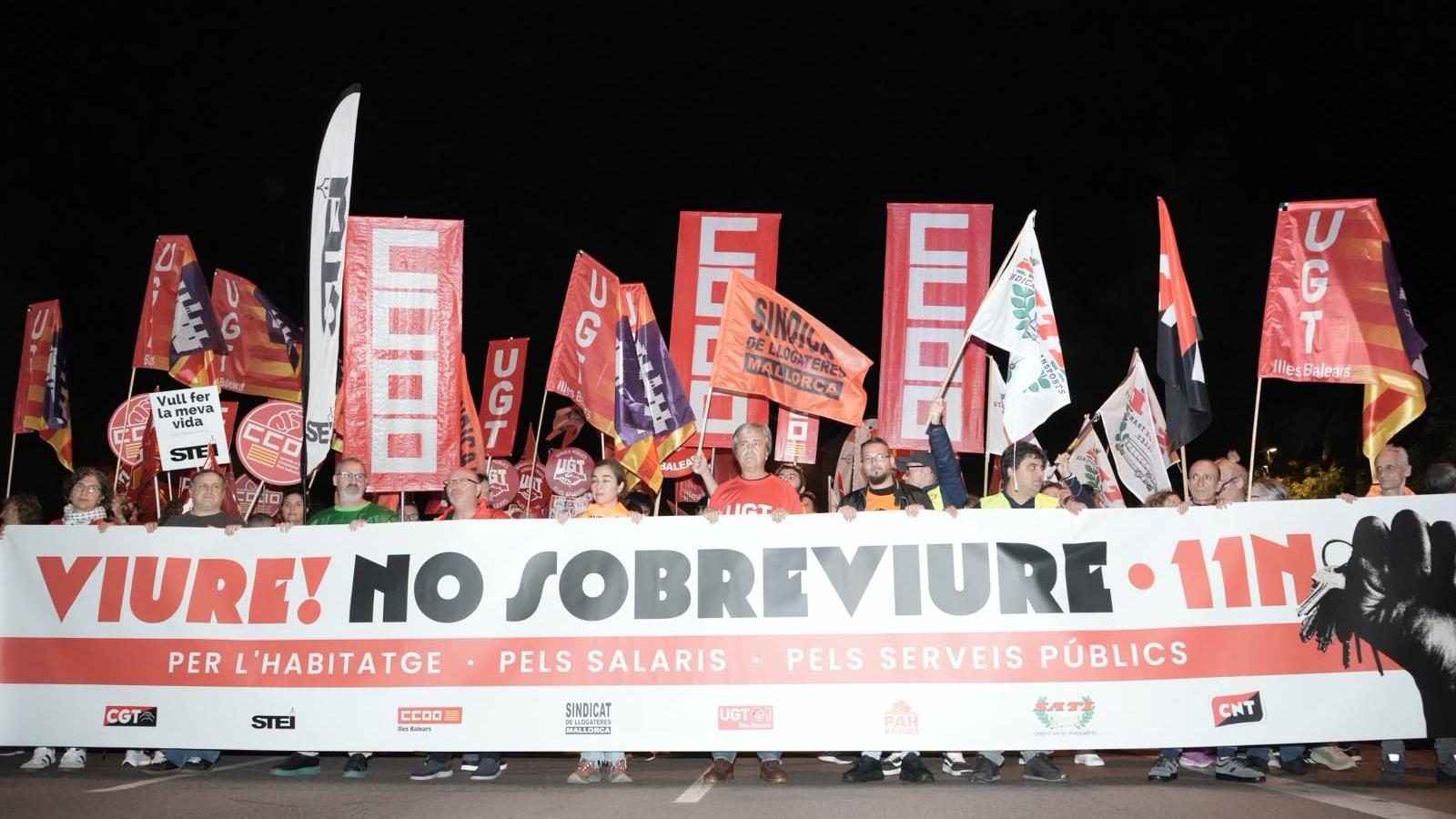
PalmaPalma became a cry for a dignified life this Wednesday evening. Tens of thousands of people –45,000, according to the organization– filled Plaça d'Espanya and the avenues in a massive demonstration against the difficulties of accessing housing, the main trigger for a general strike that, according to the unions, had a turnout of almost 50%. The day was also marked by several moments of tension during the pickets.

Plaça d'Espanya began to fill up from five in the afternoon. Families, elderly people, and youths formed a transversal mobilization with a shared cry. The sidewalks of the avenues were full of people applauding the passing of the protesters. Among the union banners and all kinds of protest messages, a girl carried a sign with the message: 'I am six years old and I am already overwhelmed by the mortgage'. The massive attendance meant that, an hour after the start of the march, protesters were still leaving Plaça d'Espanya.

The mobilization started around 6:30 PM and traveled through the avenues and La Rambla until reaching El Born. In addition to demanding urgent measures to facilitate access to housing, the call demands salary increases, an improvement in the minimum wage, measures to curb real estate speculation, and a strengthening of public services. The organizers denounce that having a job no longer guarantees being able to live with dignity or access housing.
The protest in Palma has joined those called in Ciutadella, Maó, and Eivissa, as well as those in the rest of the State. This same morning, 1,700 people participated in an educational march in the Balearic capital.
They don't make ends meet
The convening unions have celebrated the turnout for the strike and the "multitudinous" participation in this afternoon's march. The general secretary of CCOO in the Balearic Islands, José Luis García, stressed that workers are suffering from wages that do not last until the end of the month, an increase in the cost of living, and the stratospheric rise in housing costs.
From the Mallorca Tenants' Union, its spokesperson Celeste Rodríguez described the call as a "success" and claimed that the strike "is not partisan."
In this regard, the general secretary of UGT, Pedro Homar, spoke out, demanding effective solutions from all administrations. "We have local wages at international prices," he denounced, while criticizing that "absurd partisan fighting has caused this situation"
Follow-up of the strike
The unions, which estimated the turnout at around 48% in the Balearic Islands this noon, are confident that the demonstrations will be massive. CCOO and UGT have attributed the data to the economic circumstances of the workers and, in some sectors, to excessive minimum services.
Specifically, in transport, the turnout reached 100% by noon at SFM and TIB, 80% at EMT, and 60% at the airport. In education, according to government data, the strike recorded a turnout of 14.9% across the Balearic Islands. The turnout was 5.8% in the healthcare sector, and among all administration employees, the percentage rose to 11.7%.
In the state administration, Correos, with 60%, is the agency that records the most follow-up, followed by the SEPE, the General Treasury of Social Security, the National Social Security Institute (30%), and the Tax Agency (25%).
Regarding commerce, unionists have acknowledged the low turnout, although, according to the routes they have taken during the morning, many have not supported the strikes not because they do not share the demands, but, like many workers, due to economic reasons. The hospitality industry, in the middle of the low season, is also registering a low turnout.
For their part, employers' associations have described the day as normal and have estimated the impact as "minimal" both in small and medium-sized enterprises, as well as in the hotel and self-employed sector.
