Óscar Carpintero: "The Balearics were not dying of hunger when they were receiving ten million tourists"
Professor of Applied Economics
-
CAT -
CAST -
DE
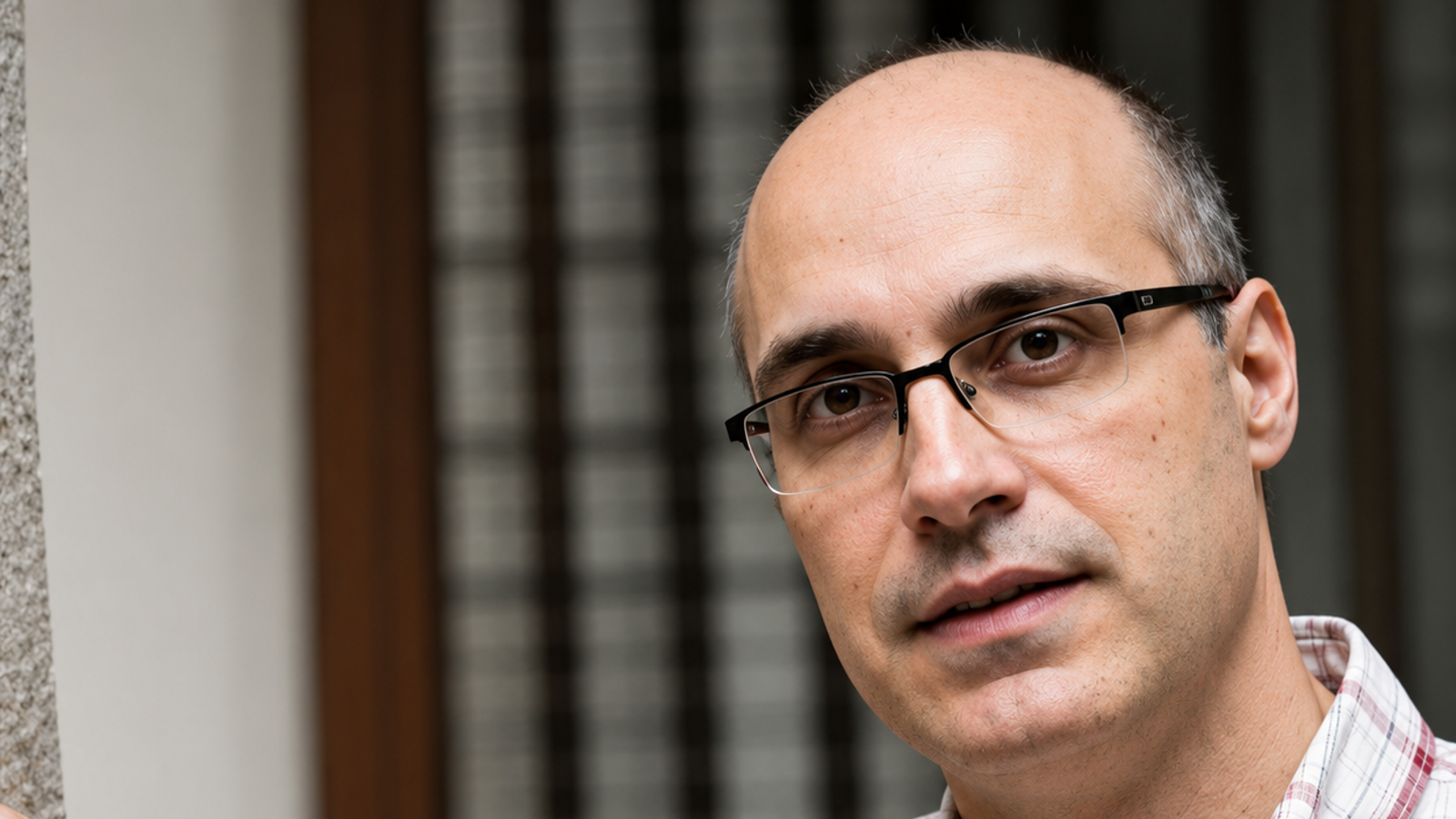
PalmaÓscar Carpintero (Valladolid, 1972), Professor of Applied Economics at the University of Valladolid and specialist in ecological economics, has spent years studying the limits of growth and alternatives to a model based on the continuous increase of production and consumption. This Thursday, November 12th, he will be at the University of the Balearic Islands to speak about degrowth at an event organized by the Faculty of Economics and Business. The next day, at 7 PM, at the Espirafocs bookstore in Inca, he will present his book Economía inclusiva: conceptos básicos y algunos debates, a collective work that he has coordinated and that proposes broadening the view of economics by incorporating issues such as inequalities, care, and ecological limits.
To what extent is the approach that questions GDP as the main indicator and benchmark of economic growth new?
— I believe that questioning the economic model and the increase in GDP is something that part of academia has been doing for decades. Highly reputable economists have already highlighted the limitations of GDP as an indicator of well-being. No matter how much it increases, it does not necessarily mean that the well-being of the population improves. From the point of view of the social sciences, it is a very well-known and quite incontestable discourse.
— For the first time in a long time, this debate has moved into the realm of political discussion, even if in a rather abstract way. In the European Union and in some countries, there is already talk of going beyond growth, and reflections from many authors on the need to take into account people's well-being are being incorporated. Well-being has dimensions related to the enjoyment of time, personal relationships, and other issues that cannot be measured solely through income.
— We must also incorporate indicators such as the ecological footprint and material consumption. There is no single indicator that explains everything. There is no super-indicator. It is about opening up this hodgepodge that is GDP, which computes the purchase of armaments in the same way as other goods and services. In this sense, a change has indeed taken place, but we are still at the beginning, and we must manage to move this new approach forward decisively, because it is more complete and incorporates many other essential variables. In recent times, with the social crises we see throughout Europe, we realize that measuring the economy with GDP is completely insufficient.
The Balearic Islands have exceeded 19 million annual tourists, but access to housing is becoming increasingly difficult. Have we confused economic growth with well-being?
— The housing crisis has had a significant influence on this debate. On an island, territory is limited and one cannot grow indefinitely. This has a very clear pedagogical component, but also a practical dimension when we talk about the possibilities of access to housing. A kind of confluence has occurred between ecological deterioration and social problems. Environmental deterioration, which has occurred in a very harmful way, is related to the lack of affordable housing.
— People who live here have the right to enjoy a good quality of life, and the deterioration of these conditions is a major problem for society as a whole. There is also the issue of the use of the territory and public spaces. A hectare of land has an opportunity cost, because allocating it to one use prevents it from being dedicated to another. There are economic interests and a desire for profit that condition these decisions.
— The privatization of public spaces is progressive. We can observe this, for example, with the occupation of public space by terraces. There are establishments that end up having more terrace space than surface area inside the premises. All of this contributes to fueling an economic machine that starts from the idea that, if it continues to grow, people's lives will always improve. The results are in plain sight.
But, if production increases, shouldn't we live better?
— Above a certain level of per capita income, increases in income do not necessarily translate into an increase in people's well-being. There are several studies that show that well-being does not depend solely on income. When people are asked what their well-being depends on, issues such as personal relationships, health, and the time we have available appear. There is a whole set of components that do not involve per capita income.
— Conversely, we can increase the rate of production of goods and services and end up observing that well-being decreases. I think it is necessary to clearly keep in mind three pillars, which are goods, time, and relationships. If we dedicate too much time to producing these goods, we have neither time nor people with whom to enjoy them. The other spheres of life become impoverished, even if we continue to increase consumption. To undo this spiral, it is essential to work with parameters that go far beyond simple GDP.
One of the main fears regarding degrowth is the loss of jobs. How can this issue be addressed?
— It is a complex issue that can be approached in global terms but which must then be analyzed and examined in depth in each case. As a society, we function the opposite of how any family would at home. In a household, you first consider what needs you have and then you do the work necessary to satisfy them. But at home, you do not clean three times nor do you make the bed three times if it is not necessary.
— On the other hand, as a society, since we do not set ourselves limits or rules, we hire people to produce goods that we may not need in such quantity. Here lies a fundamental problem. Individually, no one would consider doing a job three times that only needs to be done once. But as a society, we end up functioning this way.
— The other fundamental question is how what we produce is distributed. This is the key. Because, if we produce in excess, a phenomenon of emulation is also generated: those who have less want to have more, and thus we continue to feed the same wheel. We should ask ourselves why we produce and how we adequately distribute what we produce. Inequalities are a very clear argument in this debate.
The Balearic economic model generates very little employment for qualified professionals, due to excessive dependence on tourism. What does this tell us about the economic model?
— I do not like that we refer to people based on whether they have more or less education, as if that determined the importance of the work they do. One of the positive aspects of the pandemic was that societies looked at themselves in the mirror. We verified that many of the most important jobs were precisely the least remunerated. They were also the most essential: farmers, cleaners... They were workers who could not stop.
— In contrast, other professionals with extraordinary remuneration, such as certain executives, could stay at home. This shows that the way we remunerate jobs is not organized according to their social importance. And this should be a criterion to take into account.
— A large part of the recovery in corporate profits has occurred through wage depreciation. One way to extract profits is to socially discredit certain jobs and pay them poorly. But, when we go through lean times, look at who we call. Who are the people we really need?
— Obviously, economic diversification is a very good proposal for any territory, not only for the jobs it generates, but also to reduce risks.
After decades of tourism growth, it seems that in the Balearic Islands we do not move past the theoretical debate and it is hard for us to imagine that we could live with a few million fewer visitors. Are we condemned to continue growing?
— The latest mobilizations have been relevant in this regard. Some time ago they were unthinkable, at least those oriented towards reviewing the growth model. Are we condemned to live while growing? It is important to make people see that, in the case of an island, when there was less tourism, the population also had homes. This is basic for understanding what is happening. Growing only under the prism of producing more as a whole is a very poor and simplistic way to analyze what is happening, and now we are seeing the results.
— The Balearic Islands were not starving when they received ten million tourists. It is necessary to make this clear. In recent years, the increase in the number of tourists is related to the general worsening of living conditions. The well-being of the population as a whole is deteriorating due to the pressure on public services. Therefore, it is evident that growing indefinitely only serves the interests of certain actors, and it is important to see if this responds to the improvement of the living conditions of the majority or only of a few.
— This situation is also an opportunity to rethink the economic model. Other economic discourses must be opened up, even within Economics faculties. The simple accumulation of data on the increase of variables such as the number of tourists and production in absolute terms does not mean that the economy even improves, and certainly much less the quality of life of people. Ecological economics and feminist economics shed much light on issues that conventional economics has pushed aside.
— We must provide tools to the economists of the future so that they can incorporate these perspectives and ensure that this discourse has a greater presence.
Those who oppose intervening in the housing market argue that this limits economic freedom. What would you answer them?
— There are two issues here. On one hand, public intervention, which should serve for the public sector to look after the general interest. On the other, the fact that the administrations themselves fail to comply with their own regulations. We find situations in which the main offender is the Administration itself. The first thing the public sector must do is comply with the rules it has established.
— From this point on, public intervention can have precisely the opposite effect to what is often claimed. For example, when the public sector intervenes in the housing market, it can allow people who do not have access to it to obtain one.
— This does not limit freedom, but rather gives freedom to those who cannot access the market. The regulation that allows for intervention expands the margin of freedom for thousands of people. It has always greatly outraged me that in Spain nearly six million public housing units have been built and that a good portion no longer forms part of this protected stock.
— The regulations allowed that, after a certain number of years, these dwellings would cease to be protected and would move to the free market. The Administration has allowed this loss. But it has not even exercised, in many cases, the right of first refusal.
— The fact of not using this capacity, by action or omission, has prevented increasing the freedom of a considerable part of the population. We do not have a sufficient public housing stock because we have allowed it to be lost. We are talking about homes built with public investment, with the money of all citizens.
