The Minister of Tourism attacks Aena for the German poster: "We already had arrogance here"
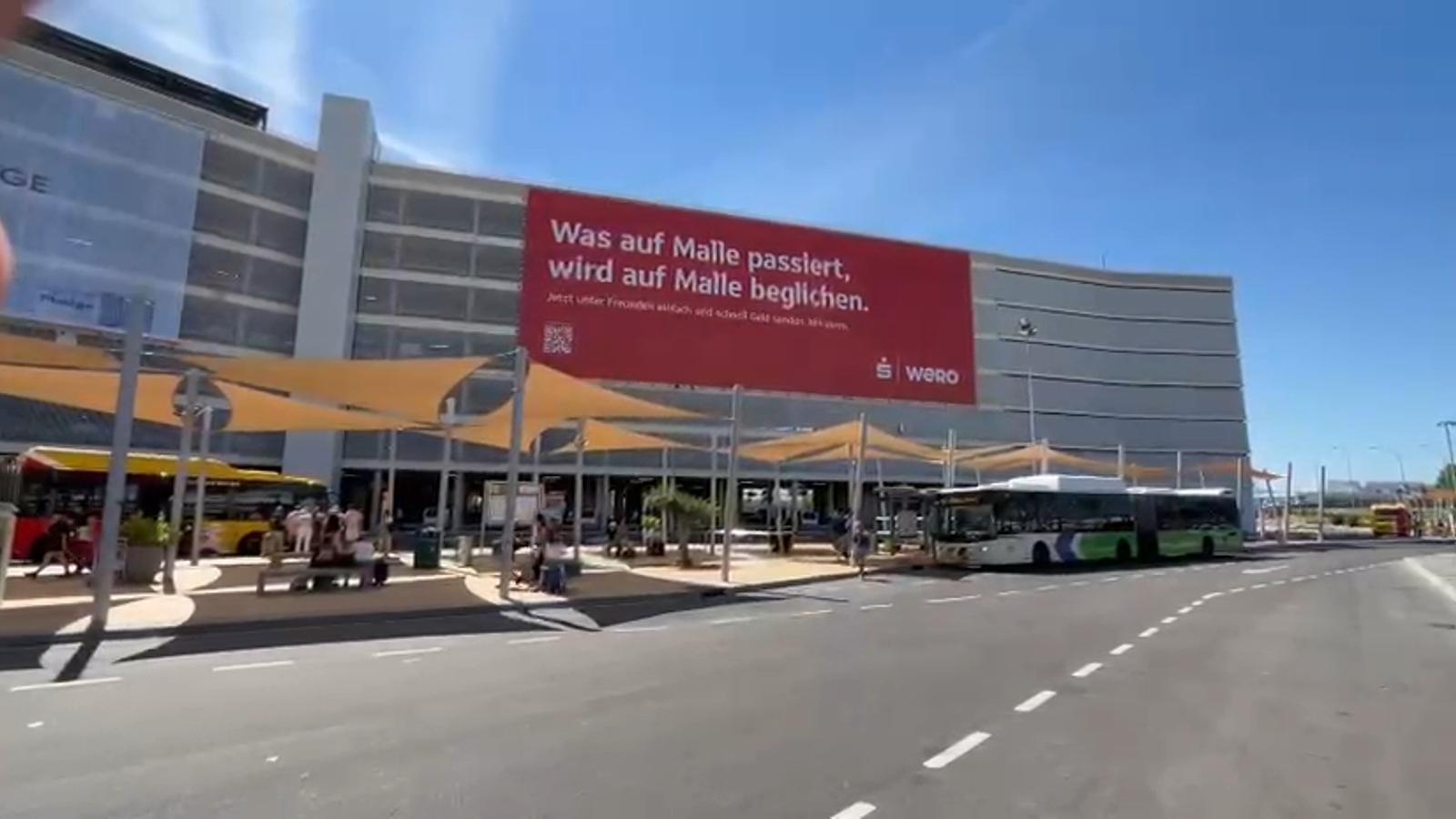
The person responsible for Tourism had been critical of the advertising banner located at Son Sant Joan, entirely in German

-
CAT -
CAST -
DE
Palma"The lesson of the day is extraordinary," thus expressed the Minister of Tourism of the Government, Jaume Bauzà, after learning that the German bank, which was advertised with the controversial message on a billboard located at Palma airport, will remove it. Bauzà thanked the company this Monday for its decision to take down the advertising billboard: "Sparkassen listens to the residents' complaints, understands the discomfort, and removes the billboard," he added in a post on his X profile. On the other hand, the minister was particularly forceful with Aena, to whom he reproached a lack of education. "Today common sense has arrived from Germany. We already had arrogance here," he pointed out.
The German financial group Sparkassen-Finanzgruppe announced this Monday that it will remove the advertising banner installed at Palma Airport following the controversy generated by its message and has apologized for the impact it has had in Mallorca. "We deeply regret that the message we intended to convey has not been successful and has been perceived in Mallorca as disrespectful," the entity stated in a statement. The group admitted that the humorous nuances of the campaign can be interpreted differently depending on the language and cultural context, which can lead to "unwanted perceptions".

The canvas, located on the facade of the airport car park building and visible from the main exit of the arrivals terminal, displayed the German slogan 'Was auf Malle passiert, wird auf Malle beglichen', a phrase that can be translated, approximately, as 'what happens in Mallorca, is settled in Mallorca'.
The campaign had been promoted by Sparkassen-Finanzgruppe and Wero, a European digital payment system similar to Bizum, with the aim of promoting their payment services. However, the message generated strong controversy due to the use of the word Malle, a colloquial term widely used by some German tourists to refer to Mallorca.
This term is often associated with a tourist imaginary linked to nightlife, mass parties, and excesses, especially in areas like El Arenal. It was precisely this interpretation that motivated the Government's reaction, which last Friday demanded the immediate withdrawal of the campaign, considering that it transmitted an image of the island tied to a tourist model that institutions are trying to overcome. Now, the financial group has acknowledged that it shares the assessment expressed by the Executive and has confirmed that it has already given instructions for the canvas to be removed.
A debate that goes beyond an advertisement
The controversy arrives with the start of the tourist season, which leaves record figures for arrivals and spending, but has also intensified the social debate about the limits of the tourism model and its effects on the resident population. The growing difficulty in accessing housing, the increase in the cost of living, the saturation of infrastructure and services, and the perception of a progressive loss of quality of life have fueled protests against tourist overcrowding in recent years.
In this context, the presence of an advertising message entirely in German at the main entry point to the Islands was interpreted by numerous social media users as an example of economic dependence on tourism and the projection of an image of Mallorca oriented exclusively towards foreign visitors. The removal of the banner puts an end to a controversy that, in recent days, has transcended the advertising sphere and has reopened the debate about the image projected by Mallorca and about what tourism model the Islands want for the future.
