During the ten years of the renovation of the Cathedral (1904-1914), Antoni Gaudí was in contact with Mossèn Antoni Maria Alcover, who in 1905, at 23 years old, would become its master canon. The priest from Manacor also cultivated the art of architecture in the service of God. This facet, however, would be overshadowed by his role as a philologist. Since he had begun the titanic work of the Dictionary in 1901, the compiler of the Rondaies mallorquines (1880) had not stopped traveling through Catalan-speaking lands. His Dietari de les eixides is full of notes on the most representative buildings of Catalan Romanesque architecture.The hidden side of Mossèn Alcover the architect has been studied by Maria Antònia Matamalas in a paper published in 2009 at the V Local Studies Conference of Manacor. The man from Manacor adopted Gaudí's quote: “It is not worth doing anything that is not eternal.” Thus, he mainly designed churches and chapels, mostly in Gothic style. He did so with the advice not only of the Catalan genius, but also of other renowned architects such as the Majorcans Joan Guasp and Pere d’Alcàntara Penya, and the Catalan Joan Rubió. His first church, and the most notable, was Sant Miquel de Son Carrió (1899-1907). In his diary, he notes that on April 2, 1901, he went there accompanied by Gaudí. “He gives us very good instructions,” he recorded. The blessing of the temple in 1907 was officiated by Mossèn Costa i Llobera from Pollença (1854-1922), who in 1909 would be appointed canon of the Cathedral.In 1901, Mossèn Alcover also participated in the expansion project of the church of Son Negre, near Son Carrió. In 1903, he took charge of the construction of the church in Calonge (Santanyí). In 1905, he undertook the construction of a Neo-Romanesque style chapel on the road connecting Felanitx with the sanctuary of Sant Salvador, at the point where oral tradition said the Mare de Déu de Sant Salvador had appeared. In 1928, on the occasion of the VII centenary of the Reconquest of Mallorca, he designed another chapel, that of the Pedra Sagrada in Santa Ponça (Calvià). He also designed the one in Mendia, near Santa Cirga, the estate where he was born in 1862.Other interventions by the versatile man from Manacor took place at the church of Portocristo, the monastery of the Santa Família in Manacor, and the convent of Sant Vicenç Ferrer, also in the capital of Llevant. Mossèn Alcover died on January 8, 1932, at his home in Palma due to a stroke. He was 69 years old. Gaudí had died six years earlier, after dedicating the last 43 years of his life to the Sagrada Família. There is now a process underway to canonize the well-known 'architect of God'.
The Mallorca that inspired Gaudí
At the end of the 19th century, the illustrious Catalan architect, who died 100 years ago, discovered the island as a hiker. The Caves of Drach and Artà and the Torrent de Pareis would have a strong influence on his work. The reform of the Cathedral, which he would undertake in 1904, would also leave its mark on the Sagrada Familia.

-
CAT -
CAST -
GER
PalmaA ntoni Gaudí Cornet, born in Reus in 1852, found in nature his main source of inspiration. “Originality consists in returning to the origin,” he used to say. At the end of the 19th century, the muses led him to Mallorca. He did so as a member of the Catalan Association of Scientific Excursions, founded in 1876. The entity used to organize trips to the island, then famous for its unspoiled landscapes. The man from Reus was particularly struck by the Caves of Artà and the Caves of Drach (Manacor). This is assured by the Japanese researcher Tokutoshi Torii in a work titled Mallorca in Gaudí's works – it was published in 2002 within the framework of international conferences on Gaudí studies.
According to Torii, the Catalan genius would recreate that underground universe in a corner of Park Güell in Barcelona. It would be in the grotto, conceived as a garage for cars, located on the right side of the iconic staircase at the entrance. The monumental complex was a commission that in 1900 the industrialist Eusebi Güell gave to the most prestigious architect of the time, who since 1882 had been living with body and soul dedicated to the construction of the Sagrada Família, on the right side of the Eixample. The Japanese scholar recounts the following anecdote through one of his workers: “Mr. Eusebi Güell, who knew of Gaudí's passion [for natural caves], wanted to give him a surprise and sent him to the offices of the Sagrada Família temple, for when he returned from Palma, a voluminous stereoscope (a device used to view three-dimensional photographs), with a magnificent collection of transparencies of the Caves of Artà and Manacor [...]. I remember seeing Gaudí many times engrossed in contemplating the transparencies”.

In 1904, 'the architect of nature' would also have considered the natural caves of Mallorca when decorating the Sala Mercè, located on the current Rambla de Barcelona. It was an innovative local entertainment venue promoted by the painter Lluís Graner after his stay in New York. Gaudí transformed the basement into a space called 'Fantastic Grottoes', which, amidst stalactites and stalagmites, hosted the first cinema for the Catalan bourgeoisie.
Torrent de Pareis
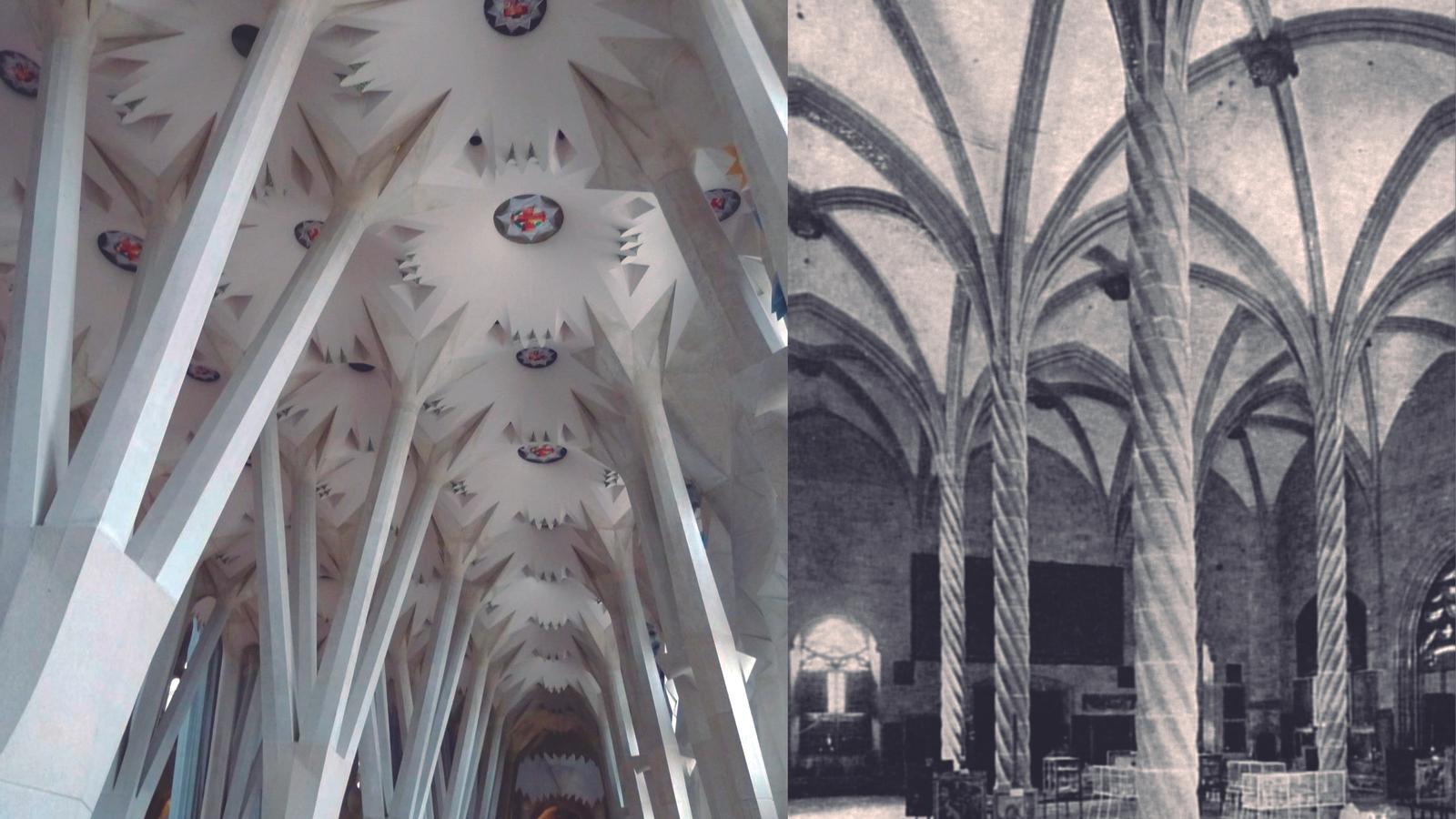
The one from Reus was equally mesmerized by the majesty of the Serra de Tramuntana. “Gaudí –affirms Torii– [...] visited the torrent de Pareis, where giant masses of crushed limestone are observed and some cave entrances that resemble the ‘Nativity Grotto’ of the Sagrada Família facade and the one also in the church of the colony of Güell [begun in 1890 in Santa Coloma de Cervelló, about 15 km from Barcelona]”. The Japanese also does not hesitate to detect parallels between the vaults inside the Sagrada Família and those of the Llotja building, designed in the 15th century by the sculptor from Felanitx, Guillem Sagrera.
Mercè Gambús, professor of Art History at the UIB, qualifies the influence of Mallorca on the work of the Catalan genius defended by the Japanese specialist. “After the Spanish Civil War, the Japanese were the first to claim the important role of nature in Gaudí’s architecture. As a fervent believer, he saw in nature a reflection of God's creative power. He was surely impressed by the landscapes of Mallorca. His mark, however, has been exaggerated. Gaudí was inspired by many things at once. He worked, above all, from images and engravings from different places that he had in his studio. Furthermore, it is known that he made few and brief stays on the island”.
The man from Reus was a man who traveled little. The excursions he made outside of Catalonia were few. At the end of the 19th century, he went to Santander (Cantabria) to follow the works of the El Capricho residence. In Castilla y León, he built the episcopal palace of Astorga and Casa Botines. His only trip abroad was to Tangier (Morocco), where he received the commission to design a complex of Franciscan missions –the project did not materialize due to lack of funding. At the beginning of the 20th century, the Catalan would frequent Mallorca more to supervise the renovation of the cathedral of Palma. However, he did not come there that much either. He delegated a lot to his collaborators, while he was more occupied with the Sagrada Família and other works such as Casa Milà, better known as La Pedrera (1906-1912), on Passeig de Gràcia.
The renovation of the Cathedral
The reform of the island temple was the star project of Bishop Pere Joan Campins. His was the most revolutionary pontificate on record, not only in the heritage sphere but also in the cultural one – he was a great defender of the catechism in Catalan. It coincided with the modernization of Palma with the demolition of the walls (1902), the inauguration of the Gran Hotel (1903), that of Gaspar Bennàssar's first graded school (1911) and the Sóller train (1912). A native of Ciutat, after having been the parish priest of Porreres, Campins assumed the supreme office in 1898, at the age of 39. He proposed to bring the Church closer to the faithful, following the openist postulates of Pope Leo XIII (1878-1903).
Aware of Gaudí's reputation as 'God's architect', in 1899 the new bishop visited him on site at the Sagrada Família, which he had been shaping for 17 years. In 1901, he was already hiring him to fill the Cathedral with light. It was the first time (and would be the only time) that the Catalan, aged 51, worked on a historic building – in Gothic style, it had begun to be built in the 13th century by order of King James I on an old mosque, by the sea. In 1904, the go-ahead was given for a reform that in 1932 would captivate Le Corbusier, the father of modern architecture, during a visit to the island. The lines of action were mainly three: reopening the blocked stained-glass windows, emptying the central nave, and moving the episcopal cathedra, hidden behind a baroque altarpiece, to the main altar, above which he placed, suspended, a sumptuous baldachin in the shape of a crown.
To reinforce the ceremonial dimension of the temple, Gaudí also designed various pieces such as furniture, wrought-iron railings, and lamps that introduced electricity to the enclosure. He did this with the help of local master craftsmen and his inseparable Catalan architects Josep Maria Jujol and Joan Rubió – the latter would be the author of the Nova church of Son Servera (1905), unfinished due to economic problems, that of Sant Bartomeu de Sóller (1904), and the modernist building of the Banc de Sóller (1909). Despite his gruff and inflexible character, the brilliant designer of impossible forms always worked in a team.

“Gaudí –Gambús points out– was fascinated by the Cathedral. The intervention he carried out there served him as a laboratory of ideas that he would end up applying to the Sagrada Família as well. For example, the choir stalls and the canopy of the Barcelona temple are clearly inspired by the solutions adopted at the Cathedral”. The works, which generated some controversy among the more traditional sectors, lasted a decade, until 1914. The Catalan genius did not attend the inauguration. A year later, the promoter, Bishop Campins, died at 56 years old. Twelve years later, in 1926, Gaudí would do so, at 73. A tram hit him while he was walking through Barcelona. He was buried in the crypt of the Sagrada Família, which now, after three generations of architects, is still in its final stretch.
Gaudí and Antoni Maura
Gambús highlights Gaudí's civic commitment. “He was an ultra-conservative man. All his work was governed by his religious devotion, but also by his love for his homeland and the Catalan language. Imbued with the spirit of Noucentisme, he wanted to turn Barcelona into the capital of the Mediterranean.” Along these lines, there is a rather eloquent anecdote. It appears in the only interview the Catalan genius ever gave. It was on August 9, 1917, for the Vilanova magazine. The Majorcan Guillem Forteza, then a young architecture student, interviewed him. At one point, the man from Reus refers to the Majorcan politician Antoni Maura, who between 1903 and 1922, intermittently, was president of the Spanish government five times during the reign of Alfonso XIII. “When I spoke to him in Catalan –he says–, he replied in Spanish. I don't understand that. Did Maura think that Catalan was a language invented by me specifically to annoy him? Speaking Catalan, for us, is a required tribute we pay to our origins. And he, speaking Spanish to me, seems to scorn the entire people who have no other expression than the language I was speaking to him and which was precisely his own.”
In Mallorca, Gaudí's modernist style would create a school. The Can Casasayas building (1908-1911), in the center of Palma, is the work of architects Francesc Roca Simó and Guillem Reynés Font and recalls Barcelona's Casa Batlló (1904-1906). This year, on the occasion of the centenary of the death of the ‘architect of God’, the Bishopric of Mallorca has made 900 documents available to the public that allow for more details about the renovation of the Cathedral to be known. It has also inaugurated the exhibition Gaudí at the Majorca Cathedral. In 2015, the documentary The Bishop, the Architect and the Baldachin (La Perifèrica) was released.
