The housing encampment returns to the Plaza de España: “No right has been achieved by asking ‘please’”
The activists accuse the City Council of prioritizing the terrace business and tourism over the citizen use of public spaces and argue that article 21 of the Constitution protects the protest

-
CAT -
CAST -
DE
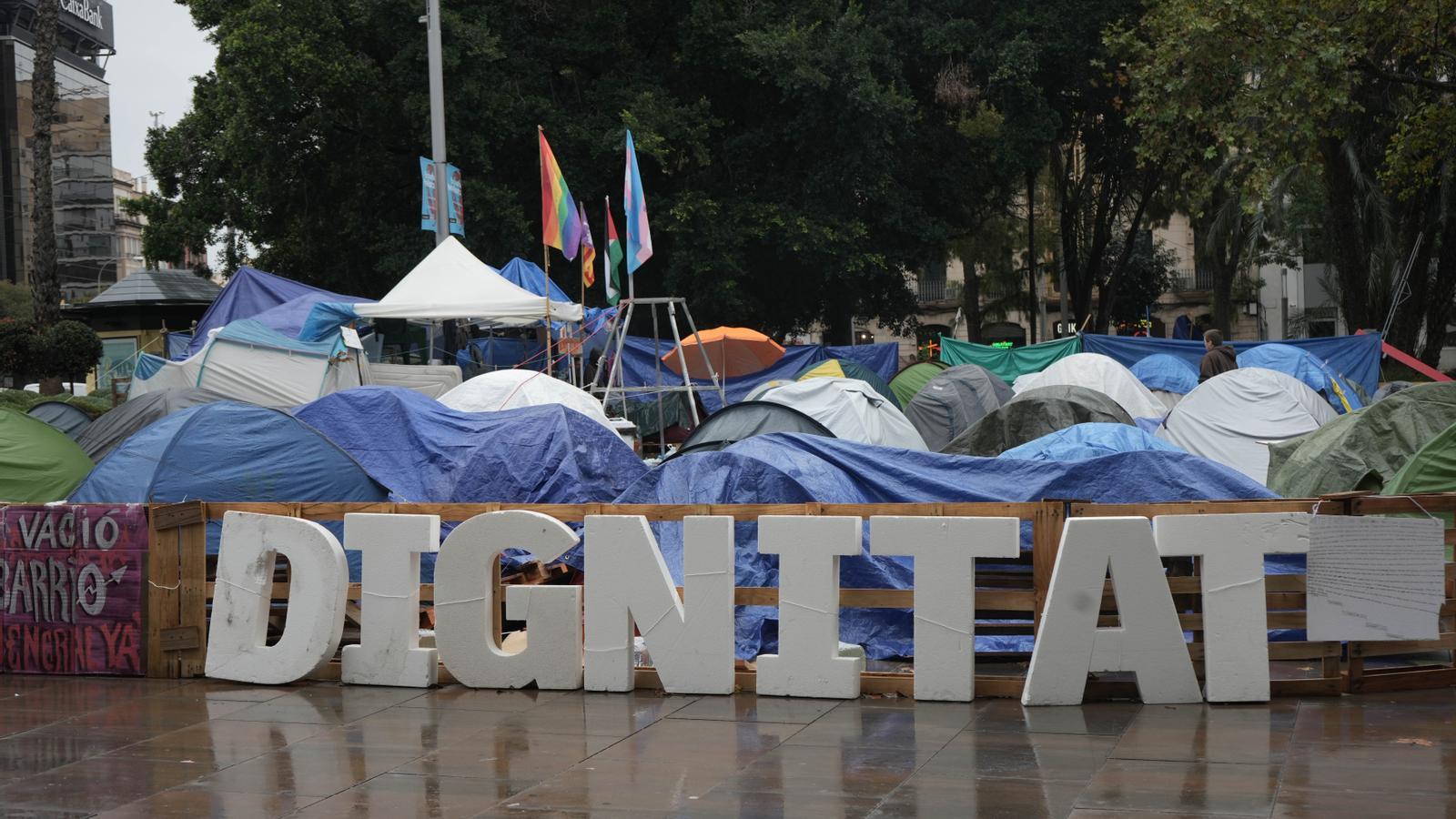
PalmaThe housing protest camp in Palma has recently re-installed itself in Plaça d'Espanya to continue denouncing real estate speculation and to demand effective measures that guarantee the right to housing. Following the actions of the Local Police and the pressure from the Palma City Council to remove the tents and protest elements, the activists have asserted the need to maintain the space of struggle and have defended that occupying public space is part of the right to protest.

“Camping to live has returned to the Plaça d’Espanya to continue exercising our right to protest”, they expressed in a statement released through social media. The collective ensures that the encampment is born from the “rage and helplessness of an entire town drowned by speculation” and that it has managed to bring together people from various parts of Mallorca who share the difficulties of accessing decent housing or who empathize with the issue.
The activists also wanted to respond to the criticisms that the protest usually receives, especially those that question the occupation of public space or consider that the encampment bothers citizens. “Protesting implies occupying public spaces, making noise, bothering, interrupting the monotony of the city and provoking the politicians who ignore the hardships of the citizens”, they argue. In this sense, the collective considers that institutions do not see squares as spaces for meeting and coexistence for residents, but as stages that must remain free of protest activity or as opportunities for visitors and businessmen who want to expand bar terraces, which often take precedence over the right of residents to make use of public spaces.
One of the main demands of the campers is that the protest has also served to recover the square as a space for socialization. The collective highlights that during the last few weeks, concerts, dance activities, acro-yoga, drawing, embroidery, sign language, theater, and poetry have been organized there, all free and open to the public. "Politicians are not bothered that a public space has been occupied; they are bothered that business could not be made from this occupation," they maintain. The activists contrast these activities with the occupation and question why they have more institutional acceptance than a non-profit citizen initiative.
The defense of the right to demonstrate
The statement also refers to the municipal actions against the encampment and to the statements of the Mayor of Palma, Jaime Martínez, who has announced that the Local Police are filing administrative reports against the participants for alleged breaches of the municipal ordinances on civility and public space occupancy. Cort is also studying whether it can once again remove the tents and objects installed in the square.
Faced with this situation, the activists argue that the protest is protected by Article 21 of the Constitution, which recognizes the right to peaceful and unarmed assembly. The Mayor, for his part, has questioned whether this right can cover the installation of tents and other elements on public roads and has demanded that the Spanish Government Delegation intervene to put an end to the encampment.
The activists assure that they will continue in the Plaça d’Espanya to demand that housing cease to be a business and that residents can continue living on the island. “We are occupying public space because no right has ever been achieved by asking ‘please’, but by taking to the streets and challenging the system that oppresses us,” they conclude.
