'Clemenza', in times of inclemency
It is not an opera of great arias, because everything distills a harmonious cohesion, where there are no musical ups and downs

-
CAT -
CAST -
DE
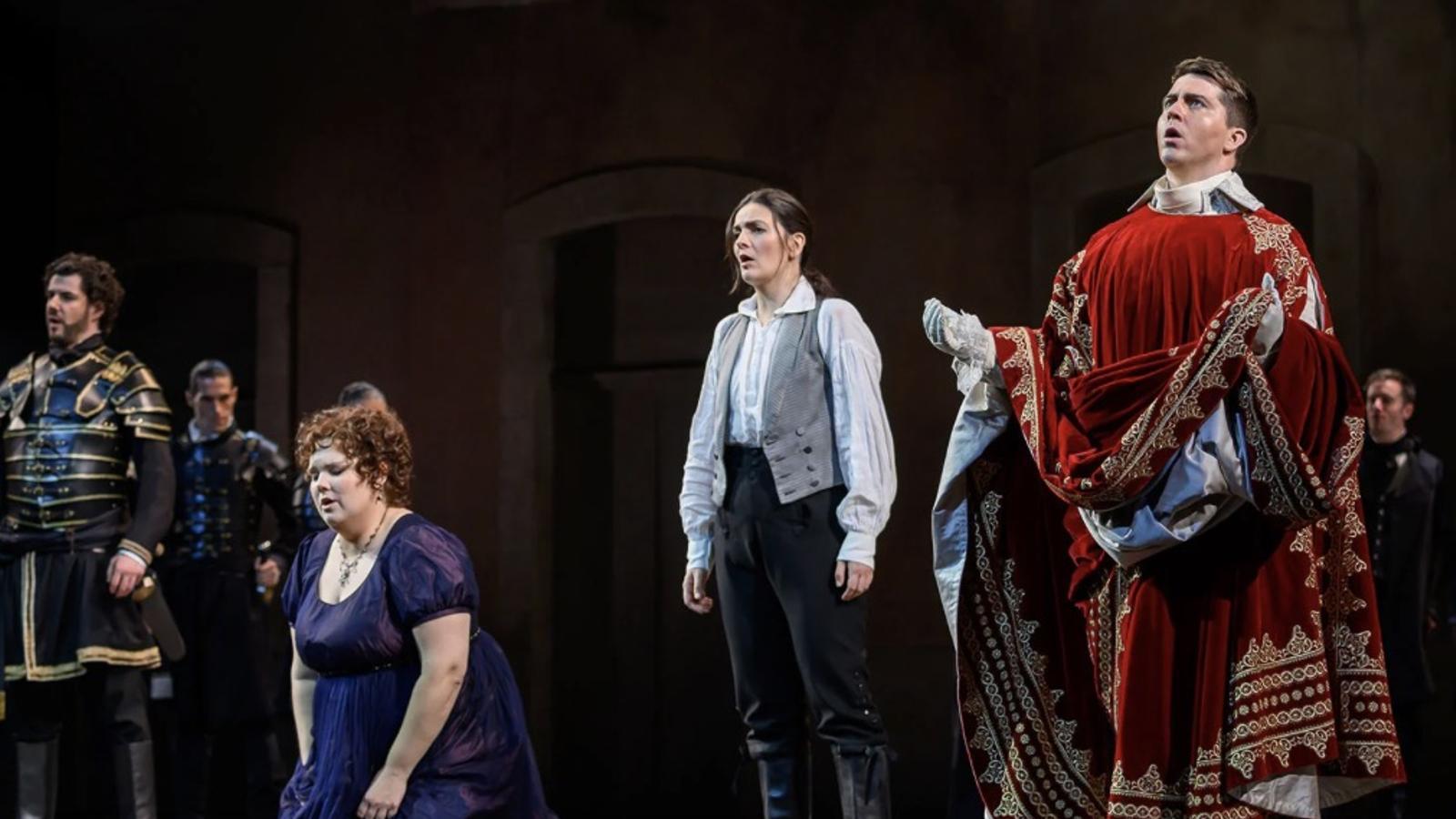
PalmaRevival at the Gran Teatre del Liceu of 'La clemenza di Tito' in the version by David McVicar that we had already been able to see in 2020. It returns with added value, such as being able to enjoy Jordi Savall at the helm of Le Concert des Nations, in his Liceu Mozartian debut, which became one of the key elements of the performance. Savall's direction was a signature of the house. Sublime and elegant, with exquisite care for the details of the score, of which there are many, with an orchestra that always uses period instruments, enhancing performance and achieving that parsimonious precision that allows us to chew with relish such beauty, that of a score both granite-like and silky. Regarding the scenic beauty to which McVicar has accustomed us, it must be said that for the occasion he seemed more focused on the stage changes and their technological aspect than on the almost Viscontian aesthetic that characterizes him. As if the location where the different chapters of the story take place were more important than the plot and its protagonists. A libretto by Pietro Metastasio, chosen by Mozart, to celebrate the coronation of Leopold II as King of Bohemia, where it speaks of love, passions, betrayals of all kinds, and forgiveness.
On the other hand, the vocal part was up to the level of the musical context, in such a way that the scenographic movements were relegated to the secondary place that corresponds to them. It is not an opera of great arias, because everything distills a harmonious cohesion, where there are no musical ups and downs, but it is worth saying that it would be unfair not to highlight the Sesto interpreted by Marianne Crebassa. A character with many emotional angles and corners, which with an immense variety of registers, the French mezzo-soprano, debuting at the Liceu, made emerge with the maximum possible efficiency. Expressive voice and rich in coloratura that broke the intrinsic homogeneity of the original with the masterful interpretation of Parto, ma tu ben mio, with which the performance took on a momentum that infected the Annio of Marianne Beate Kieland and not so much the Vitellia of Aurora Marthens, uneven in the modulations, dark and insecure in the lower notes. For his part, Jack Swanson exhibited solidity and credibility, which is not at all simple, interpreting the clement Tito Vespasiano. Regarding the Capella Nacional de Catalunya, prepared by Lluís Vilamajó, it goes without saying that in its timely interventions it achieved the same adjectives as the orchestra, with which, the ensemble achieved the essential delicacy for a story that we would like to resemble, a little, just a little, the inclement and stormy reality that surrounds us.
