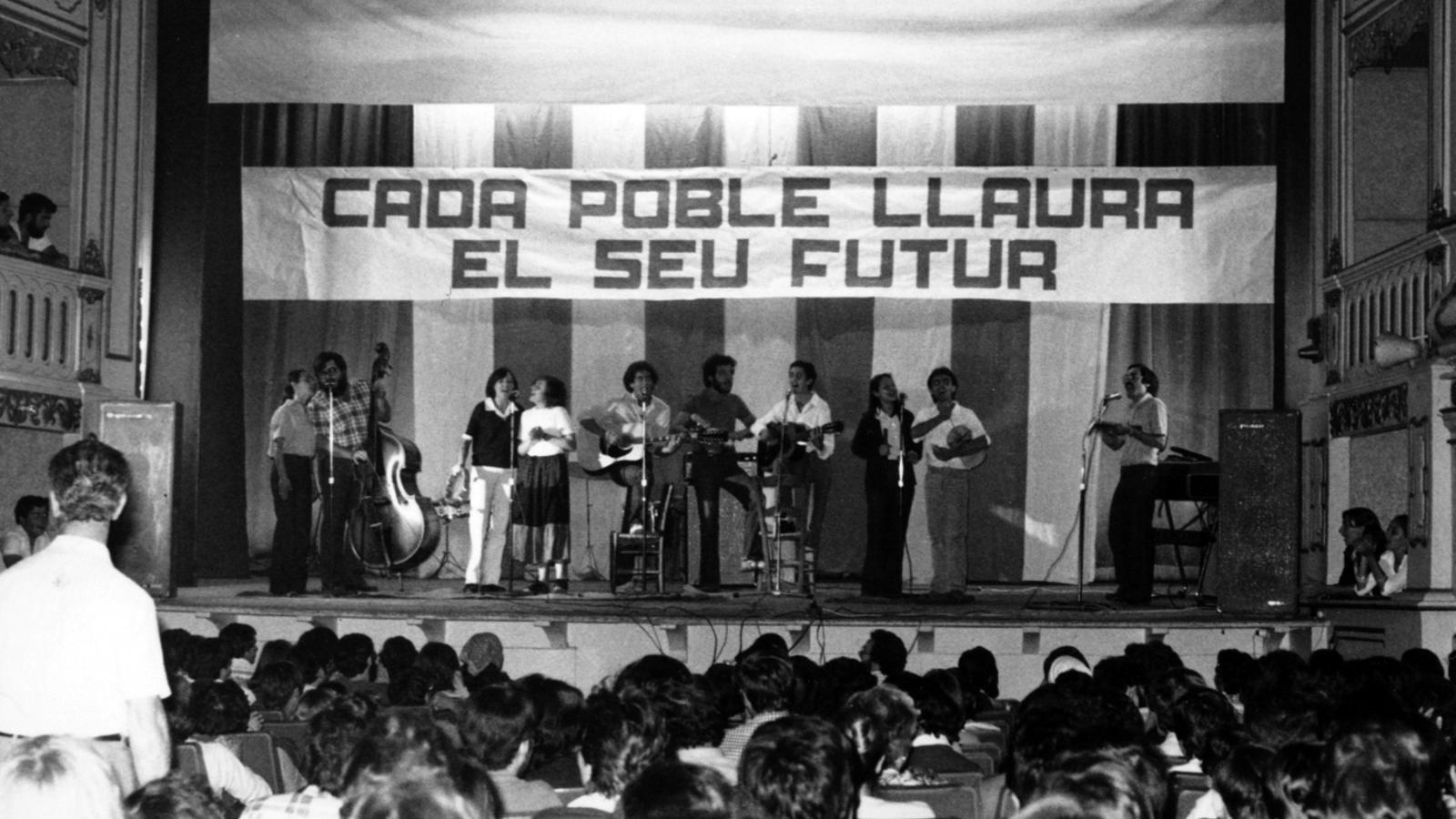
Traginada, 50 years of the explosion of traditional music in Menorca
Just as UC did in 1973 in Ibiza, in 1976 a group of 10 young people from Mahon revitalized on stage popular melodies that remained confined within the family sphere. The four years they played together were enough for them to become part of the sentimental memory of many Minorcans
5 min
Carried to the Autonomous Festival at the Principal theatre of Mahon on June 27, 1978.Javier Coll. Col·lecció La Transició a Menorca. Arxiu d’Imatge i So de Menorca-CIM
PalmaOn September 4, 1976, it had been almost a year since Franco had died. The Freginal park in Mahón hosted a festival to protest against the plans of Mayor José María Escudero to build a parking lot in that green space of the city. Then three young men, Paco Bagur and brothers Ramon and Joan Saura, went up on stage and started singing Es fantasma des Freginal. The folk-style group introduced themselves as Traginada –it is the name given in Menorca to the attics of houses where sausages are kept after the 'porcades', the slaughter.
That trio caught the attention of poets Pere Gomila and Jordi Vivet, who, a few months later, at the beginning of 1977, went to look for them to participate in the poetry recitals of the Es Mussols collective. Then it was time to ask for the collaboration of family, partners, and friends, most of them without any previous musical training. Thus, Ramon and Joan Saura (guitar and vocals) and Paco Bagur (vocals, 'guitarró' and 'simbomba') were joined by their brother, Artur (electric organ), Josep Mercadal (double bass), Magdalena Pérez (bandurria), Elena Comeche (backing vocals), Lluís Reynés (percussion), and sisters Martina and Catalina Garriga, known as Niní (vocals), who left the group in 1978 –she would be replaced by Maria Pau Bagur, sister of the other two Bagurs.
The story of that group of young people can be followed in the documentary Traginada, l’esclat d’un poble (2019), directed by Magda Timoner. “Their merit –says Timoner– is that they brought to the stage the traditional music of Menorca that until then people only sang in their dining rooms at home or sitting on a stone bench in the street. Furthermore, they were songs that were only transmitted orally and that they recorded on discs and cassettes for the first time, which has allowed new generations to know them”. Historian Miquel López, screenwriter of the documentary, offers more details about the group: “The members never considered turning professional in the musical field. They took it as a hobby, because everyone continued with their jobs. In general, the money they had to pay out of their own pockets was more than what they earned”.
Musical warmth
The emergence of Traginada in the midst of the Transition was not an exception. In Ciutadella, the group C.P.E.P (Paleontological, Etymological and Prophylactic Community) had begun to champion the use of traditional Menorcan popular music with a more festive character, detached from the rigidity and alleged authenticity of folk groups. “C.P.E.P –the researcher states– managed to record an album, but it did not have the technical means or the reach of Traginada, which had the Manacor-born composer Antoni Parera Fons as producer”. In Maó, there were also the groups Arrels and S’Eixam and the Camí d’en Barrotes Neighborhood Association, which were the first on the island to dance the fandango in updated street clothing. Likewise, the Ciutadella-born Maria Jesús Martí, settled in Barcelona –granddaughter of the Menorcan folklorist Francesc Camps i Mercadal– opted for a less folkloric model with the album El tresor d’Albranca (1979).
Traginada played a significant diversity of genres, all in Catalan: from romances (Na Cecília, Na Roseta), jotas and fandangos (Jota des Mercadal, Fandango de sa Somereta) to lullabies (No-ni-nó, Lluna la pruna) and humorous songs (Anem a Xauxa, L’anqueniero (Sic), Cançó de sa cuinera). They also had other traditional popular songs that they recovered from the working-class repertoire of the late 19th and early 20th centuries (Fora de sa ciutat, Sa festa des pobres, Cançó des sabaters). This is confirmed by musicologist Jordi Orell, the other screenwriter of the documentary: “For the occasion –López asserts– they did a huge research task among the elderly, similar to that carried out by the group UC in 1973 in Ibiza. They also knocked on the doors of more orthodox musicians and recovered the works of folklorists Francesc Camps i Mercadal and Andreu Ferrer i Ginard, largely unpublished at the time, which in 1912 they had compiled for the folklore contest organized by the Ateneu de Maó”.
The Mahon group also popularized pre-existing songs (by other authors) (Sa vida d’un berguiner, Aubada, No-ni-nó) and incorporated self-composed music into existing lyrics (Sa despedida) and vice versa (Sa monja per força, Sa nuvia). In other cases, they created it from scratch, such as the Rumba menorquina (with the participation and composition of guitarist Ernest Pagès and lyrics by Damià Borràs) and the fandango L’amo de Son Carabassa. “They used to change –notes Orell– the well-known lyrics of the songs to give them a much more protest-oriented, critical, and humorous content. They even won competitions, beating other much more traditionalist groups, and always, as was typical of the era, they sang with the prior approval of the censors. They performed many more songs than they recorded”.
“What defined Traginada the most –highlights the musicologist– was its deliberate manipulation of the songs in favor of seeking a certain modernity. Their instrumental arrangements were especially characterized by the use of an electric organ, a double bass, and a wide range of percussion instruments such as bongos, congas, etc. The treatment of the voices was also quite paradigmatic, sometimes very choral and other times with a marked solo profile within a group with very diverse vocal timbres. From the more classical and affected voice of Martina Garriga to the nasal and direct voice of Paco Bagur”.
Carrying at the Taula of Talatí de Maó.Menorca Image and Sound Archive-CIM
1977, the year that Traginada began its concert tour through Menorca, coincided with the birth in Mallorca of the children's music group Cucorba. The Menorcan band would also share the same playful philosophy. “They were –notes Orell– absolute pioneers in organizing various parades through the towns that were reminiscent of those of the company Els Comediants in Catalonia. They did so, however, as individual members, not in the name of Traginada. Under the impetus of activist Jordi Vivet, they put on circus shows with a lot of little boys and girls following them. Until then, the parades that had been seen on the island were led by giants, big-heads, and the municipal band, which were much more rigid and institutional elements”.
Traginada also promoted another unusual festive model in Maó: the well-known ‘gastronomic festivals’ in the street, dedicated to zucchini, snails, small birds, and octopus. “They were festivals –states historian Miquel López– that included multiple musical proposals and not just their own. They were born to pay the fines imposed by the regime on some companions. Throughout four editions, they broke the existing monotony and led society to shed its complexes. They were a success in terms of participation”.
“Pied Piper of Hamelin”
With the Puput-Zafiro label, Traginada recorded three vinyls at the prestigious Gema 2 studios in Barcelona: Menorca (1978), Pels camins de Menorca (1979) and Cançons de Menorca (1979). “They left,” says López, “a strong mark on a market like the Menorcan one, with a very low share of local production. However, they only performed one concert outside the island, at the festivities of the Calatrava neighborhood in Palma in the summer of 1977. In 1981, they gained considerable notoriety following the documentary in Catalan that Televisión Española made about them. They appeared in it performing songs from their records at various locations in Menorca.”
Finally, in 1981, the group decided to disband. “There was no apparent conflict,” the researcher stresses, “even though not all members shared the same position. The intensity of the four years of life and the attempts by the record label to hold more concerts outside the island clashed with the fact that it was a group of ten people who had not professionalized.” Throughout the years, the Mahón band participated in numerous protest and political events and always performed with a Catalan flag with their name hanging from the keyboard. In the words of Paco Bagur, the group's most charismatic voice, “it was a time when political parties were not legalized and musicians acted as political parties. When the political parties were legalized, we stopped doing activism.”
Some members of the group ended up participating in politics, while others remained linked to music. “Traginada,” concludes López, “acted as a channel for all the euphoria and yearning for political, cultural, and sexual freedom that was unleashed after Franco's death. It was capable of cohering part of the Menorcan society under the recovery of a culture that had to be brought out of the darkness. According to the poet Damià Borràs, linked to the group, ‘it was the Pied Piper of the people's illusions at that time’.”
The heirs
The shadow of Traginada over the current musical landscape of Menorca is very long. This is asserted by Magda Timoner, director of the documentary Traginada, l’esclat d’un poble (2019). “They created a school when it came to dignifying traditional culture. Their legacy is immense in Menorcan artists like Cris Juanico, Maria Camps, Clara Gorrias, Miquel Mariano, Moisès Pelegrí, Joan Carles Villalonga, Marco Mezquida, Annabel Villalonga, Guiem Soldevila and Anna Ferrer. In 2019, some paid tribute to them with a series of concerts, which were later captured in the form of an album titled Menorca canta. Homenatge a Traginada. They were very emotional concerts”. Last October, coinciding with the 50th anniversary, the group was recognized with the Enderrock Award of Honor for Balearic Music.
During the tourist boom, while traditional music remained confined to the home, Francoism took charge of selling the well-known white and blue island with tourist songs. Thus, in the summer of 1964, with a clear propaganda will, Foment de Turisme promoted the Menorcan song festival, popularly known as the Alaior song festival. That same summer, the Mallorca International Song Festival was also born, as an imitation of other world references such as San Remo (1951) in Italy, Eurovision (1956), Benidorm (1959) and the Mediterranean Song Festival (1959) in Barcelona.
The Menorcan song festival had a short but intense life – it lasted four editions, while the one in Mallorca lasted six. Its rules also stipulated that only unpublished songs with explicit references to the island's landscapes could be presented. The winner of the first edition was Magda Sintes with Un amor en Menorca. The following year, Sintes triumphed again by performing Adiós a la isla, by Gumersind Riera and Ortega Monasterio. In 1966, in the third edition, a song in Catalan was popularized for the first time, Escolta es vent, which came in second place, behind Volveremos, sung by José Maria Planes. With music by Ortega Monasterio, lyrics by the Mahon poet Tòfol Mus, and voice by Manuel, today Escolta es vent is one of the most iconic pieces on the island.
The winner of the last edition of the festival (1967) was Vuelvo a Menorca, performed by Los Íberos. On that occasion, among the finalists were two pieces in Catalan: Cançó d’enyorança, by Núria Espinal, and I ara què?, by the Manacor-born Antoni Parera Fons. The paradigm shift arrived in the early 70s, with Francoism agonizing. Then, Musical Youth of Ciutadella organized summer festivals with prominent figures of the Nova Cançó such as Lluís Llach, Ovidi Montllor and Maria del Mar Bonet. In Menorca, the Ciutadella-born Maria Àngels Gornés and Isaac Melis would stand out as singer-songwriters.