Four days of all-inclusive literature in Magaluf
The FLEM reinforces the presence of international authors and those from the Islands and takes a step further with a novel prize in Spanish, literary residencies and professional conferences
-
CAT -
CAST -
GER
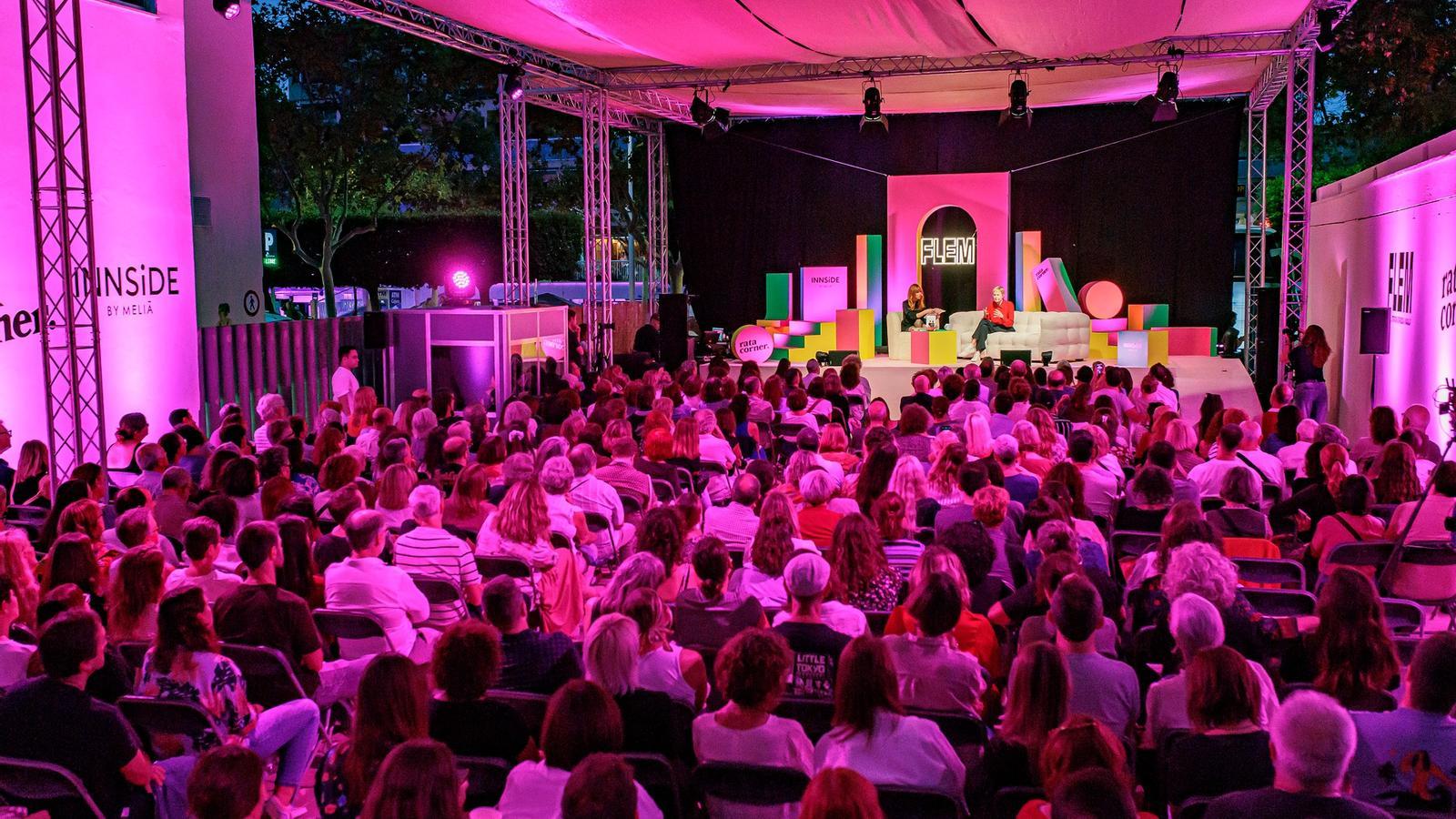
PalmaReading a book on a toy surfboard in a wave pool at a hotel on one of the most overexploited beaches in Mallorca. This is how the sixth edition of the Magaluf Expanded Literature Festival, the FLEM, is being promoted, which will take place from October 1st to 4th in one of the world's epicenters of excess tourism. The hook is clear: literature can also be fun, and the FLEM has come to provoke and break the schemes of classic festivals, against academicism and against solemnity.
The FLEM, organized by Rata Corner and the hotel chain Melià, reaches its sixth edition installed in a paradox that is also its main source of interest: it claims literature as a tool for transformation from the very heart of a tourism model with profound impacts on the territory and society. Between swimming pools, hotel rooms, and books, the festival will attempt from October 1st to 4th to expand literature beyond reading rooms.
The international presence is one of the main lures, and this year features prominent names such as David Foenkinos, Anna Todd, Anna Hope, Aria Aber, Ben Brooks, and Lara Pawson. Heterodox mixtures are not only not feared by the FLEM, but they are a hallmark of the house: the Catalan content creator Juliana Canet will kick off the conversations with international authors by interviewing the French novelist and screenwriter David Foenkinos, author of the renowned Delicacy. It will be Friday the 2nd at 7:30 PM. The next appointment with an international author will be Saturday, October 3rd, at 11 AM, when the English author Lara Pawson –author of Luz de paso–, will converse with the Manacor-born writer Aina Fullana. One of the highlights, without a doubt, is the presence of the bestselling author of the After series, Anna Todd, who will also be at the FLEM on Saturday courtesy of the director of Cosmopolitan magazine, Cecilia Múzquiz, in her only visit to Spain this year. The After series has been published in thirty-five languages, has sold more than twelve million copies worldwide, has reached the top spot on several international bestseller lists, and has set its latest work, Sunrise, in Mallorca. Journalist Marta Terrassa will moderate the conversation between one of the most recognized young authors of Anglo-Saxon narrative, Ben Brooks, and the German poet and novelist of Afghan descent Aria Aber.
While the presence of state-based creators is the most numerous—with 19 out of 32 authors—another hallmark of FLEM is not to categorize or organize events based on the origin of the authors. Thus, the program combines meetings, conversations, and book signings among literature created from all over the world, from the Spanish state, and in the Catalan language. In fact, the festival will kick off with a conversation between the Majorcan journalist Xisco Nadal and the Valencian writer Elisabet Benavent, author of the saga Valeria, brought to screens via Netflix. The Galician Rodrigo Cortés; Luis Mario (Cantabria, 1992); the creator of the creative universe of the detective Petra Delicado, Alicia Giménez Bartlett; the journalist Daniel Verdú; the film critic and writer Desirée de Fez; the screenwriter and novelist Eduard Sola; Ana Garriga and Carmen Urbita—podcasters of Las hijas de Felipe–; Enrique Rey; Carlos Bardem; Belén Segarra; Lyona; Rayden; Raquel Congosto; Marcos Giralt; Lana Corujo, and the paleontologist Juan Luis Arsuaga complete a kaleidoscopic and multifaceted lineup of literature in Spanish.
To rectify is human, and FLEM has been increasing, edition after edition, the presence of local authors and those in the Catalan language. Gabriel Janer Manila, Biel Mesquida, Aina Fullana, Laura Gost, Olívia Lund, Joan Miquel Oliver, and Jaume Oliver provide an island presence on a stage that also amplifies the literature created in Catalan from Mallorca. 'Tecnohomenatge a Biel Mesquida' promises to be one of the central events of the festival. The recently awarded winner of the Honor Prize for Catalan Letters will be the protagonist of a techno-recital in which Clara Fiol and GYE will navigate between poetry, music, and electronic sounds to recognize the author of L'adolescent de sal.
As is customary, literary conversations will be only one part of a program that once again expands into music, art, podcasts, and new performance formats. One of the great protagonists will be Rodrigo Cuevas, National Prize for Contemporary Music winner, who will arrive in Magaluf with Al pie del llar, a proposal in an intimate format in which he connects tradition, music, and the spoken word.
Tiu will also perform, while Maria Hein will be in charge of providing music for the opening ceremony of FLEM on Thursday, October 1st. The program also incorporates 'Joan Alcover, la paraula viva', a proposal by Tallats de Lluna that recovers and brings the words and work of the Majorcan writer closer to the present.
There will also be a Literary Karaoke, a Murdoku Tournament and Quadernit will return, the quiz from the creators of the Cuaderno de verano para adultos by Blackie Books which has already become one of the festival's classics.
New literary award and residency
The main step forward for this sixth edition, however, will not be found on any stage. FLEM is launching the FLEM-Magaluf Novel Prize, endowed with 10,000 euros, the publication of the winning work with Reservoir Books, and a presentation tour through different cities in the country. The first call for entries has received more than 170 manuscripts, and the verdict will be made public during the opening ceremony. The award, promoted with Penguin Random House and the Calvià City Council through funds from the Sustainable Tourism Tax, marks the festival's entry into the creation, editing, and direct dissemination of new works, although only in Spanish.
In this same direction, the literary residency program is also being launched, with Mar Picó and Amani Saeed. Both authors have been able to develop their creative work in Magaluf and will participate in the festival. The prize and residencies thus point to a new aspiration: to stop being just a great showcase and become a platform capable of generating literature and maintaining activity beyond the four days of programming.
Completing this commitment is FLEM PRO, the professional day that will bring together authors, editors, booksellers, and cultural agents on Friday. It will address the challenges of writing, editing, publishing, and communicating literature, and will present reading promotion projects driven by prisons, schools, libraries, and reading clubs. The challenge will be for the announced connections not to end with the last coffee of the day, but to translate into collaborations and opportunities for an island publishing sector conditioned by insularity.
Stage, experience, and secret rooms
But that's not all. Podcasts will once again occupy their own space, as one more element to showcase literature beyond printed books. Among the proposals: Club Tàndem, the 3Cat program hosted by Juliana Canet and Marina Porras, which will dedicate a special edition to 39 graus a l’ombra, by Antònia Vicens. Also, Mucho Texto and Guarida y Tapete will be recorded live, in a new demonstration of the festival's desire to take books beyond conventional literary conversation and connect them with new formats of cultural consumption.
Art will once again occupy the Secret Rooms, rooms and other spaces at the INNSiDE Wave Calvià temporarily transformed into installations and artistic experiences. There will be proposals by Boa Mistura, Lyona, Tamara K. Lloyd Cox, and Belén Segarra, in addition to the Flash Day Tattoo by Nil Marqués. The FLEM will also repeat the collaboration with the Fundació Miró Mallorca through Miró efímer: Bel Fullana, Albert Pinya, and Laia Ventayol will create interventions conceived to disappear, in dialogue with the experimental and fleeting character of some of Joan Miró's actions.
Between conversations, music will continue on the different stages with sessions by Cobie, Aina Losange, Som Vinils, Jimena Grock, and Biel Bibiloni. The whole set depicts a festival that long ago stopped considering literature as an isolated discipline: it makes it coexist with electronic music, tattooing, urban art, cinema, podcasts, and even karaoke.
Magaluf, a geographical space that turns stigma into an attraction
The FLEM will also leave the hotel again to try to incorporate the longed-for, touristified, and stigmatized Magaluf into the narrative. Tomeu Canyelles and Biel Vives will lead a route to explain the history and transformations of the tourist center, while Rotuïlla will explore its graphic and typographic heritage. An activity with the Red Cross will raise awareness of the wetlands and natural heritage that often remain hidden behind the international image of sun, alcohol, and excess. The underlying question, however, will continue to hover over the festival: whether these initiatives contribute to transforming Magaluf or if they only offer, for four days, a friendlier face.
