From Iran or Algeria: what Arab musicians bring to the Islands
Formations like Qanat or Muqawama, born in the Balearic Islands, have served to establish bridges between musicians and melodies from around the world
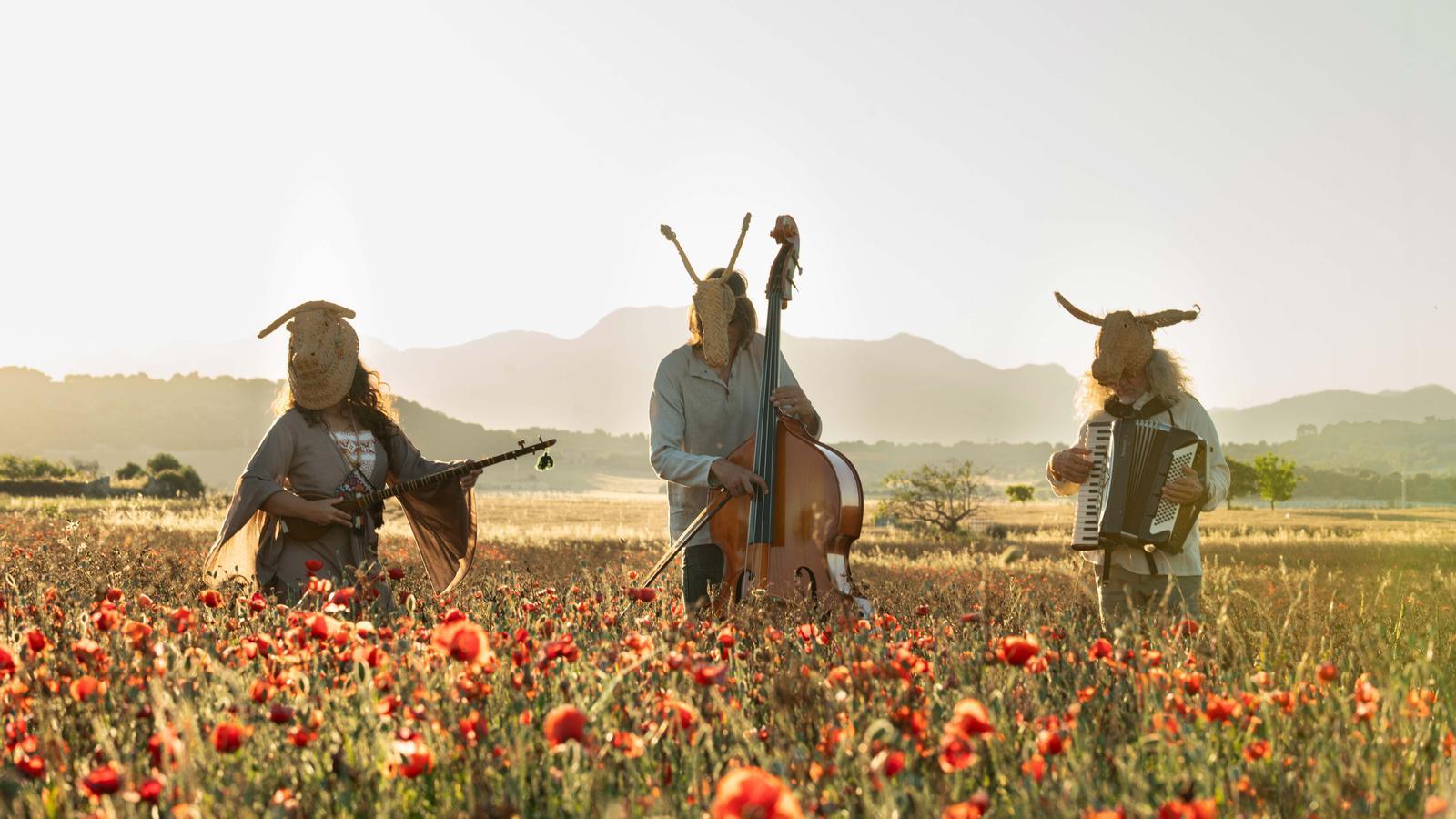

PalmaPegah Khoei, born in Iran 41 years ago, says that the song 'Tonada de collir figues' was one of the melodies that, when she arrived in Mallorca six years ago, made her feel at home. "It has vibrations that transport me to the sounds of Iran, especially those of the west of the country," she shares, although she immediately qualifies that it is by no means the only one. This is demonstrated by the fact that 'Figues de Tadjikistan' is just one of the eight tracks that make up 'Aigua ballant', the first recording by the group Qanat, a trio where Khoei, along with Tomeu Gomila and José Miguel Puigserver, weaves bridges between traditional Balearic music and Persian and Byzantine melodies. Thus, on the album, one can hear tracks like 'Fandango Bandarí' or 'Sant Antoni de Khorasan', which manage to sound both new and traditional. "It might seem that we are far apart, but it is enough to listen to the traditional music from places like Mallorca and Iran to realize that the roots are the same. We have more in common than differences between us. For me, it was enough to listen to the recordings of my partner's grandmother to see it clearly. Hearing her sing the work songs transported me directly to the sounds I had heard all my life in our home," she shares.
This singer and musician, a resident of Lloret de Vistalegre, left Iran when she was 17 with the intention of expanding her studies. After passing through Turkey, Cyprus, and Valencia, she landed in Mallorca in 2020 by chance. "I had met a musician in Turkey who turned out to live in Mallorca," she explains, "and since I returned to Iran periodically, he asked me to bring him a traditional instrument on one of those trips. When I came to Mallorca to bring it to him, COVID arrived and I couldn't leave, but I immediately realized that it was a good place to live, that I felt very close to the people and the culture here."
It has been some time since Pegah Khoei could return to Iran and she acknowledges that since the outbreak of the war she has not had direct contact with her relatives, who live in Tehran. “I have to contact a person who, if there is a little luck, can contact them and let me know they are well, but they have cut off all communication channels I had with them”, she admits emotionally. It is enough to say the word music again, however, to cling to the little hope she still holds, despite the harshness of the conflict. “There is a lot of confusion among the Iranian people; there was already before the attacks ten days ago”, she shares, “but I believe we all agree that we want neither fire nor war, we want peace. Sharing art and songs can be a way to generate it, to create bonds between people. Sharing life, culture and beauty: it is the only way to build a future together”.
Exceptional cases
However, the existence of Qanat is almost an exception within the musical landscape of the Balearic Islands, where the cultural diversity that currently nourishes the Archipelago is rarely reflected. And this, despite the fact that in the late 80s, pioneering groups in this regard existed, such as Wonkhaï Palma, an Afro-Majorcan group formed by Oscar Pla, Mané Capilla, Michel Sanmartí, Omar Niang, Lansana Soussoko, and Samba Gano. The band was one of the participants in the final of the Pop-Rock contest in 1989 and also in the famous Nit de rock illenc (Island Rock Night) that took place at La Feixina in January 1990, as part of the Sant Sebastià festivities. Today, however, musical and cultural fusion is still very limited in the Balearic Islands.
José Miguel Puigserver, better known as Púter, knows this well. In addition to being part of Qanat, he is one of the members of Muqawama, a band that he himself defines as "a musical Tower of Babel." Formed in 2018 in Sineu, its members include musicians like Jaume Compte and Àngel Garau, who joined the project initiated by Puigserver and Rabah Ourrad, a musician and cook from Algeria who had arrived in Mallorca after passing through Paris, London, and Barcelona. "I had always wanted to experiment with hip-hop, which was a genre I really liked, but I had never tried it. It turned out that in the same town as me lived Rabah, who had been the leader of the pioneering hip-hop band in North Africa, MBS. We were introduced, and a couple of days later we were already in the studio, testing and mixing, integrating sounds that interested both of us and experimenting together." The group's name, in fact, is well-intentioned: "Muqawama means resistance in Arabic," explains Rabah Ourrad from Algiers, where he has resettled, without losing his connection to Mallorca, which he defines as his second home. "The group is both a musical resistance, against the mainstream that dominates everything, which leads people to no longer even sing, just to put autotune everywhere, but it is also a resistance against the far-right that tries to dominate the world again. We resist this idea of neocolonialism that is imposed and that seeks the abandonment of everything that makes us human, from empathy to diversity, including, of course, culture," he explains.
“Music made in Mallorca is going through a significant period of weakness”, reflects Púter, “because you have no opportunities to play anywhere and thus it is difficult to encourage creation. But, in general, there is a lack of musical culture and there is also no real interest in getting to know other cultures. We are disconnected, as if the music from North Africa had nothing to do with us, when we are as far away, or as close, to Algiers as we are to Barcelona. The Mediterranean is not a border, it should serve as a cultural highway, but it doesn’t seem like we want to take advantage of it”.
