Talayotic Menorca wavers
The dismantling of the agency that has to manage it and the disobedience to UNESCO in the protection of Rafal Rubí threaten the universal recognition of some archaeological sites that receive half the visitors as before the declaration

-
CAT -
CAST -
DE
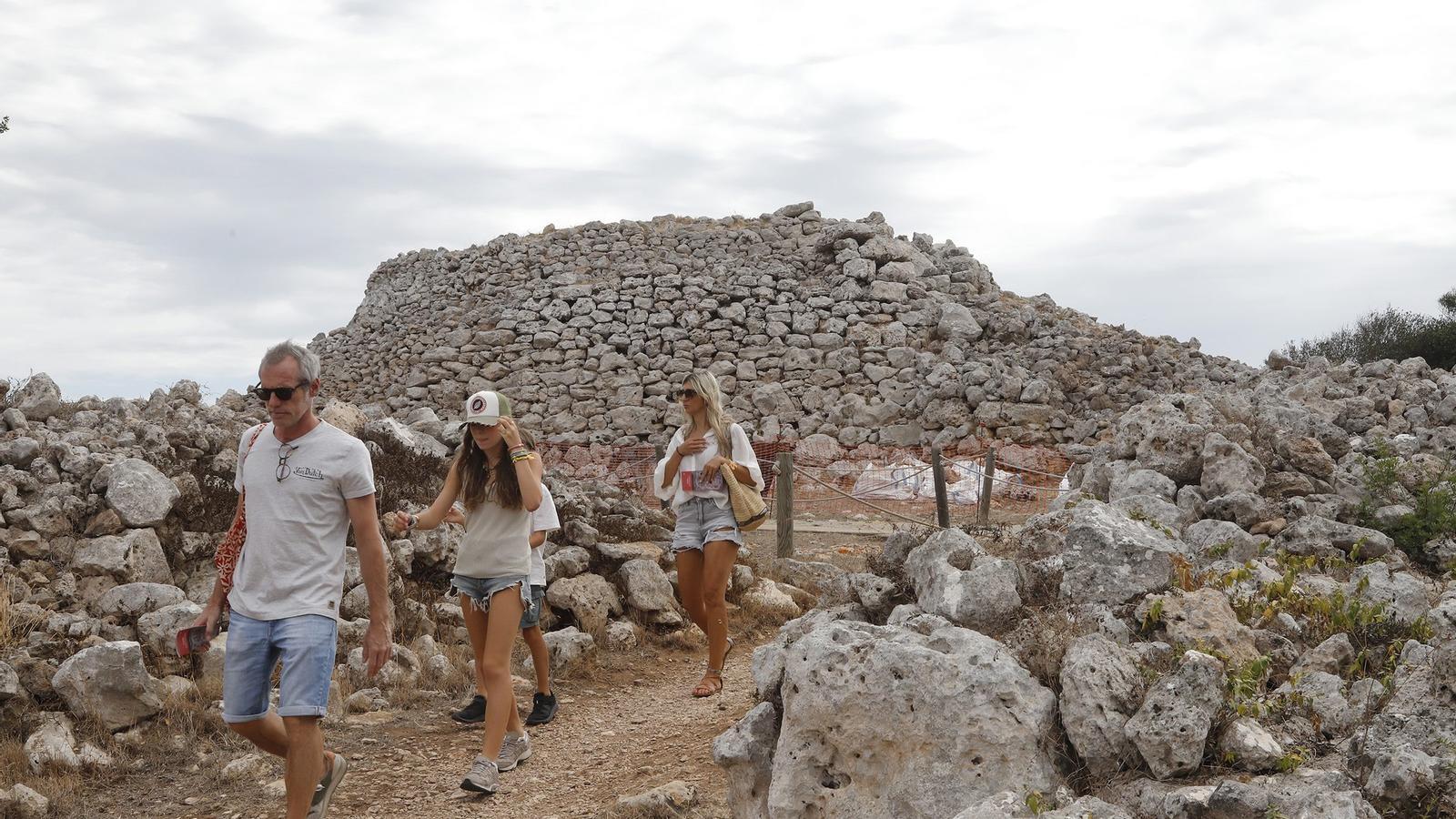
PalmaThe monuments included in the Talayotic Menorca World Heritage receive almost half the visitors as before obtaining international recognition from UNESCO. The archaeological sites, which in 2023 – the year of the declaration – recorded 81,201 visitors until the month of August, have only registered 47,814 this year. It is almost half of the 93,781 visits received in 2024, the year with the highest turnout so far. For the Menorca Tourism Promotion Foundation, it is due to the heatwave this summer. But both experts and the opposition see other even more decisive causes.
The PSOE says the origin lies in the resignation, a year ago now, of the director of the Menorca Talayotic Agency, Antoni Ferrer, a position that has not been filled since then, as the entity has been "dismantled". It also points to the friction that the PP government at the Council has maintained at all times with UNESCO due to its decision to disobey the international organization and complete the Rafal Rubí viaduct, which directly affects the prehistoric navetas in the area, included in the World Heritage inventory. The bridge has finally been built and the Menorcan entities that opposed it fear it may have consequences.
Lack of promotion
But there is also a lack of promotion. “When a person arrives in Menorca, neither at the airport nor anywhere else is there a single sign or a Unesco logo indicating that we are a World Heritage Site or a Biosphere Reserve,” criticizes the promoter of the declaration, now retired, Margarita Orfila. The professor of Archaeology misses the fact that the Council has not taken the opportunity to disseminate it through social networks, that it has not created its own channel, and that no company has been interested in taking commercial advantage of it either. Orfila believes that the example of Malta should be followed, where each site has its own interpretation center that explains it in an understandable way to visitors. “We are still in time,” she says, but she warns that investment is needed.
Quite the opposite of the case of Menorca, the archaeological site of the Antequera dolmens (Malaga), which competed with the Menorcan candidacy in its race to be a World Heritage Site, has more than doubled its visits since the declaration. Last year it counted 170,289, when, before the recognition by Unesco, it only registered between 56,000 and 95,000 annually. The Department of Culture of Andalusia attributes this to the programming of activities and the initiatives for conservation and dissemination of the site that have been carried out there for ten years. In fact, only the Torcal natural area receives more visitors each year in Malaga than the dolmens. Since the director of the Menorca Talaiòtica Agency resigned in August 2025 – in disagreement with the decision not to demolish the Rafal Rubí bridge – the situation has worsened. For unexplained reasons, the Council has not filled the position and, with no one in charge, the care of the sites included in the World Heritage and their management has diminished. The agency has been left with only one administrative assistant and the Menorca Tourism Promotion Foundation has assumed the tasks of promoting the Menorca Talaiòtica when, statutorily, it should already be disregarding this matter.
Logically, the management of visitors and informers should be done by the agency itself, but right now it is a quasi-non-existent body. The lack is evident in the very structure of the Council’s Heritage department where, despite the recent World Heritage declaration, the staff has not been increased and only two of the four technicians currently working there are archaeologists.
In fact, there has been no progress in finalizing the custody contracts that must be formalized with the owners of the archaeological sites to regulate the conditions so that they can manage visits to them. 20 of the 23 monuments included in Talayotic Menorca are privately owned, but all the owners are still waiting for the Administration to find out the obligations they must assume and how they can monetize visits to the sites. Right now, only four – three of which are privately owned – charge an entrance fee: Torre d'en Galmés, Talatí de Dalt, Torralba d'en Salort, and the Naveta des Tudons.
Not even the construction of the Talayotic Menorca interpretation center, promised by councilor Joan Pons Torres upon taking office, has been able to become a reality. The flagship project of the PP government to spread the archaeological wealth of Menorca among tourists has run into administrative and public tender obstacles. The first tender remained empty and the Council has had to revise prices upwards to guarantee its award. The works to convert the institution's headquarters in the Plaza de la Catedral in Ciutadella into the headquarters of Talayotic Menorca will cost nearly two and a half million euros and will extend over the next year and a half. According to this forecast, in the best-case scenario, its doors will not be able to open until the first half of 2028.
But the outlook for Talayotic Menorca could worsen even further if the Unesco World Heritage Centre decides to take measures that threaten the universal recognition granted to the island in September 2023. Although the Council has sent the files translated into English to Paris to justify having prioritized road safety over the protection of heritage in the case of Rafal Rubí, all the parties consulted take for granted that there will at least be a slap on the wrist from Unesco. "It is one of the few times that the island government deems an in-house report good, when throughout the mandate it is used to commissioning them externally so they say what it wants," comments an internal source at the Council.
Before the year ends, the island institution must send a report to UNESCO justifying the measures it has taken recently, including the Rafal Rubí viaduct, which ended up ignoring the repeated warnings from the international organization. The Ministry of Culture, as the only valid interlocutor for Talayotic Menorca before UNESCO, will have to cushion the blow to ensure that the island does not lose the seal that it took so much effort to obtain.
