The perennity of a human and universal work
After a process of sincerity, which discovered his own voice to him, Joan Alcover consolidated himself as a poet in Catalan
-
CAT -
CAST -
DE
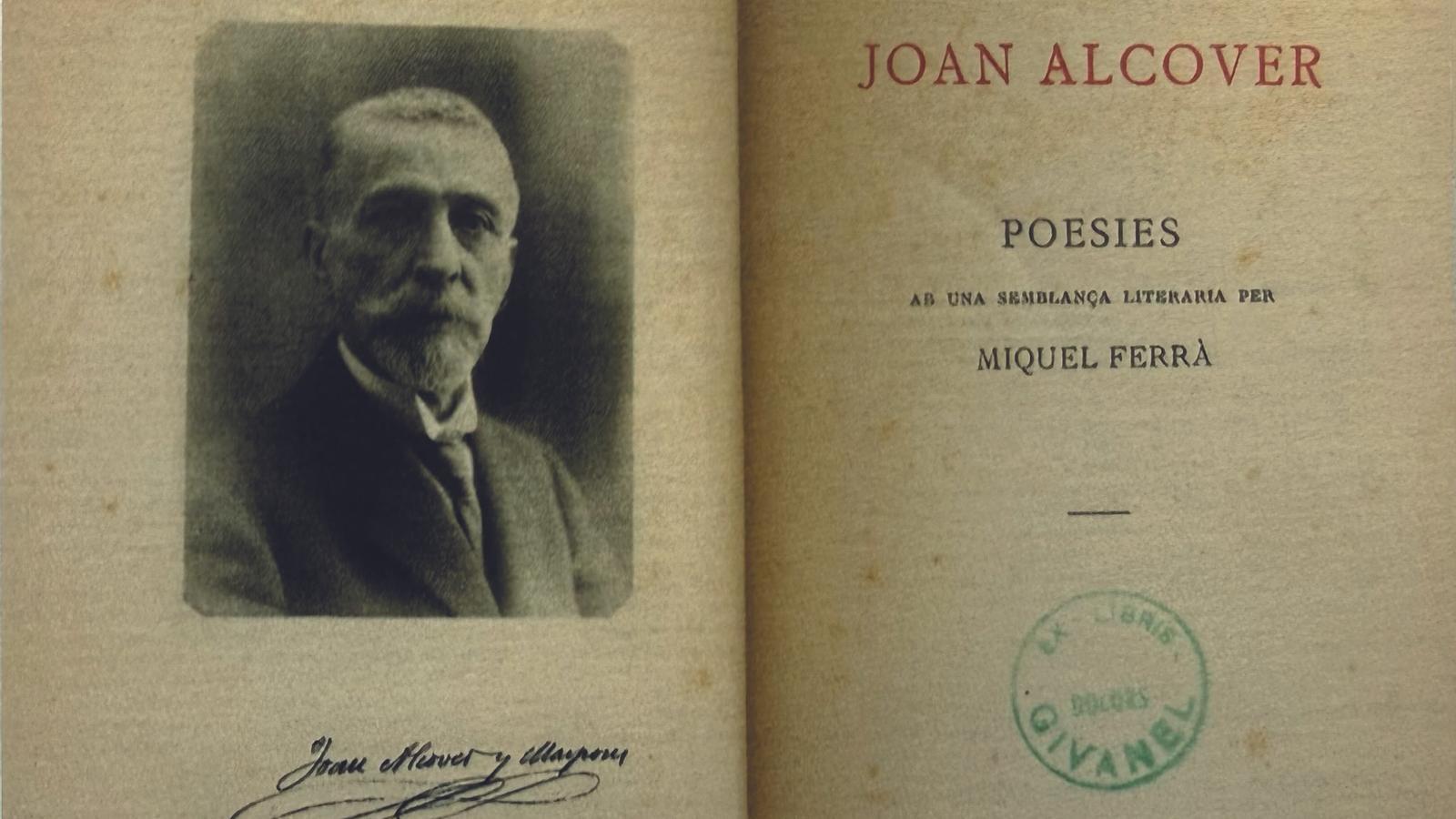
PalmaJoan Alcover Maspons made his debut as a poet and literary critic in both Spanish and Catalan in Revista Balear, Museo Balear, and El Isleño. His poetic work spans from his ingenious foray into Spanish lyricism to the discovery of his own voice which, after a process of sincerity, established him as a poet in Catalan. He had understood that “the sound of the harp is the echo of an inner rhythm”. The change of voice, accompanied by a linguistic shift, was motivated by the death of his daughter Teresa in 1901, following the loss of his wife Rosa Pujol. This event triggered a crisis in the man, which coincided with the crisis of the artist. And, then, “every speech that was not his mother tongue was refused by the feverish lip like the contact of something inexpressive, cold and metallic”, said Alcover in 1906, at the Congress of the Language, where he declared: “Catalan is, among us, the only possible expression of the artist writer”. The fruit of this marriage with the Catalan muse was the birth of Cap al tard (1909) and Poemes bíblics (1918).
Joan Alcover, who was a poet as much as he was a man, believed that poetry should be at the service of humanity to bring a ray of its comforting light and contribute to its happiness. He wanted to bring art closer to the people to make it an instrument that would improve the lives of men, as he states in Humanització de l’art (1904) and Reacció literària (1910). Like Terence, he was interested in everything that smacked of humanity, everything that carried a “trace of the affections, hatreds, memories, aspirations or desires that move the human creature”, who is small, but has the infinite as a border. He defended poetry rooted in the land and in collective life, in reality and the ideal. He made his own the Majorcan adage that says: “We are of earth and we be-earth, and in our work, in order to be born living, a little earth and a little blue of the sky must be mixed into it”. He longed to discover the soul of the people and save it through the creation of an art rooted in popular tradition, because art reflects the essence of the country. He believed that poetry must reach the people in order to grow there. Thus La Balanguera, the fate that spins the life and destiny of man, knows that “the trunk climbs higher the deeper it can take root”, for without tradition progress is not possible. La Balanguera represents the social and cultural growth of a people walking towards the future based on their tradition. From ‘La Balanguera’ is born an entire vision of the homeland which, for Alcover, is intimately linked to the daily life of the individuals of the people.
Art as contemplation
Alcover said that art is, above all, disinterested and pure contemplation. And he, as a man and as an artist, surrendered himself to contemplation, as if it were the substantial end of life; since he believed that the human soul is contemplative by nature. Therefore, he shows us an impressionistic and symbolic vision of the contemplated nature, which he humanizes and, at times, feminizes, with which he wants to merge, like the romantics. The poet of Cap al tard exudes the poetic essence of his inner landscape. He often unfolds into various symbolic characters. Sometimes he is the citizen in love with the popular muse, whom we find in La Serra, in which he longs for the free life from when he was a child. From the mountain comes a song, which becomes a peasant girl, a symbol of the mythical rurality that his heart longs for and cannot embrace, because she often reminds him: “I come from the mountain, but I am not for you”. This rurality, mythologized like a lost Arcadia, responds to the myth of the golden life spoken of by Theocritus, Horace, and Virgil. In La Serra, the poet contemplates, from his window, this idyllic nature, because his contemplative soul understood that contemplation is “the only possible form of possession of reality”.

In ‘Notes de Deià’ the poet is the onlooker who contemplates nature. In other works, Alcover personifies this nature in a sensual and eroticized way, in which he longs to discover the mysteries it hides. ‘La sirena’ [The Mermaid], this mythical being of long classical and popular tradition, beyond poetizing an impossible love story, communicates to us that the mysteries of art are impenetrable. The poet speaks to us of the impossible copulation between the solitary fisherman, who represents the artist, and the fish-woman, who symbolizes the beauty of nature and art, which the artist cannot penetrate, because its mysteries elude him. At times he is a pilgrim who, intoxicated by the beauty of the landscape, transmits his impressions to us with a certain mystical air in ‘Miramar’, where he feels the sea breathing and sighing when he sees the shadow of Blanquerna. The romantic poet feels the vibration of intimate communication with the supreme landscape that he contemplates and wishes to know in depth. In ‘L’ermità qui capta’ [The hermit who begs] he becomes a hermit who wants to grasp, step by step, the land he treads to convert this life experience into art. But he is also a man who knows how to be humble before the closed door that prevents him from accessing the mysteries of nature and accepts the human limitations that block his path. In ‘El vianant’ [The wayfarer] he contemplates the landscape of the Serra enthralled and discovers that, of all the hosts of the Earth, the only one that debases it is man, upon seeing an execution in the distance, and thus shows himself to be against the death penalty and violence. In ‘El voltor de Miramar’ [The vulture of Miramar] the caged bird that rejects freedom symbolizes the poet chained to the gray work of the bureaucrat, of the clerk condemned to read the files that reach him in the courtroom, while his heart longs to embrace the sweet lyre and spread the wings of the great bird to soar over the wide horizons of art: “He who is accustomed to servitude is not good for being free”, he confesses.
But the poet also transforms into a crazed beggar or an anxious old woman who aspires to reunite with the beings lost in ‘Dol’; or into the splinter of a tree split in two by the fury of lightning in the sonnet ‘Desolació’, an image that expresses the virulence of the poet's pain upon losing his loved ones. And in ‘Col·loqui’ he unfolds into the Poet and the Muse who maintain a dialogue about poetry, conceived as a way of expressing pain to turn it into art. Despite everything, in 1924 Alcover wanted to clarify: “I do not have a preference for pain as a source of inspiration, it is the pain that has had a preference for me”.
Reflective and sententious poet
Beyond the poet in love with the popular muse and the sublime poet of the 'Elegies' of Cap al tard, which cannot be read without feeling the striking vibration of his pain, we can also find the deep breath of the reflective and sententious poet of the Biblical Poems and of the Proverbs in the style of the wisdom books of the Bible. Some of the proverbs could be the foundation for new elegies due to the thematic content of paternal pain and the desire to be reunited with his dead. In Biblical Poems he recreates ten epic scenes from the Old Testament, fills them with spirituality and human sensuality, and wraps them in the most intimate feelings with a faint moral reflection. It is narrative poetry, of a sententious tone and simple style, which presents a human philosophy of universal scope. Most of the minor characters that Alcover chooses from the Bible are female figures, akin to his temperament, with their own personality, as if they were flesh and blood, in a real setting. He traces the profile of the human soul, with vices and virtues, such as ambition, pride, humility, generosity, the desire for love, and the feeling of fatherhood, which vibrates strongly in these verses. Some of the Biblical Poems hide contemporary historical events: 'The Juniper', 'Abigail', and 'We Want a King' reflect the political crisis of Antoni Maura with Alfonso XIII; 'Enoch' and 'The Giants' exude the war conflict of the Great War, the cruelty of which left a deep mark on Alcover. Here the poet stands as a defender of peace, as he had already done in La Vanguardia following the war of 1898 and as he also stands in the poem 'To the Victor of Port Arthur', where he wants to bring a ray of consoling light to General Nogi, who won the Russo-Japanese War, but lost two sons there.
The poetry of Joan Alcover, one of the most human and most universal in our literature, has become perennial, because only “authentic poetry is that which leaves within us a trace of illusion that survives time and schools”. Furthermore, Alcover excelled as a literary critic, because he was capable of capturing the values of a work instantly and issuing a definitive judgment on it. Miquel Costa went so far as to say that he was a “Master by nature, Master by the grace of God”, on the level of a Sainte-Beuve.
One hundred years after the death of Joan Alcover, his work has achieved perenniality, because it has taken root in the people and has linked the poetic tradition from which it came with subsequent poetry. And above all, it has achieved the highest and most sublime goal of all: that of being accompanied in the memory of the loved ones he lost, while sculpting for them a monument of love on the high mountain of poetry.
