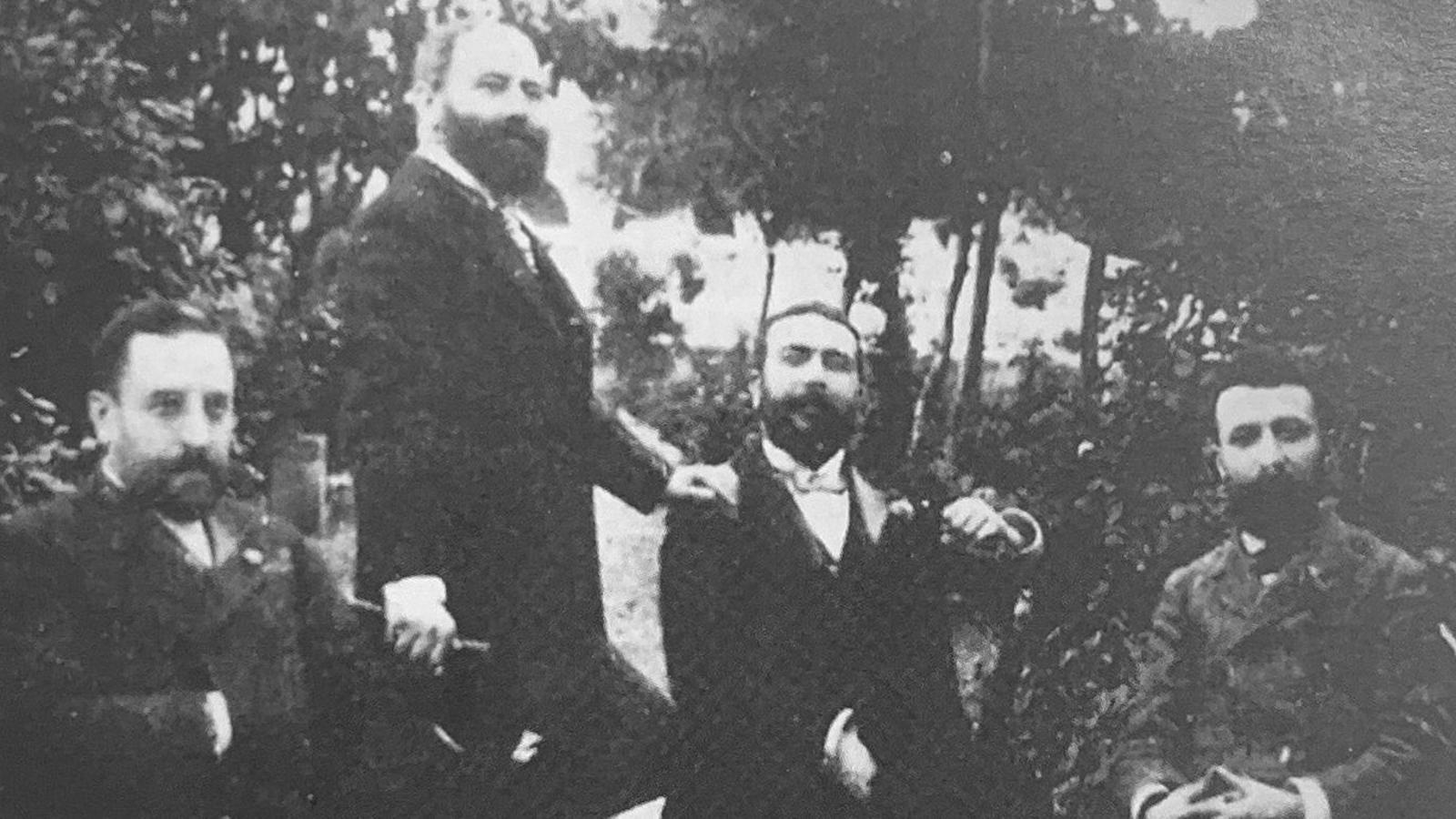
ManacorBetween 1896 and 1920, Joan Alcover's residence was also known for its intense cultural activity: one of its small lounges became the meeting point for the Majorcan intellectual elite of the time. Every Sunday afternoon, except during the summer months, prestigious writers, artists, and intellectuals from various generations, ideologies, and backgrounds would gather there, conversing about current literary events and discussing published or unpublished texts, whether their own or those of other authors. When the weather was fine, the gatherings took place in the garden that still colors the ground floor today.
These gatherings took over from those that had been held in Majorca since the mid-19th century. Initially, the meetings took place in the neoclassical and Elizabethan-style building on Carrer del Conqueridor in Palma, which is now the seat of the Parliament of the Balearic Islands. The gatherings of the Círculo Mallorquín, a recreational and cultural society of a literary and political nature, brought together thinkers from the high bourgeoisie, the aristocracy, and the Majorcan intelligentsia, among whom was Joan Alcover. The central figure of these meetings, who served as both host and master, was the writer, historian, and journalist Josep Maria Quadrado. When Quadrado's health worsened to the point of preventing him from traveling to the meeting place, the attendees moved the meetings to his private home.
Upon Quadrado's death in 1896, Joan Alcover took over, both as host and in the role of master. Thus, his home became the meeting point for the main nucleus of the Majorcan School (Miquel Costa i Llobera, Llorenç Riber, and Miquel Ferrà), as well as for philologists, writers, intellectuals, politicians, ecclesiastics, and artists of the era, such as the painters Joaquim Mir and Antoni Gelabert. Among the most prominent figures, one must highlight Antoni M. Alcover – the great compiler of Majorcan folk tales and architect of the Catalan-Valencian-Balearic Dictionary – and the conservative politician Antoni Maura.
Excerpt from the poem ‘The Relic’ from the book Towards Evening.
Mutilated faun,
dry fountain,
desolate garden
of my youth...
Blessed be the hour
that has brought me here.
The fountain that does not overflow, / the fountain that does not weep
makes me weep.
It seems it was yesterday
that within the mystery / of the flowering shadow,
lying on the moss,
we spent the best / hours of our life.
Joan Alcover's tertulias demonstrate the need for debate spaces in the Mallorcan society of the time, where conversations on diverse topics could be unfolded and literary concerns could be shared. The domestic atmosphere in which they took place reproduced the model of the private literary salon, in a cozy, familiar, and leisurely space that had enjoyed great success during the 19th century throughout Europe, in the private residences of the enlightened bourgeoisie and the aristocracy. The Mardis of the poet Stéphane Mallarmé in Paris, which regularly hosted the elite of symbolism (Paul Claudel, André Gide, Paul Valéry, and Oscar Wilde), are a paradigmatic example.
The goal of these periodic meetings was to foster intellectual debate, read unpublished works, and promote cultural patronage in an intimate and select environment. Poems or recently written chapters were read there to subject them to criticism and debate, and aesthetics and current political events were discussed peacefully. The calmness of the space and Joan Alcover's conciliatory nature guaranteed the cordiality of the meetings, despite the ideological diversity of the attendees.
Visitors from abroad
It should be noted, however, that these were exclusively male meetings, from which writers like Maria Antònia Salvà were excluded. Thus, even though Salvà was intimately linked to the circle of tertulia participants and corresponded with Joan Alcover and Miquel Costa i Llobera, she did not participate in the Sunday gatherings at Ca n’Alcover. This segregation contrasts with the relevant role that women had as hostesses or salonnières in Europe, where it was not unusual for the central figure of a salon to be an educated woman who moderated the conversations. Significant examples of this are the salon of Madame Récamier in Paris, which hosted writers and intellectuals under the guidance of Chateaubriand, and that of Emilia Pardo Bazán in Madrid, where the writer acted as hostess.
At the end of the 19th century and during the first decades of the 20th century, tertulias continued to have a very important weight across the continent as gathering spaces for artists and intellectuals of all kinds. They often took place in cafes, in a bohemian and relaxed atmosphere. Especially famous are Els Quatre Gats in Barcelona and the tertulias of the Ateneu Barcelonès, which in turn mirrored those taking place in the great European capitals.
The mansion that hosted the gatherings is a meeting point for a wide range of cultural activities and a top-tier museum space
The gatherings at Ca n’Alcover embodied the spirit of the intellectual meetings of the era, with the particularity that they took place in a private stately home. Alcover acted there as a literary patriarch and mentor to new generations. As was happening throughout the continent, these meetings brought together various generations: young writers frequented them, looking for a master and an aesthetic and moral reference in Alcover, from whom they hoped to receive advice and support.
The aesthetic and cultural debates that took place there were also enriched by the presence of intellectuals from Catalonia, who attended the gatherings when they visited the island, such as Santiago Rusiñol and Josep Carner. Joan Alcover also hosted the Nicaraguan poet Rubén Darío during his stay in Mallorca (1906-1907), where he was received with all honors. In 1916, Miguel de Unamuno also participated in Joan Alcover's gatherings during his visit to Palma, invited by Alcover and Costa i Llobera. The conversations they held there were decisive for Joan Alcover to give final form to the celebrated poetry collection Poemes bíblics (1918), which includes a composition dedicated to the Basque author.
Around 1920, the death of two of his children and the deterioration of his health put an end to the gatherings. Nevertheless, the manor that hosted them is still a meeting point for a wide range of cultural activity and a first-rate museum space. His son Pau Alcover, founder of the Obra Cultural Balear (OCB), donated it to this entity so it could be its headquarters. It opened its doors as a space for culture in 2008.