PalmaA woman, Anne Carson, has just won the Nobel Prize in Literature. This is still an unusual fact: only 15% of the winners have been women, 19 out of 123. And in the Balearic Islands? Have the authors of the Archipelago reached full equality with their male colleagues or are there still discriminatory aspects? October 19th is the Day of the Woman Writer; let us look at how the issue stands and, above all, how they are doing.
Most of the people consulted, writers of different generations, of diverse genres and from the four islands, perceive the progress. Not to mention since 1869, when the misogynist Joaquin Asensio wrote about one of the few Mallorcan authors of the time, Manuela de los Herreros, that "even if she were a wise woman, she would surely have abandoned her home".
In the last ten years, the percentage of female members in the Association of Writers in the Catalan Language (AELC), across all territories, has risen from nearly 35% to 45%, almost half of the total number of associates. This is an indicator of the more significant weight that women have achieved in the Catalan literary sphere.
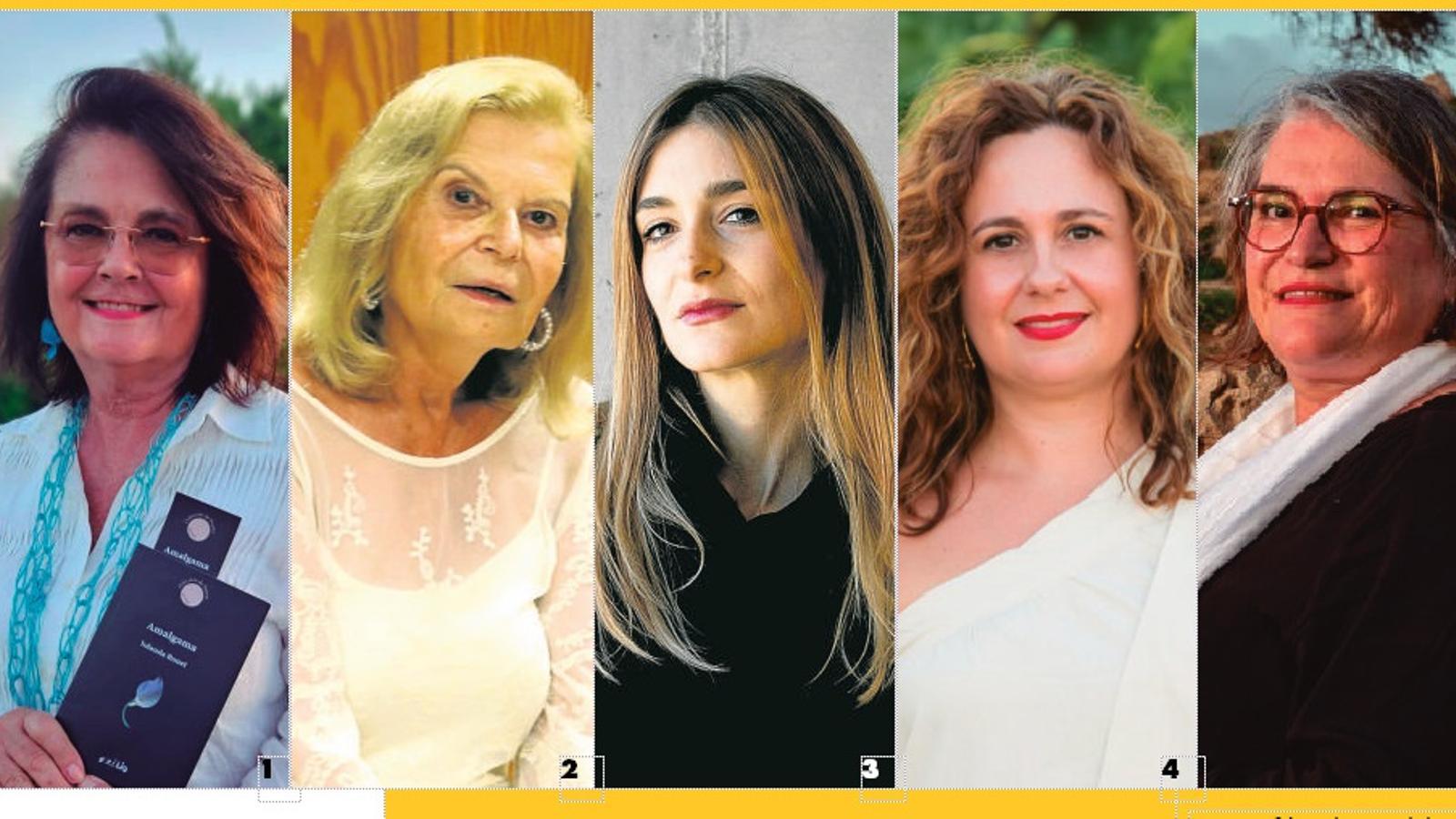
For the poet and translator residing in Mallorca Noèlia Díaz Vicedo, representative for the Islands on the AELC board, "although the situation of women writers has improved", "we still cannot say that there is full and satisfactory equality" between women and men in the literary field. Personally, Díaz Vicedo has not encountered direct discrimination for being a woman. But yes, perhaps, of a "much more subtle" nature, she qualifies. On one occasion, when presenting a proposal to a publisher, she was told that it was "not a necessary book": "And that surprised me a lot: how necessary is a book?".
Another case is the organization of literary events, to which, often, "the first names" that are put on the table "are men's". Much the same could be said of the academic field, in which gender subjects "are always optional: an added space". Unlike, she states, the "postcolonial" perspective, which has indeed been assumed in this environment.
The example of women's football
“In my case,” explains the young Majorcan narrator and playwright Laura Gost, “I have not noticed any type of inconvenience” for being a woman. “There has been a substantial change. I feel fortunate because I haven’t felt belittled, quite the opposite. I have been very lucky.” Gost did feel uncomfortable regarding one specific episode, such as that of three male writers who chose a joint female pseudonym, perhaps in the belief that this would help the dissemination of their work.
Different is the point of view of the veteran Majorcan narrator Carme Riera, who made herself known half a century ago with Te deix, amor, la mar com a penyora: “I don’t believe things have improved much. We continue more or less the same.” At national state-level awards, for example: “There is a tendency for our opponents to win them,” she says. The same goes for the Nobel: “There are very few women, even if they are just as good, or just as less good. The invisibility is there.”
Different is the opinion Riera has of the mid-seventies, when she began her career. She believes that, “to the public,” literature written by women raised a certain interest, with the books of Montserrat Roig, or her own, “perhaps more than now.” The problem, she finds, is not just one of women writers: it is that “literature is becoming something residual. Both for men and women.”
The poet from Formentera Maria Teresa Ferrer has not felt discriminated against in her career: “In no case. Currently, in the writing of men and women, there is equality. I don’t believe there is any inconvenience for a woman who wants to write.”
Iolanda Bonet, a writer from Ibiza who has cultivated poetry and narrative for children and young people, qualifies that “in 90%” she has not perceived any reservation when it comes to publishing—perhaps there remains, still, this ten percent to resolve. “They have even come looking for me” to give publicity to her writings. A different matter it was, adds Bonet, when an event had to be organized: “If there were no women,” among the participants, “it didn’t matter.” Towards the end of the eighties or the beginning of the nineties, she assures that she did not have “any problem” when it came to publishing. But if it was a congress, “in the main leadership, everything was men and that still lasts a bit,” although she points out that it happens much less than in the past.
For Bonet, it is important “that there be a female model” and uses as an example of the boom that soccer played by women is experiencing: “The female footballers are an example of a male environment” in which they have acquired prominence. “And the world has not fallen because they are women”, she observes. “Infinite is the void we must fill”, says a verse of hers, from a poem dedicated, precisely, to women writers.
Publishing houses and bookstores
The Minorcan poet Llucia Palliser believes that "the thing about micro-aggressions is there." She points out that "in Menorca I have not felt" discriminated against, "there is quite a bit of equality." Regarding other areas, she confesses: "When you coincide with male authors, sometimes I hear some out-of-place comment." "Sometimes you notice a certain suspicion. Not everyone, but some more veteran writers still find it hard for a woman to be successful in the literary world," she opines. Perhaps also, in part, she says, "because in the world of creation there is ego and ambition."
However, how many books written by women are published by the publishing houses of the Islands? To point out some of the best known, Adia Edicions reaches parity, four among the last eight new releases: La carn dels Àngels, by Alda Merini; Llàgrimes de neu, by Mireille Gansel; Vestigis, by Lucia Pietrelli, and Compost, by Quela Servera-Turnes. Among the eight most recent books from Lleonard Muntaner Editor, two are by female authors: Mallorca romaní, by Laura Jurado, and Si tota la mar fos tinta, by Rosa Planas Ferrer, who advocates, precisely, for a Mallorcan writer, Sister Anna Maria of the Most Holy Sacrament, who was a pioneer in an era as unfavorable as the 17th century. And the same proportion, at the Moll publishing house: Xorca, by Sara Rivera Martorell, and Corcs, by Olívia Lund.
At Documenta Balear, one among the eight most recent publications: El colegio de Montesión de Palma, by Concepció Bauçà de Mirabó –with Marià Carbonell. At El Gall Editor, one of its last four titles: Cantar al Pla de Mallorca. 50 anys de la coral de Sant Joan, by Bàrbara Duran Bordoy. At Disset Edició, one of the five books just out of the oven: Ton pare no té nas, by Marina Uguet. At the Ibizan label Edicions Aïllades, also one among eight: Història de la Confraria del Sant Crist Jacent de la Catedral d’Eivissa, by Carmen Tur Ferrer; but one must also take into account, from their production, two collective new releases: Relats Guanyadors del VII Concurs Literari de Cultura Clàssica Joana Maria Pol i Fiol, which includes texts by several young authors, and Lletres Pitiüses. Obres guanyadores i finalistes dels Premis de les Lletres Pitiüses 2026, among which there are creations by Josefina Torres, Teresa Navarro Pastor, Mònica Sintes, Aydee Núñez Pérez and Cristina Ortega Joan.
There is a label, however, that bets specifically on this segment: Veus Pròpies, promoted by the Mallorcan Maria Martorell. The goal of this publishing house is to recover, in Catalan, writers from the 19th and 20th centuries who would have remained sidelined. Veus Pròpies has published Cròniques d’un mig estiu, by Maria Antònia Oliver; Algú en la distància, by Dorothy Whipple, and Crònica d’un viatge de sis setmanes, by Mary Shelley.
Regarding making books written by women accessible to the reading public, in Palma there is a bookstore—an unusual case—dedicated solely to these literary productions. Llibreria Pròpia, in the Plaça del Quadrado, managed by Aldana Areco, opened its doors in 2023 and at that time, as reported by ARA Balears, it was the first one only featuring female authors in the Islands and one of the few that existed then in the whole State.
At another bookstore in the city, Drac Màgic, among its periodic activities, a feminist reading club stands out, with titles only by female authors, which this year is already reaching its tenth edition. It is "a contribution" from this establishment, highlights bookseller Laia Alegret, to make women writers visible.
In Inca, another club with the same characteristics was launched in 2022, promoted by the cultural entity Siracusa with the collaboration of the City Council's Culture area and the Espirafocs bookstore. In Porreres, another similar club meets at the premises of Veus Feministes.
Do women writers support each other? Do they practice what is known as 'sorority'? Llucia Palliser does not doubt it: "Yes, and not only have I perceived it." She asserts that she herself puts it into practice. A few days ago, she organized a recital in Menorca to which she invited "other female creators, to support each other and show sympathy. I have perceived it and I try to form a team of sorority".
Should calls for applications include positive discrimination clauses?
Should institutional calls for applications include positive discrimination clauses, that is, to compensate for the difficulties that women writers may still encounter? If we take a look at this year's criteria in the Balearic Islands, the Institut d’Estudis Baleàrics provides for “the participation of women in the creation project or the inclusion of themes related to gender perspective”, up to five points; the Consell de Menorca, “actions that favor gender equality”, up to two points; and the Consell d’Eivissa, “the incorporation of gender perspective”, themes or a balance between men and women, up to four points.
Noèlia Díaz Vicedo believes that this type of clause “is still necessary, because we have not yet reached real equality of conditions”. Iolanda Bonet thinks that the essential criterion for accessing institutional support “must be quality”. “But ensuring that there is a percentage of women, yes”, she points out. However: valuing “something bad or poorly done because it is a woman”, qualifies Bonet, “never that”.
For Maria Teresa Ferrer, “everything that encourages women's access is necessary”. “There are still a series of conditioning factors, such as the care of the elderly and children, which falls mainly on women”, she affirms. Carme Riera, on the other hand, is emphatic: “I do not like any discrimination, whether positive or negative”.
“The ideal”, for Llucia Palliser, would be “not having to include” this type of clause in the calls for applications. “Perhaps it is convenient, but it is all quite sad”.