The first day of school, between new backpacks and old problems: "I'm not thinking about the PISA today"
Students and families recover the routine while the centers face a course with fewer students but more needs
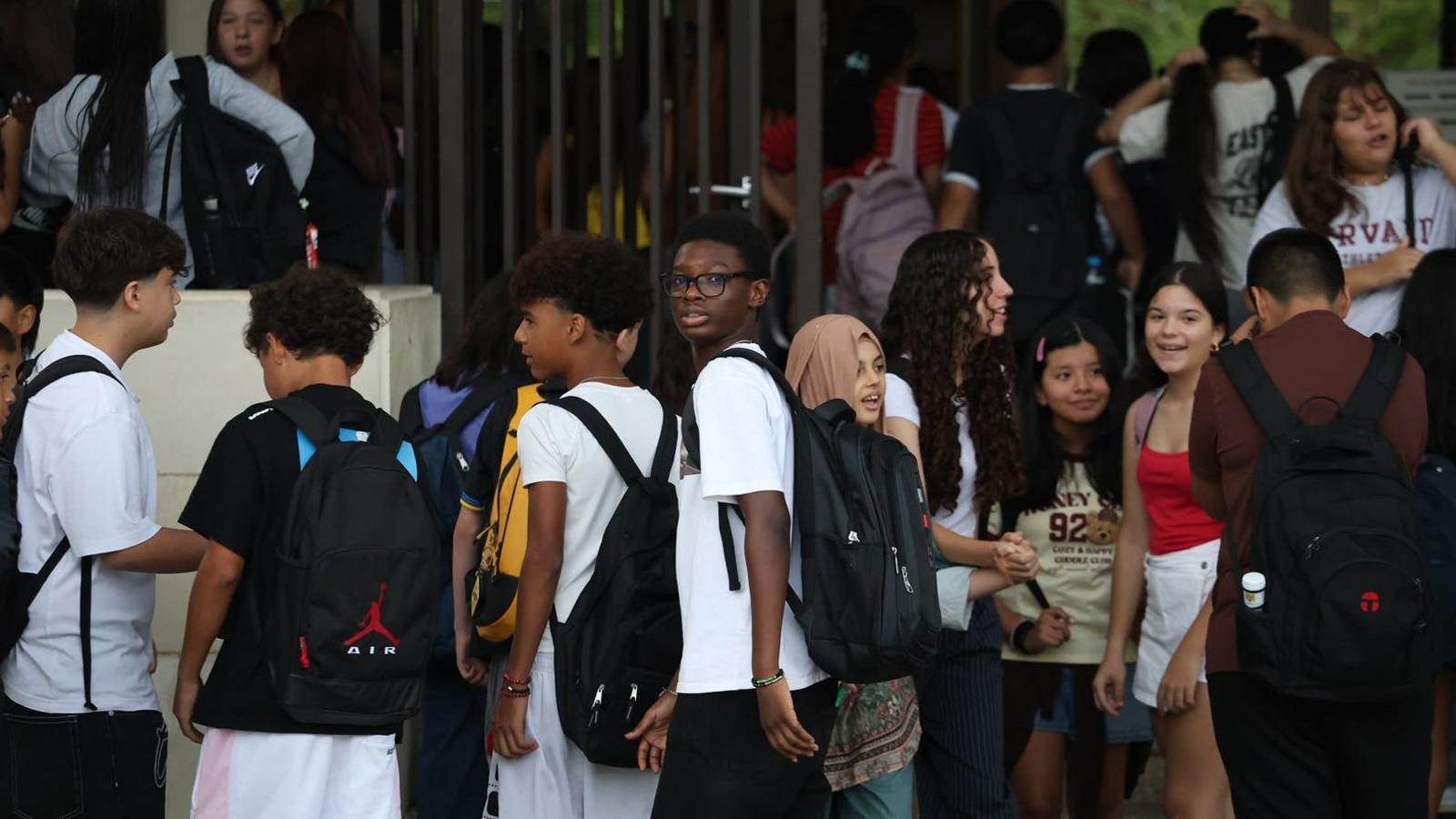

PalmaAt the gates of the CEIP Aina Moll school in Palma, this Thursday morning, there is a bit of everything that returning to school means. Children running in, parents extending the goodbye for a few seconds, backpacks still without a single stain, and the occasional cry that escapes just before crossing the door. There are also those who arrive with their holidays still stuck to their faces and those who, on the other hand, seem delighted to see their friends again. "I was more eager than he was to return," jokes a mother as she accompanies her son to the entrance. The boy, however, does not seem very worried about the start of the school year. He looks towards the door and just waits to be let in. "Yesterday he said he didn't want to come and today there is no stopping him," she explains.

It is one of the scenes repeating this Thursday at schools and high schools in the Balearic Islands, where thousands of students return to the classrooms to start the 2026-2027 school year. A school year that arrives with fewer students, but with more teaching staff and more support resources. Also with the PISA results still recent and with the debate on where schools should head on the table. At the Aina Moll CEIP, however, during the first moments of the morning, the great educational discussions still feel far away. What matters is finding the classroom, greeting friends, and discovering who the tutor will be. The youngest ones enter with their families; the older ones already do so with a naturalness that contrasts with the parents' nerves.
"What matters most to me is that he is happy and adapts well. Later the homework will come... and the fights because he doesn't do it," says another father while saying goodbye to his daughter. She is already inside and he still remains for a few seconds in front of the door, as if he needed to confirm that the school year has really started. The photograph that enrollment leaves this year is unique. The Balearic Islands are losing 2,342 students compared to last year: 2,248 correspond to the public network and only 94 to the state-subsidized private one. This means that the public network concentrates 96% of the decline and that, for every student who leaves the state-subsidized private one, almost 24 leave the public one.

Public schools go from 106,876 students last year to 104,628 this year, a decrease of 2.1%. Charter schools, on the other hand, go from 54,325 to 54,231, 0.2% less. This is a decline that does not, however, translate into fewer resources. The Department of Education assures that the school year will begin with 19,003 teaching positions, 224 more than last year: 198 additions to public schools and 26 to charter schools.
At Aina Moll, this contradiction between the global figures and the reality of each center is seen in a smaller and more everyday way. The fact that there are fewer students in the Balearic Islands as a whole does not mean that all centers have more space or that the work is simpler. There are classrooms that remain full, students with different needs, and families that arrive throughout the school year. In fact, last year 3,801 new enrollments were registered once classes had already begun. The Department of Education admits that this phenomenon puts the system "under tension" and that it "is growing".
A different pace
At IES Joan Alcover, in Palma, the first day has a different rhythm. There are no longer parents entering up to the classroom door or children clinging to their mother's hand. Adolescents arrive in groups, some with their mobile phones still in their hands and others discussing the latest stories of the summer. "I was looking forward to returning mainly to see my friends. For the classes, not so much," admits a 3rd-year ESO student before entering the high school in a bit of a rush.
The older ones have a different relationship with the first day. There is not so much nervousness as a kind of shared laziness, especially among those who still have the feeling that the holidays could have lasted another week. But there are also those who are starting a new stage and arrive with more uncertainties. "It's a big change because it's no longer school and you know far fewer people. But I am looking forward to starting," explains a student who is entering 1st-year ESO this year, accompanied by her mother.
At the door, parents also experience the first day in a different way. "I can no longer accompany her inside, so now it is my turn to trust," says the mother, half-jokingly. It is one of the small differences that separate the two centers: while in Primary school there are still hands being held and let go, in Secondary school the doors are almost always crossed in groups. Holding hands with parents is the last option.
But the challenges that await behind the doors are shared. This school year there will be 39 more support specialists, reaching 171, and 16 new counselors, up to 467. There will also be 426 technical educational assistants and 11 new health psychologists for Primary education. The Department of Education also assures that there will be 166 groups with reduced ratios and that only 25 of the 4,798 official groups will exceed the maximum legal ratio. However, the vulnerability of the student body in the Balearic Islands means that even apparently normal ratios turn out to be truly exorbitant.
The point is that the number of students alone does not explain the complexity of a classroom. A group can be within the legal ratio and, at the same time, have newly arrived students, specific support needs, learning difficulties, and social situations that require more time and more resources. And the system will continue to need space. The Balearic Islands will begin the school year with 187 modular classrooms, 22 more than last year: 149 in Mallorca, 7 in Menorca, 23 in Ibiza, and 8 in Formentera. The overall decrease in the number of students, therefore, coexists with schools that still need portable classrooms due to construction work or because demand continues to increase in certain areas.
PISA remains outside the door
Over the last few days, the PISA results have occupied a good part of the educational debate. The results from the Balearic Islands have once again sounded the alarms, especially in Reading and Mathematics. But outside the school gates this Thursday, international figures seem distant. "I'm not thinking about PISA today. I'm thinking about whether he'll arrive home eager to tell me how it went," says a grandmother, while waiting a few moments before leaving. Parents are at work.
It is probably one of the paradoxes of the first day of school. While Education, unions, experts, and teachers discuss ratios, staff, knowledge, skills, screens, and pedagogical innovation, families look at a smaller scale: whether their child is okay, whether they have found their friends, whether they have understood what they were told, and whether they will want to return tomorrow. At IES Joan Alcover, a group of 4th-year ESO students continues joking at the door before entering. "This year we have set ourselves the goal of passing everything," says one of them. The friends laugh. The promise lasts, probably, until the first exams arrive. At Aina Moll, meanwhile, the classrooms are already full. Backpacks hang from chairs, teachers take attendance, and the children begin to discover that summer, definitively, is over.
The school year begins with fewer students than a year ago, but with 224 more teaching positions. It begins with more support staff and more counselors, but also with more modular classrooms. It begins after a year in which thousands of students arrived at schools when classes had already started. And it begins with a system that is still trying to digest PISA results that have brought uncomfortable questions to the table. But at the school gates, this Thursday, all of that remains in the background for a few hours. A mother makes a final gesture with her hand. A teenager takes off their headphones before crossing the door. And a teacher greets the students by name. The 2026-2027 school year has already begun.
