The bar customers carried my mother's coffin to the cemetery
Mateu Martorell, owner of Can Vinagre, remembers the Palma of the tram and of the neighbors who filled Carrer dels Oms, before tourists and businesses transformed the neighborhood

-
CAT -
CAST -
GER
PalmaThe story of Mateu Martorell (Palma, 1939) is that of a man who has always remained in the same place while everything around him changed or disappeared. When he speaks of himself, he is actually speaking of the neighborhood where he has lived for 87 years, of his family, of his neighbors, and, of course, of Can Vinagre. Of the bar counter on Carrer dels Oms from which he has watched the transformation of this urban space. He disappears from the narrative as if his identity were more outside than inside, as part of a generation that explains itself by talking about others. He does not lament his sacrifices nor does he recognize this idea—so contemporary—of self-sacrifice, of a whole life spent working. "Only a year ago I was still serving behind the bar, but now my legs no longer respond," he reveals, calmly.

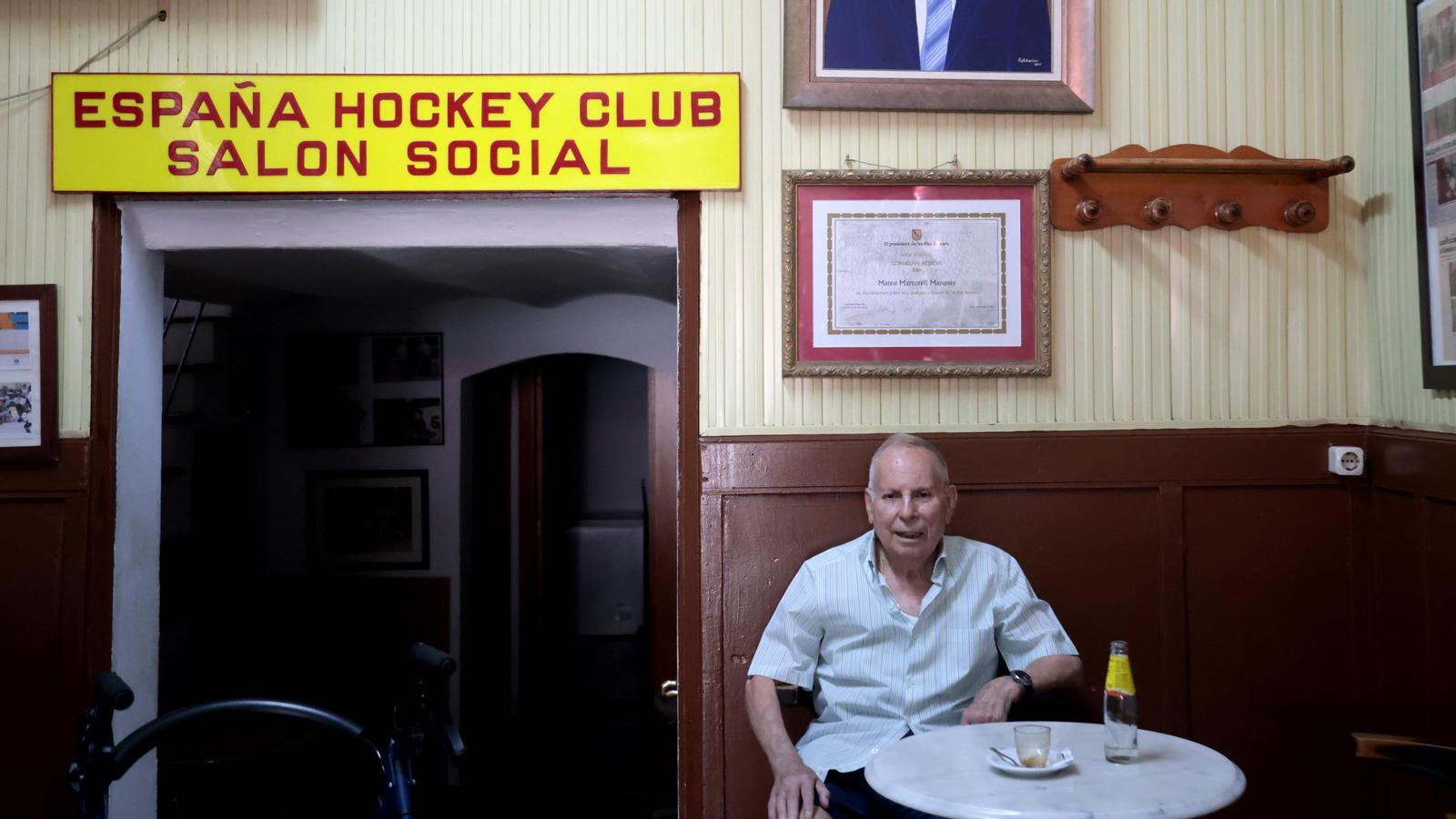
It is 11 o'clock on a sweltering morning and Mateu sits at a table at the back of Can Vinagre, beneath a portrait of himself that shows him distinguished, with a serene dignity. He pushes his walker aside and leaves it next to a chair, while greeting a customer. "We're going to roast today," a middle-aged man says to him about the high temperature, while giving him a pat on the shoulder. "He works at Social Security," he clarifies. "And that one over there was a bullfighter," points out another of the regulars. For decades, the regulars were neighbors from the neighborhood; now the majority are administrative staff, civil servants, lawyers, and shop assistants who work in the area.
But Can Vinagre preserves the breath of the past in its aged details, in corners where a siurell and a Saint Pancras coexist, and tables with decades of history. For other things, there is Martorell's memory: "My first memory is the billiard table that used to be here –he points to the middle of the bar– and that mark on the column was from the cue when they hit the balls. The billiards and the smoke. Everything here was smoke. Men smoking all day. I remember someone left a bull's head that we hung up and I never knew whose it was."
He is the youngest of seven siblings. When he was born, just a few months after the end of the Civil War, his father was already running Can Vinagre. They lived above the bar. "The business did not provide enough to eat. I didn't go hungry, but sometimes I would go to eat at a neighbor's house or they would give me a little bit of bread with chocolate." That was a life of "smoke and noise, a lot of noise".
The neighborhood streetlights
If a brother closed at two in the morning, the patriarch was already behind the bar before the sun came up. "When the first tram passed by, my father would already be raising the shutters," he recalls. Without stopping. Serving drinks and coffees every day of the year to men who drank and smoked while playing cards, Parcheesi, and dominoes. "When the neighborhood festivals arrived, a gentleman had made us a model and we followed it to the letter to make the lanterns that hung in the streets. We made them together with all the neighbors. They even had light bulbs in them. That was 80 years ago," the same number that Franco saw when he passed through Carrer dels Oms.
At the bar there wasn't work for everyone, and Mateu started delivering ice at 13 years old. "I went to the houses of the wealthy people who had an icebox: especially doctors and lawyers. Later I helped a traveling salesman sell clothes, and later on, I would carry trays of coffee with a dash of milk to the workers of the Montepío Laboral. I would take out the notebook and write it down. Some paid me at the end of the month, when they got paid," he relates.

The brothers had made a living in a perfumery, preparing meals and fixing shoes. He would stay on Carrer dels Oms, behind the bar counter. "On the street, everything was housing. Compared to now, there were fewer businesses. Opposite us, there was a dairy. A little further on, a place where they made mattresses. They would go to the farms to fetch the wool, prepare the fabric, and then assemble them. Now I hardly know the people who live in the neighborhood anymore. Carrer del General Riera had always had more prestige because, when the Carme barracks existed, many military personnel lived there. In the rest of the area, the people were humbler." Precisely, the humble gathered at Can Vinagre in front of the first television on the street, bought on installments shortly after Televisión Española began broadcasting in 1956: "It seemed like a cinema. One night there was a police raid where they simply asked for identification, and that day no one could watch the movie in peace."
From his parents he learned "respect and the importance of work." He lost his mother when he was just 20 years old and was about to leave to do his military service in Melilla. "When she died we already had cars and carriages prepared, but the clients wanted to carry the coffin on their shoulders to the cemetery. It moved me. I will never forget it. My father lived to be 84 years old."
Mateu Martorell ended up working at Can Vinagre as part of a natural process. "I really liked the atmosphere, the clients and I felt very comfortable among the people I knew." His father handed over the reins to him in 1973. By then, the first tourists had already arrived in the city center. "I had not left Palma and I didn't really know where they were coming from. They were everywhere. A gentleman had an inn and, since he didn't have enough rooms, many stayed in private homes. For me, seeing them arrive by bus was a novelty," he recalls.
Associative life
Mateu's day-to-day life was not limited to the bar at Can Vinagre, but also structured the neighborhood's associative life. On one hand, he had promoted the Espanya Hoquei Club, based at the rink of the so-called Plaça dels Patins, a fact that would lead him to travel across Europe in championships that would project the entity's successes. On the other hand, he presided over the Association of Merchants of Carrer dels Oms and promoted its conversion into a pedestrian zone at the end of the 80s, convinced that a street without cars would be better for commerce. The supporters prevailed by a narrow margin. "I still keep the paper with everyone's votes," he asserts.
It is the time when the neighborhood underwent its greatest transformation: "Businesses changed hands. Today everyone wants to live in the center, but back then people wanted to leave. The houses were very old, they didn't have showers or amenities. They were looking for more modern, new housing in the outskirts and were abandoning the neighborhood."
Mateu continued behind the bar. He never married nor had children. "I was at the bar," he justifies as if speaking with overwhelming logic. "There was always work here. I was there until I went to sleep." He still lives in the flat upstairs. He has been operated on twice for a foot wound, which retired him from the bar. Before, he would get up at 7 a.m., get ready, and by 8 a.m. he was already serving coffees. Now he goes down the stairs and spends the day moving from one table to another. His nephews run the bar. No trace of the billiards table: "I never played it. My father sold it to a doctor from Monaco."
He does not fear death. "If I thought about it, I would stop doing many of the things I do. I like being here, chatting with people and living in the present. But life has changed a lot." How would he like to be remembered? "As a good person who served people."
