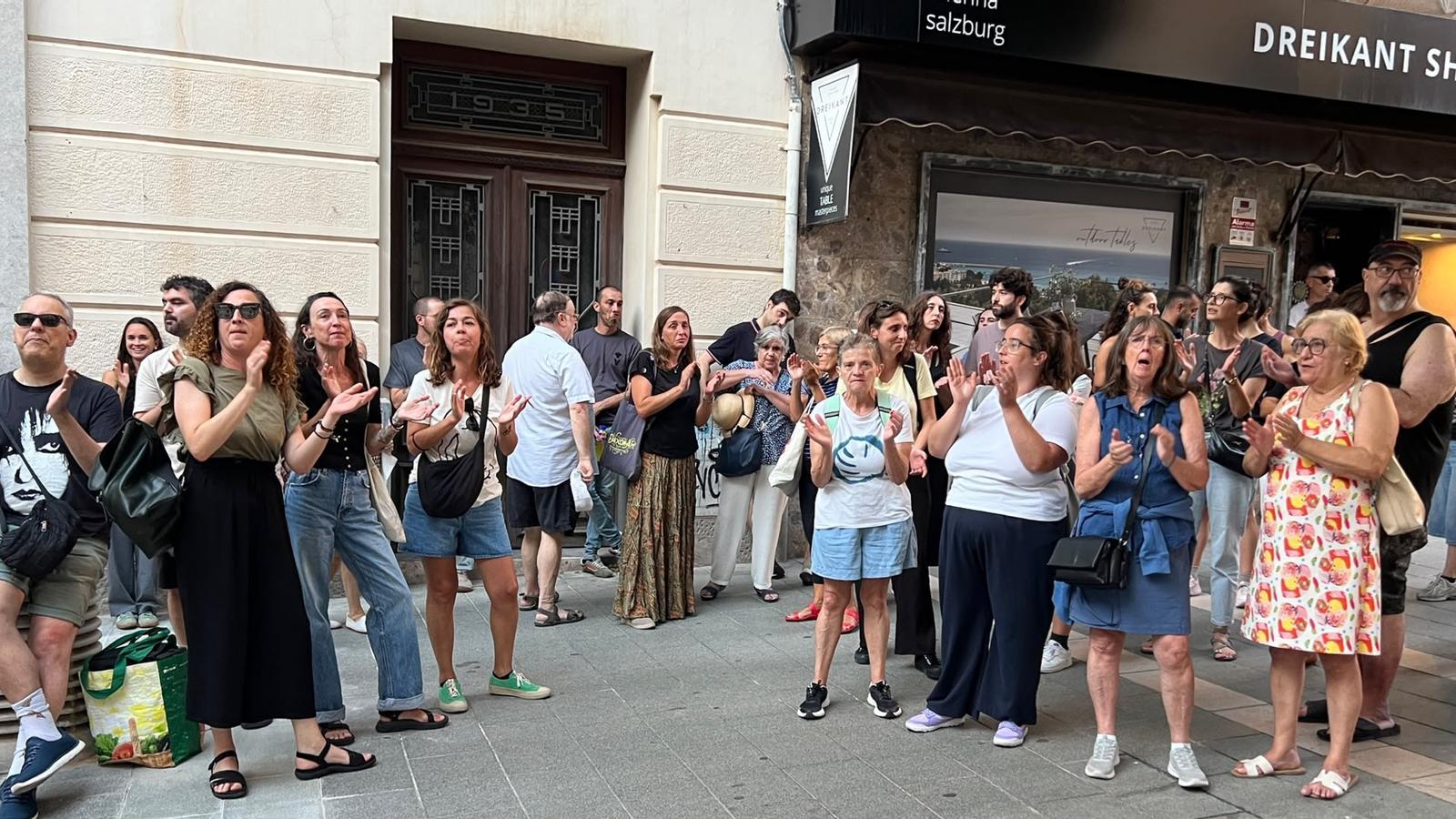
A hundred people gather in Palma against the eviction of Maricarmen: "Tomorrow it could be you"
PAH Mallorca, the Tenants' Union and Less Tourism More Life call a protest to show solidarity with the neighbor from Madrid, evicted from the apartment where she had lived for 70 years

-
CAT -
CAST -
GER
PalmaA hundred people gathered this Wednesday afternoon in Mallorca to show solidarity with Maricarmen, the 87-year-old resident of Madrid who was evicted this Wednesday from the home where she had lived for seven decades. The protest was called urgently by the Platform for People Affected by Mortgages (PAH) Mallorca, the Mallorca Tenants Union, and Less Tourism More Life following the woman's eviction.

The organizers wanted to denounce Maricarmen's situation and show their support after what they consider a "deplorable" eviction. The woman, who uses a wheelchair, has been expelled from her home after three previous eviction attempts. The attendees chanted slogans such as "today it is Maricarmen, tomorrow it could be you".
Maricarmen's case has generated strong mobilization in Madrid. Since Tuesday evening, hundreds of neighbors and members of the Madrid Tenants' Union had gathered in front of the building with the aim of preventing the woman from being evicted. Finally, the National Police riot squad executed the judicial resolution this Wednesday.
The police action caused moments of tension. The Tenants' Union has denounced the use of "violence" by the agents and has assured that some of the protesters allegedly received blows to the head, in addition to denouncing the use of pepper spray during the operation.
Magistrate Juan Pedro Yllanes questions the judicial interpretation that has left Maricarmen on the street
For his part, the magistrate and former vice president of the Balearic Government Juan Pedro Yllanes has questioned this Wednesday the judicial resolution that has ended with the eviction of Maricarmen, an 87-year-old woman who had been living for seven decades in the same home in Madrid. In a video broadcast this Wednesday through the social networks of Sumar in the Islands, Yllanes considers that an interpretation understanding the context in which the lease agreement that was signed by the father of the evicted woman in 1956 could have prevented her from ending up on the street.
The former judge and also former Podemos deputy in the Balearic Parliament has focused on article 3.1 of the Civil Code, which establishes that norms must be interpreted "according to the proper meaning of the words", but also taking into account the context, historical and legislative precedents, and "the social reality of the time in which they are to be applied", in addition to the spirit and purpose of the norms.
In his view, if this provision had been applied considering the social context of 1956, Maricarmen would probably still be in her home and the "regrettable events" of this Wednesday during the execution of the eviction would not have occurred.
A subrogation that changes everything
The key to the case lies in the interpretation of the rental contract subrogations. Maricarmen's father signed the lease in 1956, during the Franco regime, at a time when women had much more limited legal capacity and rights than they do today. According to the interpretation defended by Yllanes, the contract should be understood as an agreement signed by the father on behalf of the family unit.
When the father passed away, Maricarmen's mother became the contract holder. This transfer was considered a first subrogation. Subsequently, when the mother passed away, Maricarmen's continued residence in the home was interpreted as a second subrogation. This second subrogation is what ultimately allowed the property owner to claim the eviction.
Yllanes considers, however, that there was another possible interpretation more consistent with the context in which the contract was signed. If Maricarmen's father acted in 1956 on behalf of the family unit, he argues, this family unit would have remained the same after his death, first with the mother and subsequently with the daughter. Therefore, understanding that the change of ownership in favor of the mother already constituted a first subrogation would have been, according to the former vice president, a restrictive interpretation of the tenant's rights.
In this sense, the judge considers that the courts could have applied article 3.1 of the Civil Code to take into account the historical and social circumstances in which the contract was formalized, especially the legal role of women during the Franco regime.
The conflict originates in the contractual situation of the dwelling. The property owner, the investment fund Urbagestión Desarrollo e Inversión SL, proposed raising the rent to 1,650 euros per month, an amount that Maricarmen could not afford. The woman receives a pension of 1,350 euros and until now was paying 500 euros per month thanks to the old rent contract.
Despite attempts at negotiation, the parties have not reached an agreement and the procedure has ended with the execution of the eviction. Now, Maricarmen finds herself not knowing where she will go to live. For the moment, the Madrid City Council has assured that it has an "emergency spot" for her in a residence.
