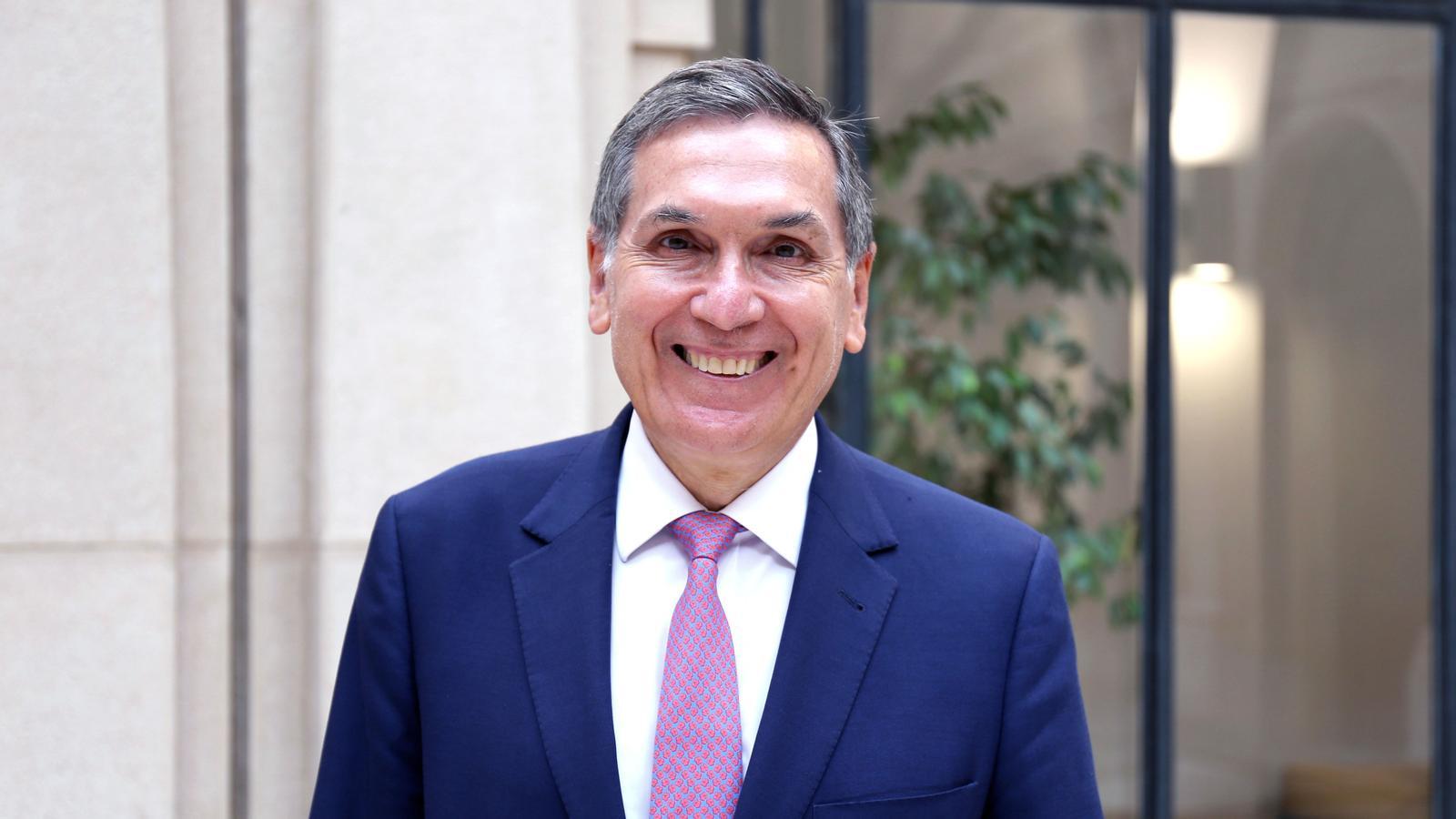
Tomás Chivato: "We don't come to compete with the UIB, but to respond to the lack of professionals"
Dean of the Faculty of Medicine of CEU San Pablo
-
CAT -
CAST -
GER
PalmDr. Tomás Chivato, dean of the Faculty of Medicine at CEU San Pablo, is one of the driving forces behind the establishment of the center in Mallorca through CEU Beato Luis Belda, which will begin operating next academic year with degrees in Nursing, Physiotherapy, Psychology, and Medicine. He maintains that the project is born with the will to contribute to Balearic society and advocates for the coexistence of public and private universities as complementary models.

Why does CEU decide to establish itself in the Balearic Islands now and why with a project focused on Health Sciences?
— CEU is an institution with a long trajectory, which, since 1973, has been training professionals in the healthcare field. It has progressively expanded its offering with Medicine, Nursing, Physiotherapy, Pharmacy, Biotechnology, and other related degrees. Over the years, the CEU group has grown in different autonomous communities and has identified a common need: the lack of well-trained healthcare professionals, with technical skills, but also with humanistic values, communication skills, and solid ethical principles.
— It was detected that the Balearic Islands did not have a private Faculty of Medicine. After analyzing it, and with the support of the Government, it was decided to promote the project. We arrived with the enthusiasm of more than 50 years of training good professionals, competent both theoretically and practically, to respond to a real need: the shortage of healthcare professionals, which is a global problem and requires collaboration on a state level.
What have you detected in the Balearic university and healthcare system that made you think there was room for a new faculty?
— The shortage of professionals is evident. In the Balearic Islands, in the case of allergists, for example, their incorporation into public healthcare had been requested for years and until recently there was insufficient response. For decades, the Balearic Islands was the only community that did not have them, until a few years ago, with the current government. The problem is not only local but global: there is a lack of generational replacement, professional burnout, lack of an attractive professional career, and a healthcare system with room for improvement.
The project arrives in a context of debate about private universities. Does the CEU aim to fill a gap or compete with the UIB?
— We are not here to compete with the UIB. We are here to provide a solution to a problem of a lack of professionals. The UIB has a consolidated trajectory and a strong structure, just like us. There is no real competition, but rather different models that can coexist. What the CEU San Pablo University does is establish agreements for the training of students in hospital settings with Juaneda, and the UIB has its hospitals. The objective is the same: to train good professionals. The problem is global, and we all share the need to address it.
The project has been criticized for the speed of its processing and the declaration of strategic interest. Is it an 'express lane'?
— It has not been an express route. It has been many months of work. What has been done is to respond to a real need. We are not here to replace anything, but to complement the existing offer. I would not speak of public or private universities as opposites, but rather that what should be looked at is which centers offer quality, regardless of ownership. There are many young people who have to leave the Balearic Islands to study Medicine. Now an alternative can be offered to them so that they can stay here.
How has the relationship with the Government and other institutions been?
— The relationship has been fluid and with good predisposition, not only with the Government, but also with the UIB, professional associations and hospitals. Aspects such as the purchase and requalification of the Beato Luis Belda headquarters, as well as other spaces necessary for the project, have also been facilitated. We come to add and collaborate with the entire system.
What will differentiate you from the UIB's proposal to get students to pay for a more expensive educational offering?
— It's not about being better or worse, but different. One of our commitments is the humanization of healthcare training. We have specific subjects, a chair, and an observatory dedicated to healthcare humanization, in addition to biomedical congresses. We also place great importance on clinical simulation, which allows students to train skills in safe environments before treating real patients. This reinforces their preparation when they reach professional practice.
What would you say to someone who believes that this private model fragments or weakens public universities?
— Not at all. We live in a free country and each person can decide where to study. The coexistence between public and private universities is normal in many countries. It is not about substituting but complementing. Furthermore, we are an institution that offers an important state-level scholarship system to facilitate that if a student meets the profile, they can come to study with us.
Why do you think that in the early 2000s in Spain there were few private universities and now they are about to surpass public ones?
— Mainly due to the need to train more professionals. If the public system cannot provide a sufficient response, complementary solutions must be sought. The key is not whether it is public or private, but the quality of the training and that the degrees are valid in Spain and in Europe.
Some criticize that practices such as abortion and euthanasia are not incorporated into medical training.
— We have palliative care subjects, which is an area that needs further development and unfortunately lacks a legal framework to support it. It is true that euthanasia and abortion are legal practices in certain cases, but from a medical and deontological point of view, there is a profound debate. Medicine is a millennia-old profession, linked to the Hippocratic Oath, which places the defense of life at its core. From this perspective, it is argued that euthanasia is not a medical act. The doctor cannot intentionally cause or collaborate in the death of a patient.
But dignified death is a right.
— Nobody knows it, but Adolf Hitler was the first to decriminalize euthanasia practices, with the aim of eliminating people considered a burden, such as the wounded or disabled after World War I. It is necessary to clearly differentiate between what is legal, what is technically possible (such as creating a cocktail of drugs that lead to death), and what is ethically and deontologically acceptable. What should be done is to advocate for palliative care: there are still tens of thousands of people in Spain who do not have access to them. When one cannot cure, the objective must be to care for and accompany the patient.
How will the center be integrated into the sociolinguistic reality of the Balearic Islands?
— Common sense will prevail here.Teaching will be conducted in Spanish, which is the authorized language of the project, but if there are groups where Catalan predominates, it will be adapted. They do not yet know what the language of our students will be nor which one the teaching staff will feel most comfortable with. It is also planned to incorporate groups in English in the future. The objective is to guarantee effective communication and good training.
What impact do you expect to have on retaining young talent in the Balearic Islands?
— It will be possible to assess in a few years, when the first cohorts finish. The real challenge is also the system's ability to retain these professionals, because international competition is very high.
If you look back ten years from now, what would you want to have been said about CEU in Mallorca?
— We would like it to be said the same as is already said about other CEU campuses: that we train good professionals. That hospitals are satisfied with our graduates and that they find work and develop a good career. This would be the best possible recognition.
