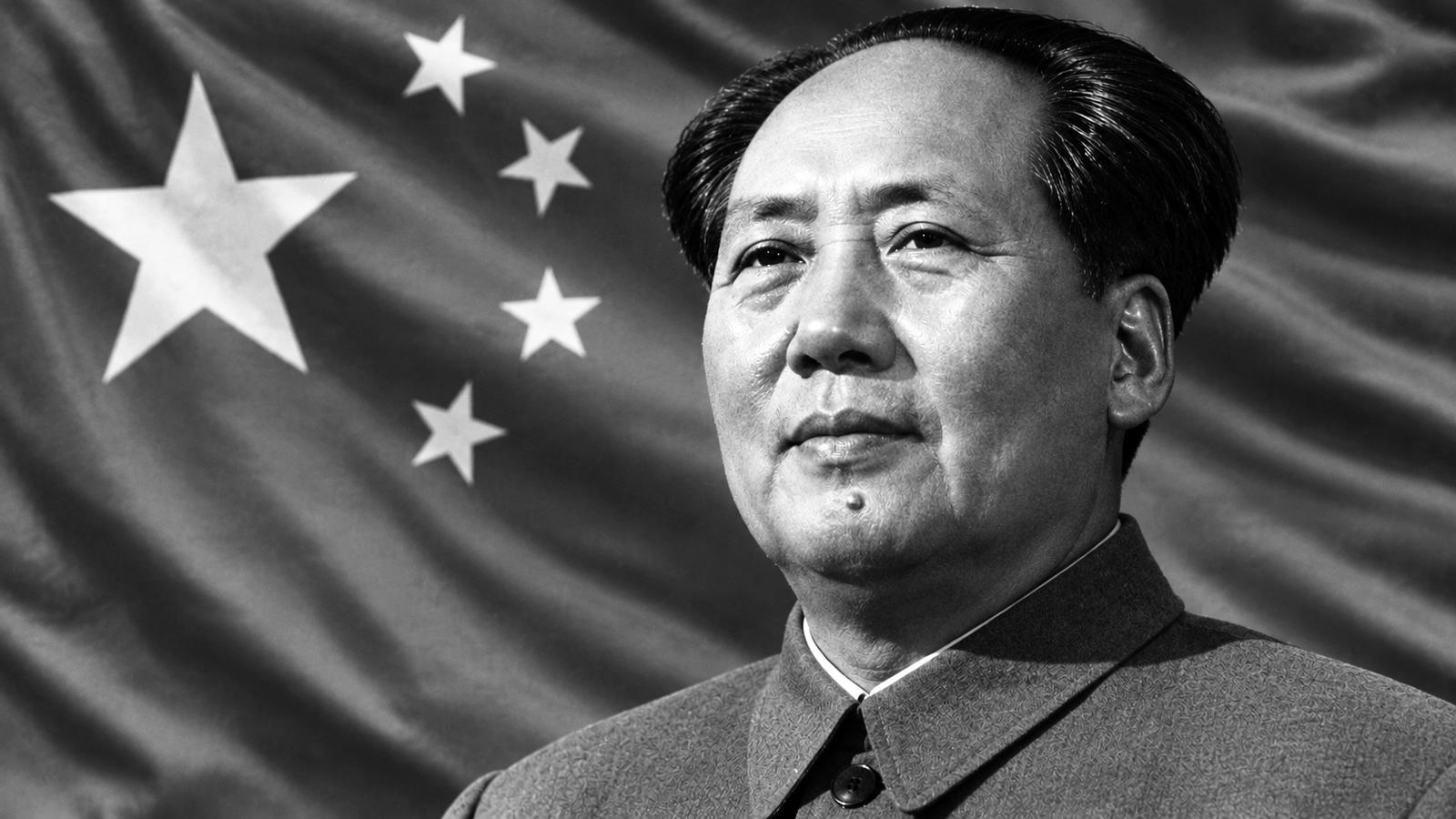
Was Mao a dictator?
Mao defines the political and ideological framework of his thought within revolutionary Marxism and the principle of historical materialism

-
CAT -
CAST -
DE
PalmaThe soccer player Killian Mbappé made a very timely allusion to the communist leader Mao Zedong (Mao Tse-Tung, for my generation), because just this year 2026 marks the fiftieth anniversary of his death. In a television interview, Mbappé acknowledged that he found a meme circulating on social media funny in which he was compared to a Chinese dictator, and his face appeared superimposed on Mao's. This humorous reference has caused a diplomatic crisis and growing unrest among various sectors of Chinese society, who consider it offensive to associate their admired historical leader with an authoritarian figure. The resulting controversy has led to the loss of multi-million dollar sponsorships with Chinese companies and has caused both the player and the Spanish soccer league to apologize to China for fear of further economic repercussions.
In this article, I will not delve into assessing the profound meaning of the apologies. I will only say that the conduct of the player and the Spanish soccer management constitutes a clear example of self-censorship and submission to the economic power of the Chinese giant, in addition to representing an act contrary to freedom of expression, and a representative example of the dominant values in the capitalist world. What I am interested in addressing is the crux of the matter: whether Mao was a dictator.
The second most reproduced book
Mao is known worldwide for being the author of The Little Red Book, a collection of 431 quotes and speeches, originally published in 1964, under the title of Quotations from Chairman Mao Zedong’. Curiously, the book did not arise from Mao's initiative, but from Lin Piao, then Minister of Defense of the Chinese government. The impact of the Little Red Book is spectacular, as it is estimated that since it was first published, more than six billion copies have been printed, which makes it the second most reproduced book after the Bible. At the time, it was compulsory reading in schools, and members of the Chinese Communist Party were required to always carry it with them and know its content by heart.
The publisher Rosita y Amparo has recovered The Little Red Book on the occasion of the aforementioned anniversary, and offers the first commercial edition in our language, after the previous militant-natured editions went out of print. The work is structured in 33 thematic chapters that address issues such as class struggle, socialism, communism, imperialism, democracy, war and peace, the people's army, the people and the masses and their relationship with the army, youth, women, and art and culture, among others.
The publication of the Catalan version of The Little Red Book, with a prologue by Laura Llevadot, allows us to access Mao's thought and philosophy directly and is a unique opportunity to perform the critical exercise of assessing whether the ideological and political principles he exposes contain authoritarian elements.
According to Piao's prologue, the work was conceived as a revolutionary catechism, “a spiritual atomic bomb” aimed at the masses, and an “ideological weapon” to combat imperialism, revisionism, and dogmatism.
Mao defines the political and ideological framework of his thought within revolutionary Marxism, under the leadership of the Communist Party, and the principle of historical materialism, according to which the driving force of history is class struggle. Based on this premise, he positions himself in favor of the proletariat and the popular masses, and interprets the need to mobilize them to combat the enemies of the revolution, that is, the counter-revolutionaries, those who defend imperialism, feudalism, and bureaucratic capitalism. Mao considers that class enemies cannot be defeated solely through violence, but that it is also necessary to maintain a long ideological struggle. His plan is to advance China toward a socialist and communist society through the socialization of agriculture, industrial modernization, the cooperativization of production, and the socialist education of the masses.
Mao himself recognizes that the Chinese state is a people's democratic dictatorship, which is characterized by the application of two distinct methods. On one hand, the dictatorial method, which prevents the enemies of the people from participating in political life, forces them to obey the laws, and aspires to re-educate them through labor. On the other, the democratic method, directed at the people, which aims to convince them to participate in the political actions aimed at socialist construction that puts an end to "the exploitation of man by man".
Mao defines the internal organization of the party based on democratic centralism, which combines a centralized direction with mechanisms that allow for informed decision-making, and collective work without arrogance, in which members can express divergent opinions. Likewise, he considers that the party must be characterized by the practice of criticism and self-criticism, with the goal of identifying and correcting errors, without resorting to personal attacks. Finally, Mao defends gender equality, the incorporation of women into the workforce, and the application of the principle of "equal pay for equal work".
Authoritarian control
However, these theoretical principles contrast with the way he exercised political power during the Maoist period. If we adopt a historical perspective, there is no doubt that Mao was a dictator, as the facts demonstrate. It is well known that after coming to power and proclaiming the People's Republic of China on October 1, 1949, he imposed a communist regime based on authoritarian control of the population and the systematic repression of any opposition and dissent, and policies that caused millions of deaths.
Among the murderous policies promoted by his government, the Great Leap Forward and the Cultural Revolution stand out in particular. The former was a campaign initiated in 1958 that intended to accelerate the industrialization and transformation of the country's economy, but which ended up causing widespread famine with deadly consequences. On the other hand, the second campaign, launched in 1966 under the name of Cultural Revolution, had a fundamentally ideological character, and intended to preserve the revolutionary orientation of the communist regime and avoid the bureaucratization of the state. To achieve this, he promoted the permanent mobilization of the masses, especially the youth, against capitalist deviations and traditional ideas contrary to Maoism. The campaign also served to reaffirm Mao's undisputed leadership, it lasted for almost a decade, until the death of the Chinese leader in September 1976, and triggered a wave of political and ideological persecution against intellectuals, artists, dissidents, people considered counter-revolutionary and political adversaries within the Chinese Communist Party. Many were imprisoned, publicly humiliated and sentenced to forced labor or murdered.
Be that as it may, it would not be intellectually honest to reject reading Mao's work simply because it was written by a dictator, because an idea cannot be disqualified exclusively based on who formulates it. In other words, the fact that Mao was a dictator does not automatically invalidate everything he wrote. However, Mao himself insists on the inseparable link between theory and praxis, an idea that he already introduces in his early philosophical writings, collected in the volume On Practice and Contradiction (Akal, 2026). This link highlights the coexistence of an authoritarian conception of power and some emancipatory elements. Recognizing these contradictions does not imply rejecting his thought as a whole, but it does not exempt him from having exercised power in a dictatorial manner.
