Feeling like Cordelia or killing the father after he is dead
The direction, by Jiménez and Úrsula Martínez, makes everything flow with the most essential characteristic of good theater, naturalness

-
CAT -
CAST -
DE
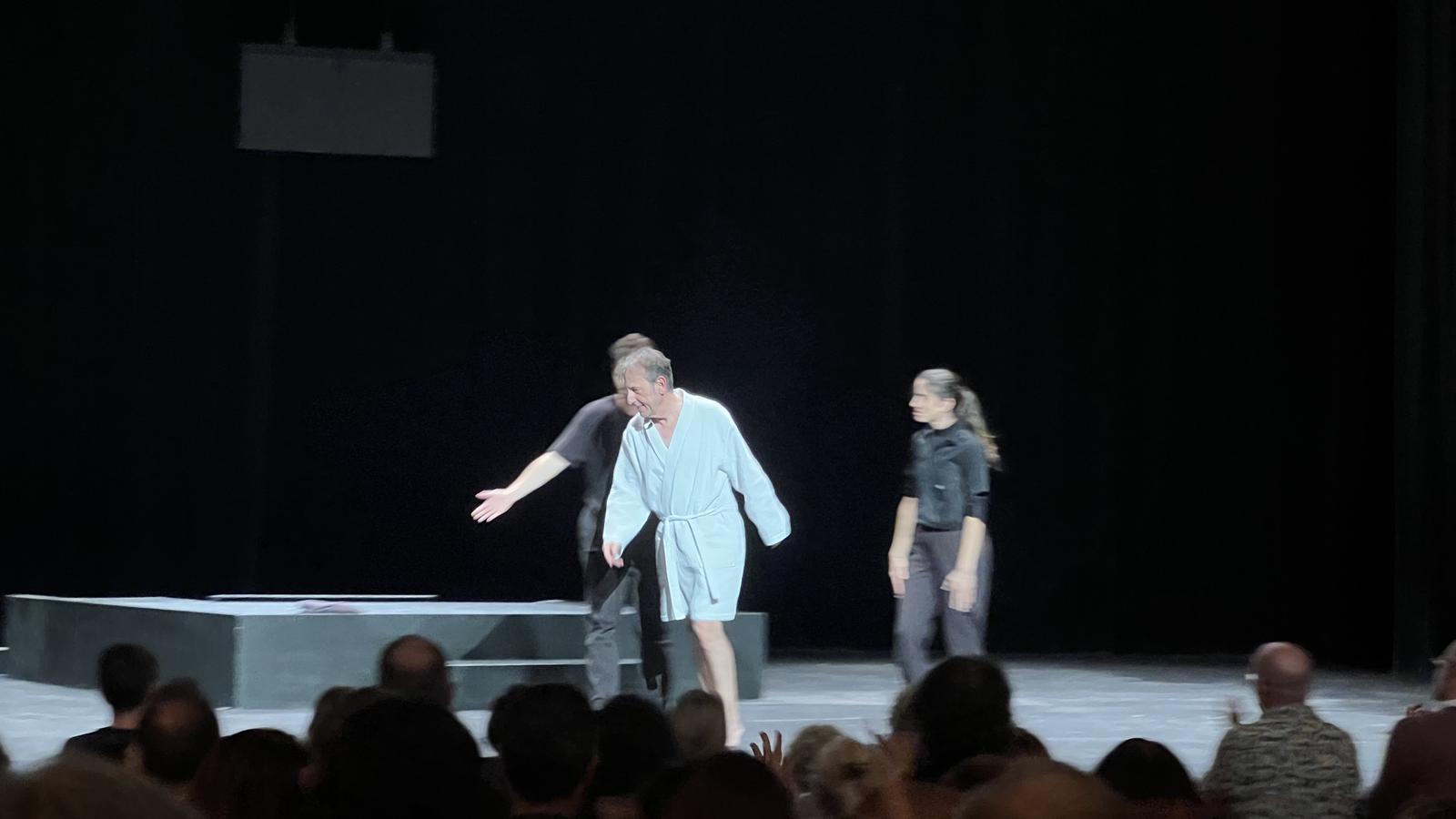
PalmaMixing Shakespeare, Lecoq, Mayorga, Brook, and a personal situation in a cocktail shaker, stirring with intensity and care, appears Casting Lear, by Andrea Jiménez, Max Award for best show and best adaptation. It is not a conventional piece at all, and that is why the author, director, and performer protects herself in the first sentence: “As Peter Brook said, for there to be theater, all you need is an actor walking across a stage and a spectator watching them.” Casting Lear is original to say the least and for different reasons. The first, for example, is that at each performance, and this was the one hundred and forty-first, she shares the stage with a different actor who has no idea what to do, so he follows the instructions and speaks the text dictated to him from the stage, in full view of everyone, by Pablo Gallego, the prompter. On the other hand, it is not a standard adaptation of King Lear, but even so, Shakespeare is always present and at no point does it lose any of its ingredients along the way, nothing that is not fundamental to the story of the rejecting and rejected king, which intertwines and fuses with the protagonist's experience, whether it is true or not, let everyone think what they want, although most people will think the same thing, because, in any case, it is not only probable but constant and universal, since everyone knows someone with a very similar, if not identical, circumstance. There is also an analysis of the play, the character, and the point of view of the person who wrote it from that of the protagonist and the female character, Cordelia, as well as a cry of denunciation against parents/dictators who want to direct their children's lives, in addition to a love letter to the theater. To all this, we can add a whole overabundance of material for debate that gives weight and consistency to the story, which like all stories, always repeats itself.
Andrea Jiménez plays herself, but even that is neither easy nor simple, just as it is not for the guest actor, or perhaps guest is not exactly the right word. For the occasion, the challenge fell to Carles Molinet, who, for the first and last time, dramatized each and every one of the earpiece instructions with impressive efficacy, which is no news, as if it were a role he had been rehearsing for weeks and which, naturally, caused the performance to reach an astronomical level. A stage with only a simple platform, Brook in its purest form, and two actors and a prompter, from whom a major complicity flows. The direction, by Jiménez and Úrsula Martínez, makes everything flow with the most essential characteristic of good theater, naturalness. The audience, standing, bid farewell to the protagonists of this theatrical, original, and dramatic way of killing the father, even if after he is dead.
