Absolute disagreement between Prohens and the environmentalists: "she will not take any real measure against the saturation"
GOB and Terraferida demand the Consulate to put a brake on unlimited growth with explicit policies and warn that Mallorca "needs to stop being saturated"
-
CAT -
GER
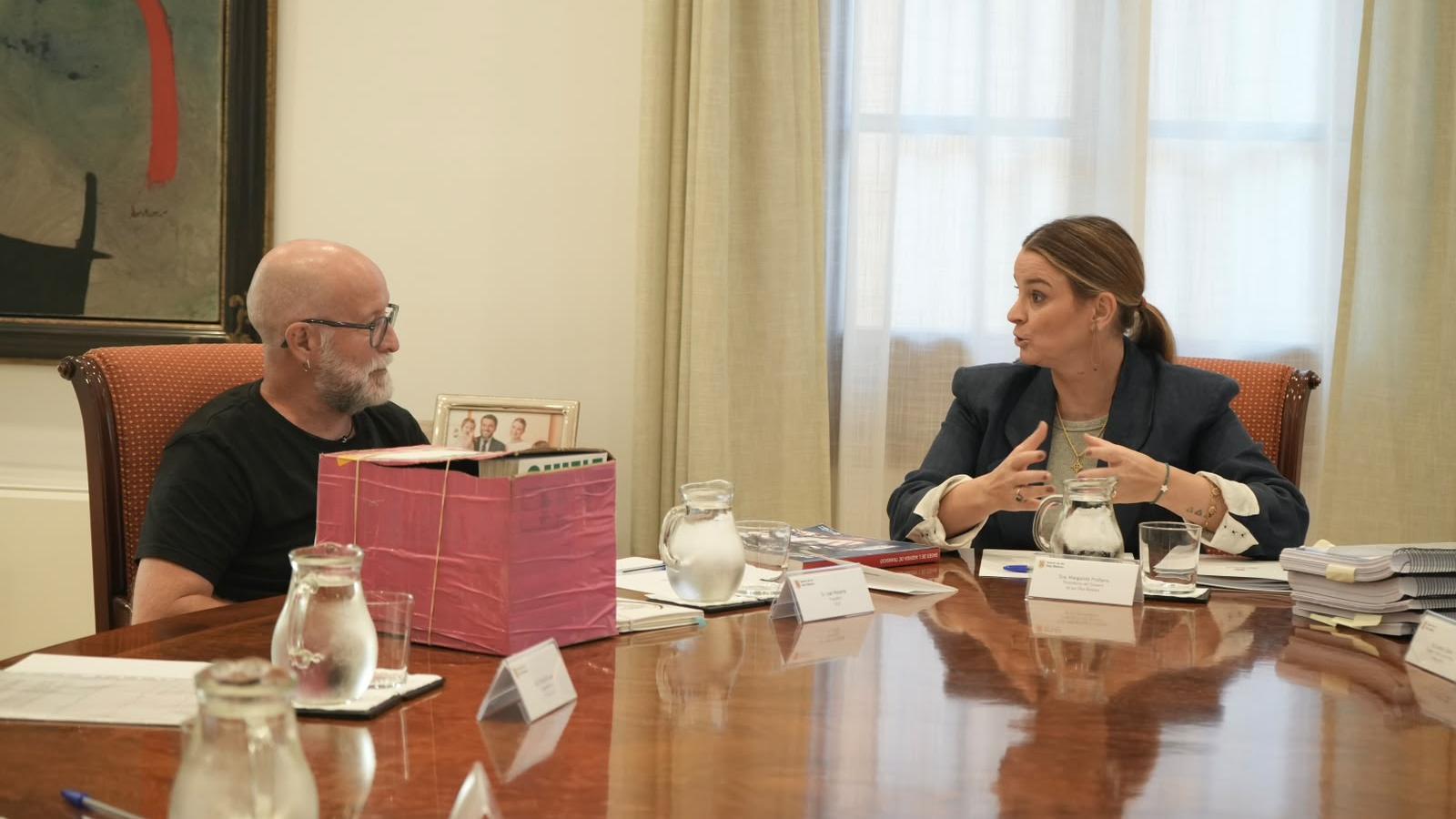
PalmaFor three hours, the President of the Government, Margalida Prohens, and the representatives of GOB and Terraferida addressed the outcry heard in the streets this summer demanding limits on the territory consumption model and tourist saturation of the Balearic Islands. Prohens received the two environmental organizations this Tuesday afternoon at the Consolat de Mar, after a few months marked by massive social mobilizations.
The three hours, however, were not enough to bring the two sides closer, as they ended in "absolute disagreement," in the words of GOB vice president Tonina Siquier. "We do not agree on the diagnosis or the measures," Siquier summarized the meeting.
Despite the result, the environmentalists highlighted Prohens' "dialoguing" nature. The Minister of Agriculture, Fisheries and Natural Environment, Joan Simonet, and the Minister of Labor, Public Function and Social Dialogue, Catalina Cabrer, also participated in the meeting. However, the environmentalists believe that the willingness to dialogue has not translated into any rapprochement on the policies necessary to face saturation.
The main point of rupture is degrowth, and they accuse the Executive of trying to respond to tourist saturation with "small measures of makeup and containment that will lead us to collapse." "Mallorcan society is already tired of studies, plans, and photographs, both from left-wing and right-wing governments," Siquier asserted. "The perception that we have exceeded the limits is so great that we must take action, and not pass laws surreptitiously to be able to continue growing," she added. The GOB vice president also warned that "people are fed up with one side and the other passing the buck."
The representatives of GOB and Terraferida also delivered to the Consolat the 1,050 contributions collected during the human chain on August 29, promoted by Madò Farta, and at the demonstration against the airport expansion held last Sunday. Participants had to answer the question 'What Mallorca do we want?' on a sheet of paper. Among these contributions is also a letter that Madò Farta has addressed directly to President Prohens.
Containment is not enough
Environmental organizations have submitted a wholesale amendment to the economic, territorial, and urban growth model of the Balearic Islands, which is in permanent expansion, and have delivered an extensive document to Prohens in which they demand a profound change based on concrete policies. "It is no longer enough to contain, we must start to reduce," is the main message that has been conveyed to the Consolat de Mar. GOB and Terraferida call for actively reducing tourist, urban, and automotive pressure, the impacts on ecosystems, and the consumption of energy and natural resources "to ensure that future generations can continue to live with dignity on these islands."
They warn that the crises of housing, mobility, water, biodiversity, and quality of life are interrelated problems resulting from this economic model based on unlimited growth. Therefore, they demand that public policies adapt the economy and development to the physical and ecological limits of the Balearic Islands, instead of adapting the territory to endless growth, and they ask that the idea of "managing saturation better" and "containment" be replaced by explicit policies for reducing existing pressures. "Mallorca does not need to learn to better endure saturation, it needs to stop being saturated," they insist.
The document delivered to the president of the Executive branch outlines eight main lines of action, which are based on recovering housing for living, stopping urban growth, putting a brake on new roads and betting on public transport, placing limits on airport growth, adapting growth to available water, recovering food autonomy, returning to the initial essence of the ecotax, and ensuring a habitable and climatically secure future.
Environmentalists have been particularly critical of the Sustainability Pact: "if the major decisions being made in parallel continue to facilitate more lack of protection for the territory, more urbanization, more tourist uses, and more roads". Therefore, and pointing out this contradiction without questioning the spaces for dialogue, they assert that "sustainability is not demonstrated by the number of dialogue tables that are convened, but by the decisions that are taken". Dialogue, they ensure, "only makes sense if we are willing to also talk about limits and the reduction of pressures that are already unsustainable", and they mark biophysical limits as the framework within which "any economic model must function" in an island territory.
Likewise, the document demands the recovery of the mechanisms of the Law 10/2023 on well-being for present and future generations that were suppressed or weakened in 2024 by the Administrative Simplification Decree-Law promoted by the PP Government with the support of VOX, especially the reports on the intergenerational impact of regulations, plans, budgets, and large projects; the functions of the commission in charge of ensuring the application of the law; or the evaluation of all major decisions according to their future impact on water, the territory, the climate, biodiversity, and quality of life.

Housing
To address the serious housing crisis experienced in the Balearic Islands, environmentalists are calling for the Balearic Islands to be declared a stressed residential market area, to regulate rental prices, to mobilize vacant housing and expand the public housing stock through purchase and renovation, to ensure that social housing permanently maintains its social function, to approve a moratorium on new tourist rental licenses, to pursue illegal tourist offerings, and to progressively reduce existing places, without returning those that are cancelled to the market pool.
Stop urban growth
An immediate moratorium on new buildings on rustic land is one of the main measures that GOB and Terraferida have put on the table to put a brake on massive urbanization, as well as to move towards the prohibition of new dispersed housing. They also bet on preventing the development of developable land not yet transformed, preventing new private swimming pools, or preventing the reform of the Agrarian Law from turning the countryside into a new urban, real estate, or energy frontier.
The document highlights that between the years 2021 and 2024, 546 hectares of agricultural land were artificialized and 846 villas were built or expanded, while between 2015 and 2024, 10,680 new swimming pools were built in Mallorca, almost a third of which are located on rustic land.
Fewer roads and more public transport
At a time when traffic collapse has become widespread on the roads of Mallorca, the organizations have requested to halt the expansions planned in the Road Plan, as they generate induced traffic, greater territorial dispersion, and a greater dependence on the car. They also want the number of vehicles allowed to circulate on the island to be limited and to replace the Road Agreement with the State with a Sustainable Mobility Agreement.
In this sense, they call for the promotion of the Llevant train and the rail connection with Alcúdia, as well as increasing rail frequencies, reinforcing buses, and recovering BUS-HOV lanes where they are effective.
Limits on airport and tourism growth
Another of the main lines of the requests to Prohens is the reduction of tourist places, thus eliminating public spending on tourism promotion and incentives for new commercial air routes. Regarding airport growth, they ask to oppose expansions of the operational capacity of airports and to incorporate ecological and social limits based on each island into airport governance.
Likewise, they have taken the opportunity to criticize that the DORA III promoted by Aena foresees investments of 622 million euros in Palma, 230 million in Ibiza and 170 million in Menorca, within a planning based on the growth of air traffic.
No to new growth without available water
The most scathing criticism regarding water concerns Law 4/2026, which allows the processing of certain urban developments without a Water Resources report. For this reason, they demand conditioning any new urban or tourism development on the proven existence of sufficient water and restoring and strengthening water sufficiency reports. They also point out the need to protect aquifers and reduce excessive residential, tourism, and recreational consumption. They flatly reject that the structural response should be to produce more water through more desalination or new water intake projects.
Primary sector and food production capacity
Among the package of measures, GOB and Terraferida bet on increasing food autonomy and reducing external dependence, which would involve the protection of agricultural land and marine ecosystems and ensuring generational renewal for farmers, as well as strengthening agriculture, extensive livestock farming, and low-impact artisanal fishing. They also request that local, organic, and seasonal products be incorporated into schools, nursing homes, and hospitals.
Ecotax earmarked to protect the territory
Environmentalists are very critical of the distortion of the Sustainable Tourism Tax and advocate for "recovering the meaning of the ecotax". This would involve increasing its amount so that it adapts to the current tourism pressure, giving it a definitive purpose, and prioritizing its allocation to restoring ecosystems, protecting the territory, and adapting the Islands to climate change.
A habitable future
For all these reasons, and with the aim of guaranteeing a habitable and climatically secure future, the two entities have asked Prohens to accelerate the implementation of the Climate Change Law approved in 2019, to turn "climate security" into a cross-cutting criterion that affects all major public decisions, to avoid energy transition involving the occupation of agricultural land or ecologically valuable spaces, and to execute the pending proposals made by the Citizens' Assembly for the Climate.
"On July 26, more than 70,000 people took to the streets of Palma to say that Mallorca is at its limit". That mobilization did not simply ask for better management of saturation, they claim, but rather "expressed the need to address its causes", for which the institutions "now have the responsibility to turn this outcry into decisions", they concluded.
