Emissions are 80% more than those of 1990 because of flights
Experts recall that the airline industry causes more than a third of CO2 in the Islands and demand a review of the model that goes beyond a debate "to replace one fuel with another"

-
CAT -
DE
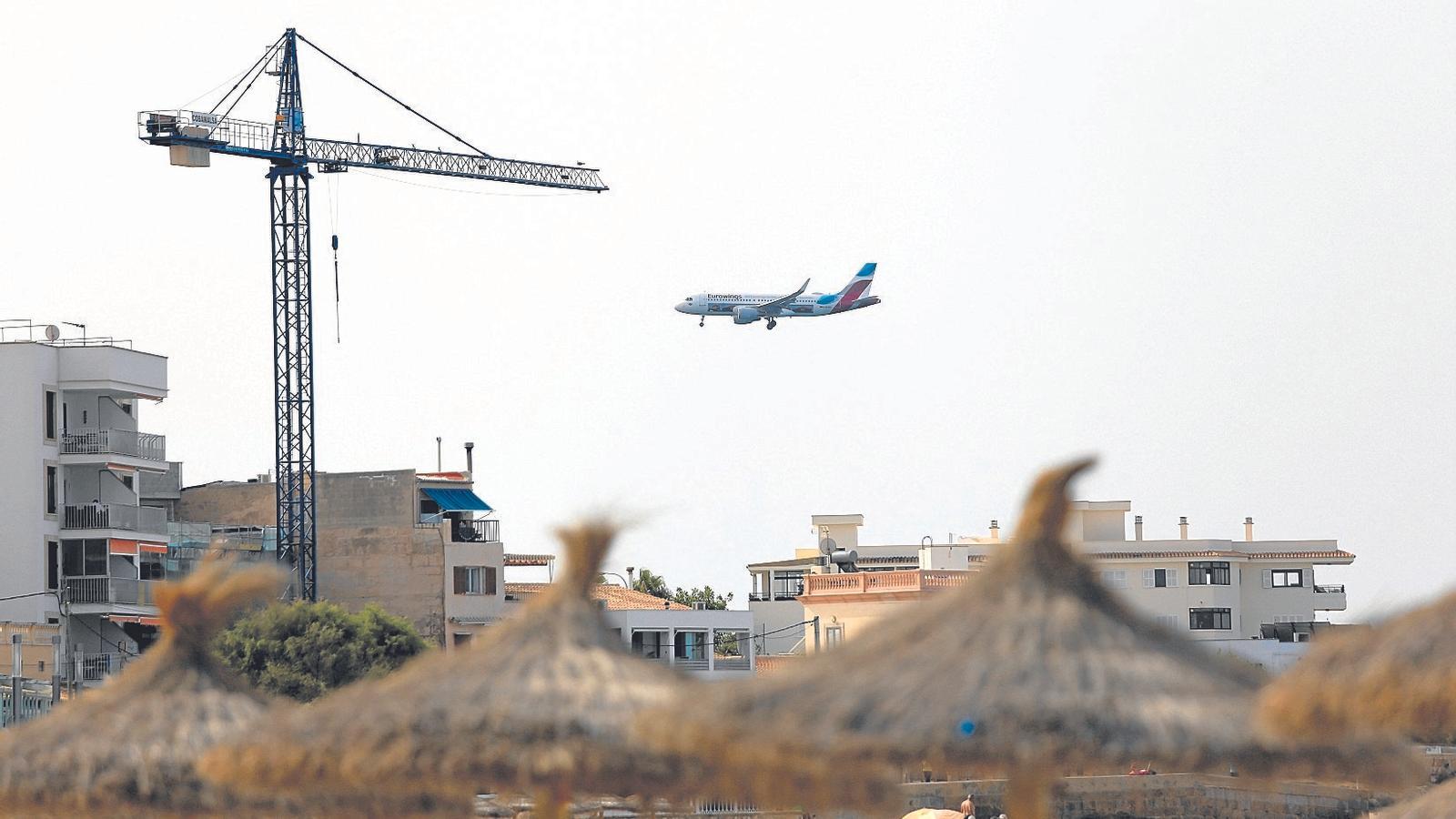
PalmaThe Balearic Islands are failing to reduce greenhouse gas emissions, despite progress in the deployment of renewable energy and the transformation of the electricity system. Experts in climate change and energy agree that this trend will continue if air traffic is not reduced, which is responsible for more than a third of the CO2 equivalent in the Islands. Improvements in energy production and transport efficiency, together with the introduction of renewables, have helped to slow the increase in emissions. However, the growth of tourism and the population makes current commitments to combat climate change unattainable.

In 2024, the Islands emitted 12.2 million tons of CO₂, 80% more than in 1990. A large part of the increase is explained by transport: while emissions from electricity generation have remained relatively contained, those from land, sea, and air transport have tripled during this period.
Physicist and climate change expert Damià Gomis and Professor of Mechanical Engineering Ramon Pujol agree on this analysis and ask to what extent climate goals can be met if the transformation of energy sources is not accompanied by a “review of the economic and consumption model of the Islands”.
Pujol's data shows the magnitude of the problem. Air transport accounts for 35.8% of the final energy consumption of the Balearic Islands, while land and sea transport together represent another 30.4%. 66.2% of the final energy consumed in the Archipelago corresponds to the mobility of people and goods. “It is essential to tackle a much more ambitious strategy than the simple debate about the fuels used,” states Pujol. Gomis regrets that “transport, especially air transport, shows no sign or real interest in changing the trend”.
Fossil dependency
The difference with respect to the other sectors is considerable. Households account for 13.8% of energy consumption; commerce and services, 11.5%, and industry, only 1.6%. These are 2025 data that highlight “to what extent the Balearic energy model depends on the fossil fuels used by planes, ships, and vehicles circulating by road”, insists Gomis.

The physicist from Menorca warns that the global emission figures for the Balearic Islands "are not cause for much satisfaction." Despite the growth in electricity demand, the emissions associated with electricity generation are only slightly above 1990 levels. The replacement of coal with natural gas, the increase in electricity imports from the Peninsula, and the progressive implementation of renewables have contributed to containing them.
In contrast, transport emissions have tripled since 1990, an evolution that makes fulfilling climate commitments enormously difficult.
The evolution of total emissions also highlights this difficulty. The Balearic Islands reached their peak emissions in 2008, with 14.2 million tons of CO₂ equivalent. Since then, they have been reduced, but the 12.2 million tons in 2024 remain far above the levels of 1990, the reference year for legal targets. The Balearic Climate Change Act stipulates that emissions must be reduced by 40% by 2030 and by 90% by 2050 compared to 1990.

According to Gomis, “the magnitude of the challenge forces us to go beyond technological substitution”. The physicist believes that it is not enough to change one energy source for another and that we must also “review the way we live, consume and produce”. Otherwise, the growth in demand may counteract the improvements in some sectors, he warns.
Air transport is one of the main examples of this contradiction. Gomis and Pujol point out that the sector does not show enough transformation to substantially reduce its emissions.
More tourism and population
Pujol warns that efficiency improvements can partially reduce environmental pressure, but that they will hardly compensate for the “increases in population, economic activity, and mobility if the trends of recent decades are maintained.” The professor places the population growth of the Balearic Islands since the 90s at around 65%, an increase which, added to the tourist volume, makes it very difficult to “achieve global emission reductions.” This being the case, Pujol believes that “one cannot aspire to meet climate commitments without also addressing the evolution of energy demand,” which in the same period increased by 58.9%. However, domestic consumption only grew by 11%.
According to Pujol’s analysis, 60.8% of the increase in summer electricity consumption corresponds to the accommodation and restaurant sectors. This contribution cannot be attributed solely to tourism, “but it shows the weight of seasonal economic activity on energy demand.” The professor points out that Palma airport recorded 33.8 million passenger movements in 2025, 42.4% more than ten years earlier. This figure is equivalent to almost 35 passenger movements per resident per year in Mallorca. “These are entry and exit movements, not necessarily different people. Residents are also part of the problem.”
Gomis considers it essential to review the volume of travel associated with tourist activity. “Short trips, round-trip getaways, and the arrival of a very high number of visitors are dynamics that cannot be ignored if the goal is to reduce the climate footprint on the Islands,” he says.
The electric vehicle is not enough
Cars are one of the examples that Ramon Pujol uses to explain the need to rethink the model. “Replacing a combustion car with an electric one reduces emissions, but it does not mean eliminating them completely,” he stresses. The manufacturing of vehicles and batteries requires materials and energy, just as scrapping and recycling do.
Furthermore, indirect emissions during circulation depend on the origin of the electricity used to charge them. An electric car does not generate exhaust gas emissions while driving, but the climate footprint includes electricity production and the manufacturing process. “It is important to look at how we move and not just think about changing one fuel for another,” he adds.
Pujol has developed a scenario based on several international studies: an electric vehicle powered by energy coming 70% from renewable sources would reduce CO₂ equivalent emissions by about 63% throughout its life cycle compared to an efficient diesel one.
The “delayism” in the face of the crisis
The Secretary of State for Energy, Joan Groizard, explained to ARA Balears that, when responding to experts' recommendations by administrations, it is necessary not to lose sight of the “political and social delayism” that hinders the adoption of decisions that accelerate the energy transition.
This positioning manifests itself in various ways. “On one hand, the argument that it makes no sense to reduce emissions in Europe if other countries, such as China and India, do not do the same,” points out Groizard. On the other, there is the belief that “future technologies, such as hydrogen, will solve the problems without having to introduce immediate changes.” “Another form of delayism, based on resignation, is to consider that it is too late to act against climate change,” he continues. According to the Secretary of State, these approaches can turn into excuses to postpone necessary decisions.
2.8 billion for the Islands
Groizard mentions the investments to transform the energy system and highlights that “the Balearic Islands will be one of the most benefited communities”, with a contribution of 2.8 billion euros over the next few years. One of the main actions –approved at the last Council of Ministers– will be to complete the second electrical link with the Peninsula: it will connect Castellón with Mallorca through an infrastructure of about 400 kilometers, of which about 390 will be underwater. Red Eléctrica calculates that the two links will allow covering 65% of the Balearic electricity demand and avoiding the emission of more than 900,000 tons of CO₂ per year.
The planning also provides for a new connection between Mallorca and Menorca, of 82 kilometers, 64.5 of which will be underwater. The link must strengthen supply security and reduce dependence on the Maó thermal power station. According to Red Eléctrica's estimates, this infrastructure will allow the avoidance of about 154,000 tons of CO₂ annually.
Another objective is the electrification of the ports of Palma, Alcúdia, Maó and Eivissa. Groizard highlights its importance, because docked ships generate emissions: auxiliary engines run to provide electricity.
