Fewer controls, more growth: this is how Prohens has changed the territory's rules
Ecologists and civil society lament the Government's inaction, which has had saturation explode in its hands. The Executive defends small measures
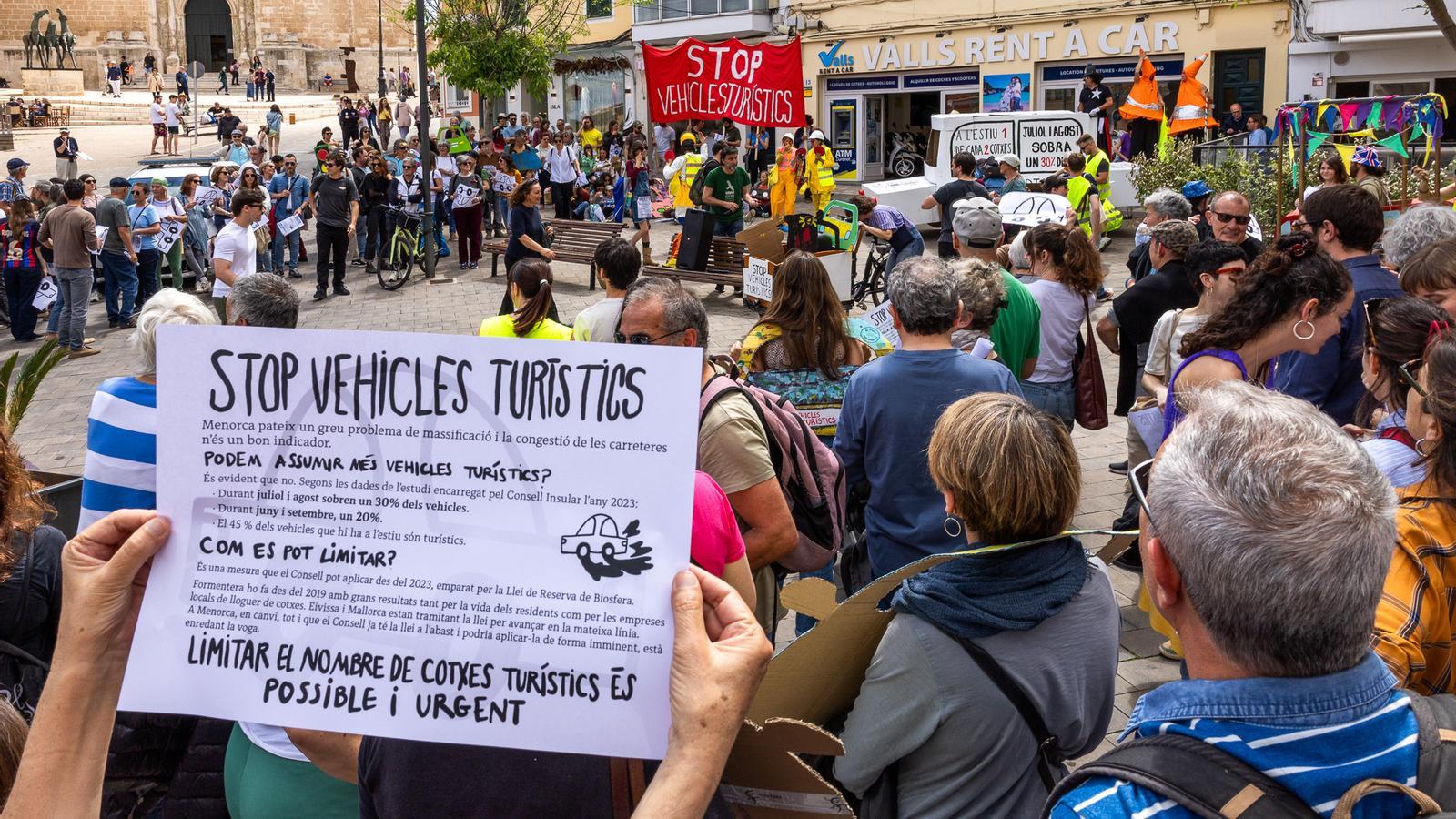

PalmaMarga Prohens' Government cannot be blamed for decades of saturation. However, the social and environmental movements calling for this summer's demonstrations – Menorca is giving the lead – consider that “it cannot be stated that they have taken a single real containment measure, not even to mitigate the impacts,” according to UIB geographer Macià Blázquez.
The regulatory reforms approved in the last three years have been presented as a response to the need to simplify the Administration. However, the political opposition and conservation organizations have reiterated their criticisms because the reforms have gone in the direction of reducing the mechanisms that were used to limit the transformation of the territory in recent decades.
Different laws and provisions have built a model that establishes “fewer controls, fewer environmental constraints, and more capacity for growth,” in the words of the opposition.
For its part, the Government defends that it has promoted various measures to contain tourist pressure and limit the increase in visitors, among which it highlights “the Tourist Containment Decree, which prevents increasing the accommodation offer, since to register a new place it is necessary to deregister another, and which prohibits the creation of new tourist places in apartments,” argue sources from the Executive.
Without Environmental Commission
If there is a decision that symbolizes the Government's philosophy, it is the suppression of the Balearic Environmental Commission. Sectors such as developers had complained about the large number of urban development projects that were progressing “much too slowly”, and the Prohens Executive committed to eliminating what environmentalists considered an independent environmental filter for projects with the greatest territorial impact.
The Government justified its elimination by arguing that it was a slow, bureaucratic, and excessively politicized body. But the disappearance of the Commission implies more than an administrative reform. “It means replacing a collegial system with a structure integrated within the Administration that drives a large part of territorial policies”, criticizes the spokesperson for GEN-GOB, Neus Prats. Sixteen environmental entities publicly demanded the maintenance of the Commission.
The Executive appointed Paz Andrade as head of environmental validation and assessment of projects. Technical sources from different ministries consulted by ARA Balears confirm that Andrade has a "very executive profile, and has no problem promoting the necessary actions to make the political commitments to accelerate projects possible". "She has not come here to protect the environment," they state.
Torre Vella, first case
A few months after the Commission's removal, a case arrived that many environmentalists have turned into an example of the risks of the new system. In Torre Vella (Menorca), seven swimming pools had been built in a project where initially only seven water collection tanks were listed. The former Balearic Environmental Commission had maintained objections to this change. When the Alaior Town Hall granted the license, the GOB denounced that the suppression of the Commission had left that environmental opposition without institutional continuity. “No one defends or claims this environmental sanction,” they warned.
Rustic amnesty
The most symbolic measure of the legislature is probably the extraordinary legalization of illegal constructions on rural land. “Something had to be done and the dwellings could not be kept in limbo indefinitely,” explained Vice President Antoni Costa to ARA Balears when the first version of the measure was approved. The Administrative Simplification Law approved by the Government has made it possible to regularize hundreds of dwellings and buildings out of order that had become time-barred from an urban planning perspective. It is a historic demand from certain sectors of owners, but also one of the decisions that has generated the most alarm among environmentalists, urban planners, and territorial planning experts. “Those who legalize now can rent, for example. They will have everything in order and there will be more occupation of rural land,” warned the spokesperson for Terraferida, Jaume Adrover.
According to the opposition – which took the norm to the Constitutional Court – “the message is given that building an irregular house is not something done wrong, because it ends up being fixed by the Administration”.
ARA Balears documented a flood of inquiries and hundreds of cases after the initiative came into force, a situation that confirmed that the measure had a significant impact. “Electorally this can work, sadly,” assures Neus Prats.
The simplification project
The Administrative Simplification Law modified more than 170 articles and dozens of sectoral regulations. The aim was to reduce procedures, eliminate reports, and establish fewer conditions. For certain business sectors, it was a blessing, but for conservationists, it meant a reduction in controls.
Among the approved measures – in addition to legalization in rural areas – the GOB and other entities negatively highlighted that the Government recovered the possibility of building new houses on rural land at risk of erosion, landslides, and fire. “The cataloging of these areas was not well elaborated and rights were removed, sometimes without any real basis,” explained the Executive. Simplification was an electoral commitment that the PP has applied in a large part of the communities where it governs.
On the other hand, Executive sources assure ARA Balears that "the fight against illegal tourist offers has been strengthened through the obligation to include the registration number in advertisements; the toughening of sanctions; the contribution of resources from the Sustainable Tourism Tax to strengthen the inspection of the island councils, and collaboration with digital platforms to eliminate irregular advertisements". According to the Government, the actions taken so far have made it possible to remove advertisements equivalent to about 60,000 tourist places.
Among the measures adopted is also the decree that prohibits the rental of private boats, as well as the agreement with shipping companies to reduce the weekly cap on cruise passengers. According to the Executive, this limitation will be equivalent to a reduction of about 30,000 cruise passengers per month during the months of July, August and September from next year.
More construction
The housing reform agreed between the PP and Vox probably represents the biggest increase in urban planning capacity of the legislature. The housing emergency has led the Executive to deploy a set of initiatives, among which the increase in density of up to 45% in large urban projects stands out. Palma is processing eight, which will mean around 11,000 homes, at least half of which will have some degree of price limitation.
The GOB denounced that, no matter how much the objective is to increase the number of flats for residents, one cannot opt for a growth model "disconnected from the real ecological capacity of the territory". At the moment, there is an important debate about whether this urban growth – Palma's General Plan did not foresee it – can be developed when the Government's Water Resources reports already warned in 2023 that there was not enough water even for the plans approved by the left.
Less water control
The confrontation over water has been one of the hallmarks of this legislature. The team of Palma's mayor, Jaime Martínez, has promoted the construction of more housing and has often clashed with the directives and restrictions of the Ministry of the Sea and the Water Cycle.
This paints a paradox. On islands that chain together episodes of drought, restrictions, and aquifer overexploitation, territorial policy continues to plan thousands of new homes while the capacity of some technical bodies to act as a brake is reduced.
With this scenario, for the moment, “the battle is won by the need for housing and the pressure of developers,” explains a technician consulted by ARA Balears. An additional provision of the Omnibus Law approved weeks ago allows, in certain cases, for town councils to decide not to submit their urban plans to Water Resources.
Also the transition areas
Also, under the pretext of a housing shortage – following a specific demand from Vox – Parliament included in its legislative reforms the possibility of building housing in transition zones in municipalities with over 20,000 inhabitants.
In a community that denounces the progressive disappearance of free spaces, the flexibilization of these zones represents a paradigm shift that is difficult to ignore. The Government admits that "the Islands have reached their limit". "We have recognized it, starting with the president herself," point out sources from the Executive, who counter that "not only are measures being taken, but also significant investments in innovation and actions such as the creation of the Accelerator Unit for Strategic Projects," they say.
