Odón de Buen himself recounts in his memoirs how, one fine day, a curious character appeared at the Portopí laboratory, with whom he came to enjoy a close friendship. He was called, or called himself, Gandolfi Hornyold: careless in appearance, insatiable in eating and drinking and enthusiastic about Mallorcan gastronomy and, at the same time, a man of solid culture, a good person and very hardworking. He settled with his wife and two daughters in the Terreno neighborhood, in Palma.Hornyold studied eels, and the most curious thing is that, in his study, he could be heard talking to himself: until they discovered that he was doing it with those little animals, whom he insulted if his research did not advance or addressed them affectionately if they went to his liking. This curious relationship was not incompatible with using them as culinary ingredients, as this was another of his passions.De Buen was stunned when they called him from the Royal Palace in Madrid, asking him if he knew the address of the "Duke of Gandolfi," because, his mother having died, King Alfonso XIII wanted to offer his condolences. And, in fact, it turned out that the man who talked to the eels was the Duke of Gandolfi and Hornyold, a member of the British aristocracy and godson of Alfonso XII, the father of the reigning monarch.
From discovering the Mediterranean to ending up imprisoned in Mallorca: the story of Odón de Buen
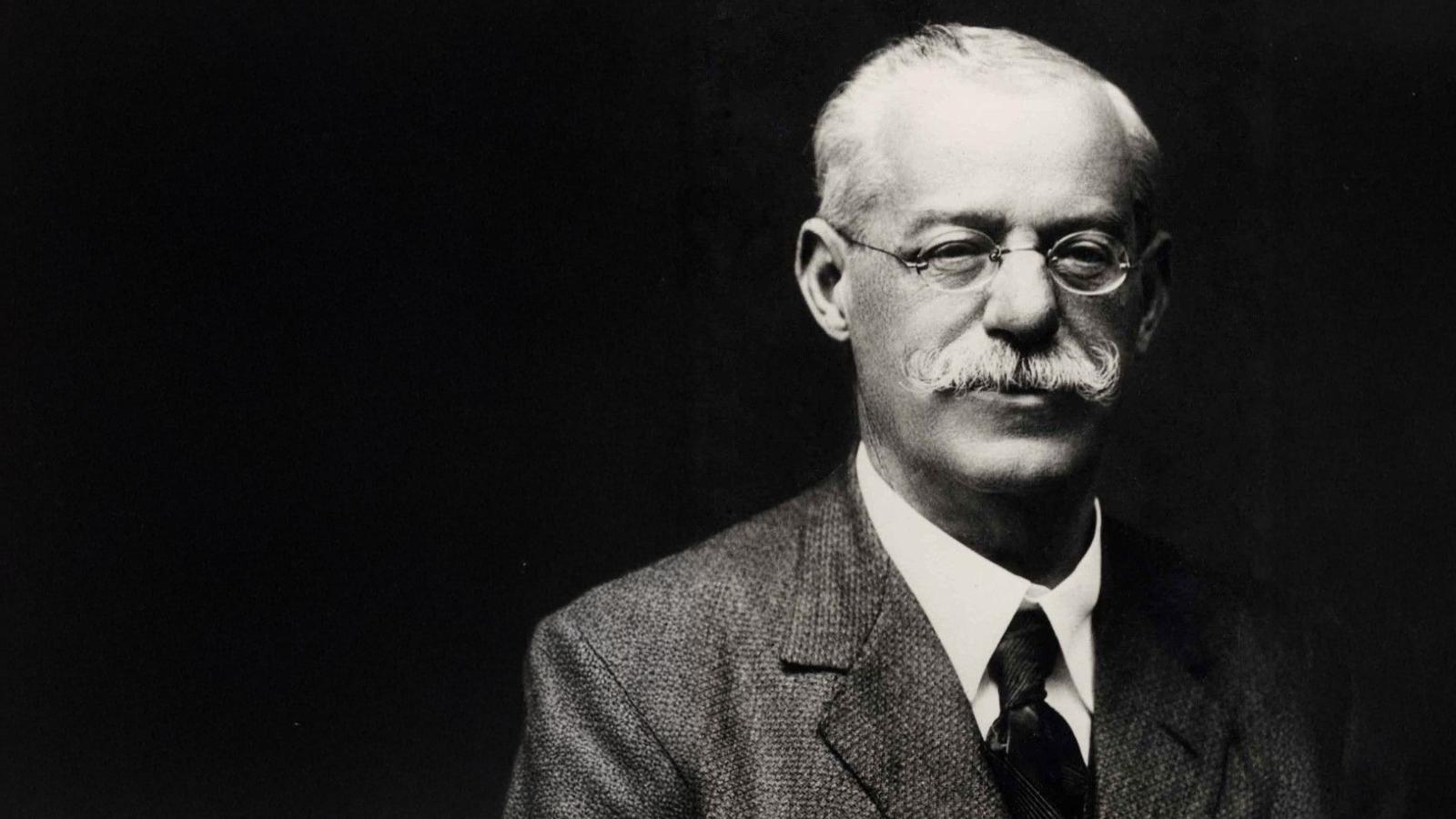
We review the trajectory of Odón de Buen, creator and director of the Balearic Oceanographic Laboratory, the second in the State, when it is 90 years since his imprisonment in Mallorca

-
CAT -
CAST -
DE
PalmaHe was Aragonese, from inland, but a long sea voyage, including a visit to the Islands, revealed his vocation: the study of the sea, oceanography, of which he was a pioneer in Spain by creating and directing the Oceanographic Laboratory of the Balearic Islands, the second in the State and an international reference. It was the final stages of his career when in July 1936, 90 years ago, he was arrested in Mallorca and imprisoned until August of the following year.
Odón de Buen, born in Zuera (Zaragoza) in 1863, was a multifaceted character, of incessant activity and what would now be called a good public relations man, who invited journalists and researchers to publicize his scientific adventures, and who came to enjoy solid international prestige. He was a man of advanced ideas for his time: a free-thinker, secular, and republican. He was a senator for the Solidaritat Catalana coalition.

A journey marked his trajectory forever, much like Darwin's on the Beagle around the world: the one he took as a naturalist, between 1886 and 1887, aboard the frigate Blanca, through Northern Europe, in a first stage, and through the Balearic Islands, Algeria, and Southern France in the second. His career was closely linked to Mallorca: an uncle of his lived on the island and he and his wife visited it often. He was an enthusiast of Mallorcan cuisine.
Traveling the world was all well and good, but he had to earn a living. De Buen obtained, by competitive examination, the chair of Natural History at the University of Barcelona. And problems rained down on him. His educational innovations, the content of his books, and his defense of the theory of evolution made him the object of the wrath of the most conservative sectors and, above all, of those linked to the Church.
Study trips to Mallorca
His volume Geologia was included in the index of prohibited books by the ecclesiastical authority and its cessation was decreed. De Buen did not back down: he stood his ground at the university and declared: “It seems that it smells of death here. But let it be known that, if anyone dies, it will be the freedom of teaching”. The students mobilized and his professorship was returned to him. Upon resuming his classes, he used the celebrated expression of Fray Lluís de León, in a similar circumstance: “As we were saying yesterday...”
With his students from Barcelona, the Aragonese professor organized study trips – these must have been real studies – one of the destinations of which was the Balearic Islands. More than 200 students arrived there on some occasions. In 1923, among those young people, a “tall, thin, taciturn Asturian boy” visited Mallorca – as collected by José María Tejerina. He was called Severo Ochoa and would go on to become a Nobel Prize winner in Medicine. It was also during that period that his visits to the Aragó maritime laboratory in Banyuls, in the Roussillon, began. With French colleagues, he carried out the first joint study of the Balearic coasts. On one of the excursions, they discovered a new species: a small blind shrimp, in the lakes of the Drach Caves. They also visited Archduke Lluís Salvador in Miramar, a friend of De Buen and a faithful follower of his initiatives.
The Aragonese scientist conceived the idea of creating facilities similar to those in Banyuls in his own home. Where should this new laboratory be located? De Buen was clear: in the Balearic Islands, an “archipelago of unparalleled position”, as he stated in a conference at the Ateneu de Madrid in 1906. It would be both a training center for university students from all over the State and a focus of attraction for foreign researchers.

Only six months had passed since that talk when the new facility was created, in Palma, by decree of the central government. It was the second in the State, only behind the one in Santander. Initially, it had a provisional headquarters, near the Mal Pas stream, close to Bellver. Of course, complications were not lacking: Madrid had not provided the promised land, while the Palma City Council turned off the tap of economic aid.
Finally, in 1908, the headquarters was inaugurated, in Portopí. That laboratory had everything needed for scientific research: workbenches, instruments, a library, a museum, chemistry and photography rooms, and, above all, an aquarium, with two large windows overlooking the sea and divided into eight spaces, one for each group of species, to the admiration of visitors.
What else did De Buen need to complete the task? Very simple: a boat with which to conduct scientific explorations. That request astonished the ministry officials –“what on earth would this good man want a boat for?”–, but they handed over not one, but two that had been confiscated from smugglers. On the first crossing, in Ibiza, on the way back to Mallorca, they hired an additional sailor as reinforcement. He only stipulated, as a condition, that he could take away "a couple" of melons. And he showed up with a cart full. That is to say, 'a couple' in the island version.
The visit of the Prince of Monaco
In 1909, the Palma laboratory received a visit from Prince Albert I of Monaco, another oceanography enthusiast, who declared himself La Época. The following year, Santiago Ramón y Cajal came, who by then had already received the Nobel Prize in Medicine. The objective: to study the neurons of cephalopods. He set up in the same laboratory, accompanied by his wife, who prepared his meals.
In 1914, the Spanish Institute of Oceanography was created, in accordance with a proposal by De Buen himself, to integrate the laboratories of the Balearic Islands and Santander, and some others that would be created later, such as Malaga. Of course, the headquarters was in Madrid, where, as everyone knows, there is a lot of sea. De Buen was in charge of its launch.
That scientist with such advanced ideas, curiously, was a good friend of General Miguel Primo de Rivera – they had been schoolmates in Madrid – who, upon becoming dictator, from 1923 onwards, entrusted him with the general direction of Fisheries, which included the National Institute of Oceanography. The appointee insisted heavily that that position was "exclusively technical".
With the Majorcan Antoni Maura, five-time president of the central government, he met several times in Palma, and among his friends in Mallorca were several prominent Maurists. Another Majorcan, General Weyler, a liberal, had used his influence so that De Buen would be reinstated in his professorship when he had been removed from it.
In April 1933, already under the Republic, the Palma laboratory celebrated its 25th anniversary in a new headquarters, in Aigua Dolça, with a hotel – the Royal – above the scientific facilities: a premonition of what the essential future activity of the Majorcans would be. De Buen was accompanied by the then military commander of the Balearic Islands, Francisco Franco; and by the doctor Emili Darder, who only a few months later would become mayor of Palma. Before the end of the decade, the former would become dictator and the latter would be shot.

When the summer of 1936 arrived, the atmosphere in the State was one of marked tension: on July 13, the right-wing deputy José Calvo Sotelo was assassinated. Fortunately, De Buen, who was already 73 years old, and his wife were expecting a holiday in their beloved Mallorca. It was "the island of calm." Nothing bad could happen to them. They arrived on July 18, very early. And, while they were enjoying a good snack on the terrace of the Royal, with sea views, they learned of the coup d'état.
Just a few days later, De Buen was arrested and imprisoned in the old Capuchin convent, in more than lamentable conditions and without being able to communicate with his wife. Sick with diabetes and cataracts, he managed to have food brought to him from outside and was then transferred to the hospital, where he was assisted by doctors who were former students of his and was able to receive a visit from his wife. After dinner, De Buen fascinated everyone – patients, guards, and nurses – with his talks about marine animals.
On December 3, the Danish consul arrived at the hospital, dressed in formal attire, to inform him, with all the solemnity required by the occasion, that he had been awarded the Schmidt prize for oceanography. Everyone, colleagues, doctors, and the nun attending them, surrounded him to express their satisfaction.
Finally, in August 1937, De Buen and his wife were transferred to Valencia, where he was exchanged for two women from the opposing side: a sister and a daughter – how small the world is – of his old friend Miguel Primo de Rivera. With the defeat of the Republic, they had to move to Mexico, where Odón de Buen, the man who rediscovered the Mediterranean, even for the islanders themselves, died in 1945.
Information prepared from texts by Antonio Calvo Roy, José María Tejerina, Albert Herranz Hammer and Joana Maria Roque Company, Luzbel Ruiz, Josep Massot i Muntaner and Odón de Buen himself.
