Ibiza has invented ultraturismo, or how to be rich and poor at the same time
The success of 'premium' tourism, nightclubs and millionaire villas coexists with evictions, sub-standard housing and an increasingly visible housing emergency

-
CAT -
CAST -
DE
IbizaIbiza constitutes a tourist offering without competition. It sounds exaggerated but it is not. What makes the difference are the discotheques, the best in the world, as recognized by several awards in the last couple of years (the Golden Moon Awards and the annual DJ Mag ranking). Clubs have always been the distinctive Ibizan element, but their weight in the overall offering has skyrocketed since the Matutes Group entered the business with three large venues: Ushuaïa, Hï, and for two seasons now, UNVRS. Right now in Ibiza you can party at night or during the day, under the stroboscopic lights of a club or on a beach, it doesn't matter.
Add to this, an excellent dining offer, with several Michelin-starred establishments and a multitude of famous chefs and their brands looking for clients: Gordon Ramsay (Hell’s Kitchen), Dabiz Muñoz (StreetXO), Dani García (Lobito de Mar), Paco Roncero (Sublimotion)... Add some of the best coves and beaches in the Mediterranean, with extraordinarily transparent waters thanks to posidonia – a plant that is a UNESCO heritage site and is dying from climate stress and from so many boats anchoring on top of it. And add a luxury hotel and real estate offering too, with stunning villas and infinite pools.
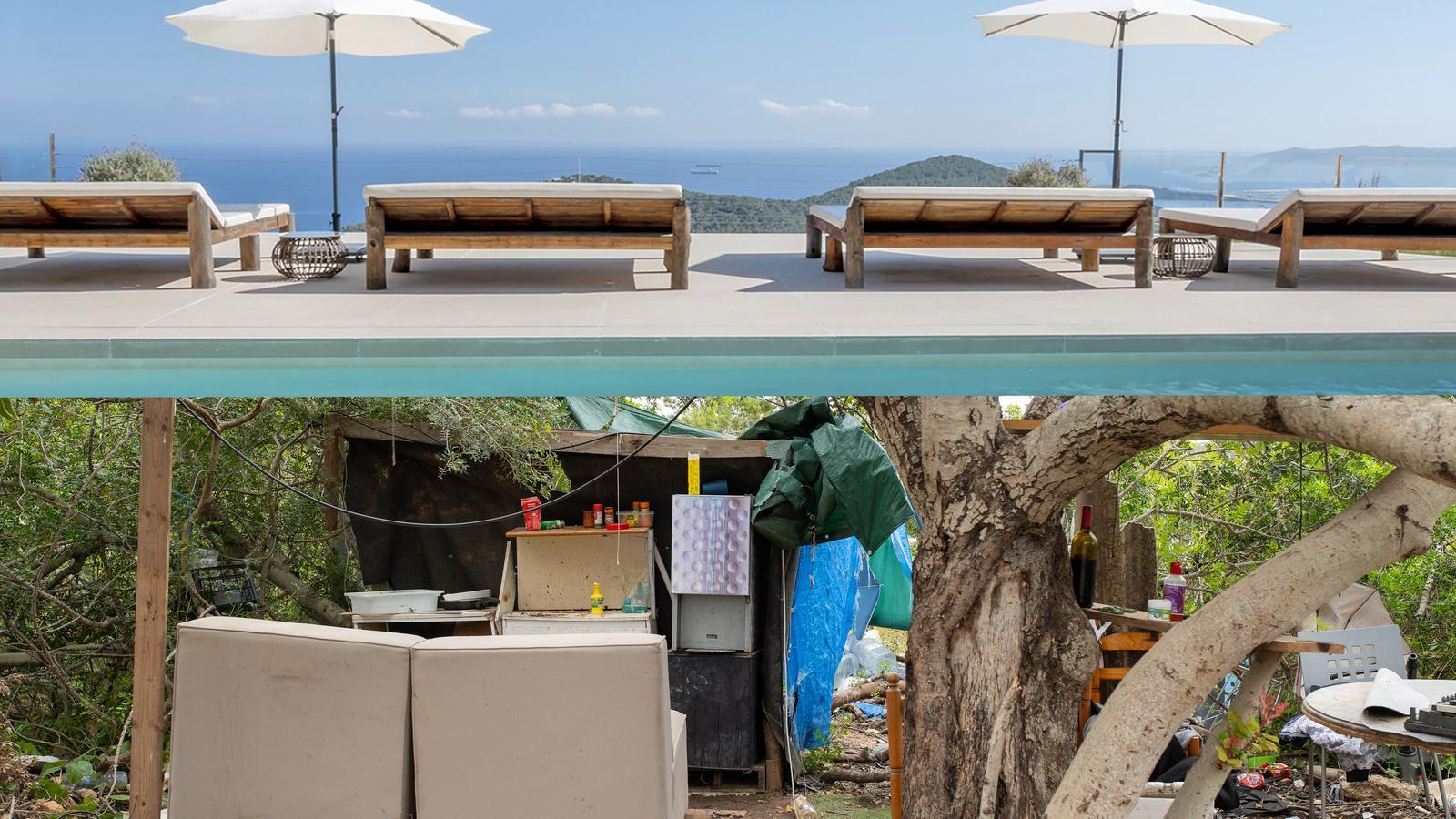
It's not a metaphor: an infinity pool is one that gives the impression of continuing into the sea. You'll find them in mansions that also have a private chef, security, helipad, or private access to a beach club; they will cost you between 30,000 and 70,000 euros per week during high season. If you are also super-rich or famous, you can access the segment of off-marketvillas, where you can end up paying 130,000 per week. Companies like Luxury Lifestyle Villas and Ibiza Luxury Villas manage this. Everything is luxury, here. It's no wonder that the Ibiza tourism sector invoiced more than 4.5 billion euros in 2025 (data from the Balearic Institute of Statistics). The figure is dizzying when compared to the island's dimensions: 570 square kilometers and 160,000 inhabitants. Nor is it surprising that Ibiza Airport is the second in Spain for private jet operations, only behind Mallorca Airport.
Ibiza's positioning as a luxury destination has not been a recent development. Not only has there been a clear vision from powerful businessmen, but the public sector has also participated decisively in relaunching Ibiza as a high-level product. The creation of the Ibiza Luxury Destination brand through Foment del Turisme is a good example; its promotional video mixes images of Dalt Vila, a yacht crossing the sea, a young woman with a straw bag, and a Ferrari Testarossa: this is the idea, authenticity and opulence at the same time. And it has worked. The bet has been a balm in overcoming the pandemic and repositioning Ibiza in a segment like sun and beach, which is already oversaturated.
And, now, find a house to live in
But all medicines have side effects. In Ibiza, housing needs have not been planned with the same effectiveness as the tourist brand. It seems they have not been planned at all. While real estate agencies, nightclubs, and some hotels are living a golden age, the staff who have to work there find it very difficult to access housing. A 60-square-meter apartment can easily go for 1,600-1,800 euros per month. A figure equivalent to the entire average salary. Many owners prefer to rent to tourists and keep the homes for themselves. Thus, in recent years, shantytowns have multiplied in Ibiza, some with hundreds of inhabitants. At the Can Rova settlement, evicted in July 2025, 300 people lived in 90 substandard dwellings; after they were removed, municipal services removed 900 tons of waste. People started talking about the Ibiza of shantytowns instead of the Ibiza of glamour.
A bad thing. This year the excavators were already prepared. In April, before the season began, the Ibiza City Council carried out the eviction of the La Joveria settlement, with 120 inhabitants, and that of Can Misses, with 80 people. The directive has been clear: to prevent large concentrations of shantytowns from forming again at all costs. The Social Welfare department of the Ibiza City Council has assured that no more judicial evictions are planned, but a few days ago about twenty caravans near the old settlements received notification that they must leave the area. In a forest near the urban center of Sant Antoni, this week the Local Police used a drone to locate three small settlements made up of tents. These are just cases from the last seven days.
“Those evicted somewhere have to go”, opines the coordinator of Cáritas in Ibiza, Gustavo Gómez. “If they are thrown out without offering them any alternative, they will have to fend for themselves”. People living in sub-standard housing continue to arrive at the entity's soup kitchens. And the reception center run by Cáritas, intended only for women and children, is at 100% capacity; some of the latest evicted families have ended up there. Poverty is no longer just a matter of people who don't work. “Now we have the soup kitchen full all year round; before, it always went down during the summer”, explains Gómez. “It means that people have needs even if they have a job, usually because rent consumes a significant part of their income”.
Normal salaries can no longer pay for the high Ibizan standard of living. But life always finds a way. Recently, at Cáritas' reception center, there has been an admission by an unusual method, a new user named Ailani: she is a baby, only three weeks old, and was born at the center itself. Perhaps one day her mother will tell her about the circumstances in which she was born. Ailani's mother is a Colombian immigrant. “But the baby is Ibizan”, remarks the Cáritas coordinator.
