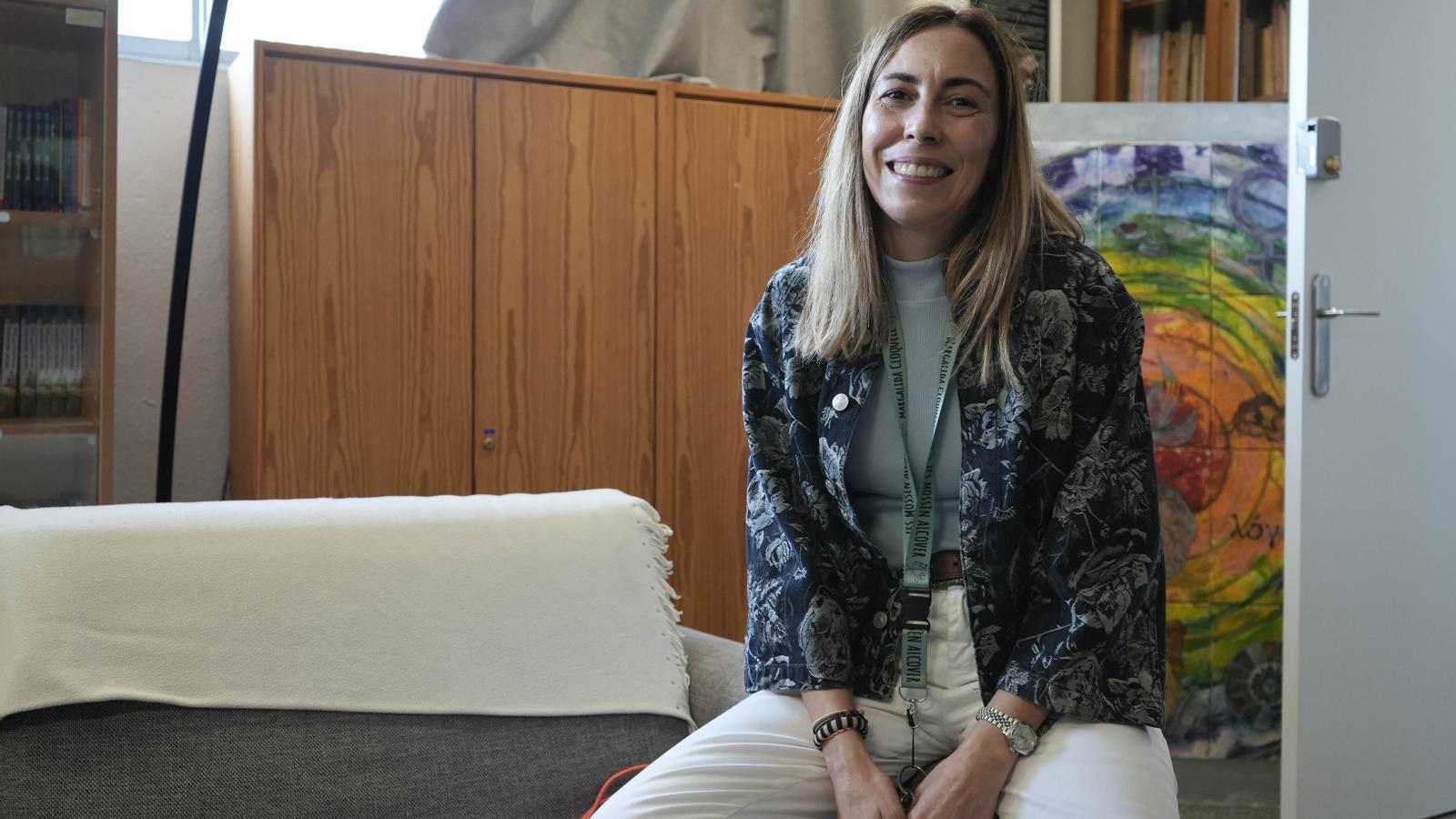
Margalida Cloquell: “It is difficult for us that the use of Catalan has continuity outside the classroom”
Coordinator of the Linguistic and Cultural Reception Program of the IES Mossèn Alcover
-
CAT -
CAST -
DE
Manacor22% of the population of the Balearic Islands has foreign nationality and nearly 30% were born outside of Spain, which represents the highest percentages in the State. The number of students with Late Incorporation into the education system has increased in the Islands by 425% between the 2021-2022 and 2025-2026 academic years, going from 1,297 to 6,814. These are students who have a heritage language other than Catalan, with the handicap that many do have Spanish as their initial language. The Linguistic and Cultural Welcome Program, regulated by the Ministry of Education since 2002, allows each educational center to specify the reception and linguistic and curricular support measures aimed at students who join the education system late and do not know or master Catalan. Among the measures it provides are workshops, welcome classrooms, and reinforcement classes, to facilitate the student's incorporation into the group and help them follow their studies. Newcomer students who join ESO (Secondary Education) not only have to learn Catalan: they often also have to adapt to a new center, continue their studies, and, in some cases, catch up on basic learning. Margalida Cloquell, coordinator of the PALIC at the IES Mossèn Alcover in Manacor, has been accompanying these students for eight years.
You have been coordinating the PALIC at IES Mossèn Alcover for eight years. How has the profile of newcomer students changed and which languages and backgrounds have the most presence now?
— First of all, I would like to highlight that the PALIC is team work. I am the contact person for late-enrolling students at the center, but the reception and follow-up are carried out in a coordinated manner with the various professionals involved. Regarding origins, in 2018 we received more students from the Maghreb, while currently we receive more students from South America. We also tend to receive, each academic year, one or two students from other European countries, in addition to students coming from other autonomous communities. Enrollments occur throughout the school year. Many of these students arrive when they have one or two years left to finish their ESO. This implies that they have less time, within this stage, to learn Catalan and familiarize themselves with the language of the different subjects, while at the same time adapting to the new center and continuing their studies. Having to face all these learning processes and changes in such a short time can also make it difficult to obtain the ESO degree.
How has the way the school welcomes these students and supports them in learning Catalan evolved? Has there been any social change that has specifically transformed the school?
— Currently, the reception process is more structured and is coordinated with the management team, the Guidance and Learning Support team, and the Catalan Language and Literature department. From my experience, we have moved towards a more personal reception that is more attentive to the needs of each student, with more defined procedures to organize their accompaniment and monitoring. When they arrive at the center, all newly arrived students who do not know Catalan are incorporated into the Linguistic and Cultural Reception Program. Information is gathered about the languages they know and their prior schooling, and their linguistic and curricular competence is assessed. Based on this assessment, each student is assigned a schedule that also takes into account the time of incorporation, the degree of autonomy within the regular group, the subjects that coincide with the sessions, and the program's hourly availability. The intensity of support is reviewed according to progress. Regarding social changes, one of the most visible is the diversity of backgrounds, languages, and school trajectories of the student body. This diverse reality is a richness for coexistence and learning, but it also makes it necessary to plan specific measures for reception, accompaniment, and linguistic support that facilitate a positive incorporation into the center and a progressive access to the regular curriculum.
Differences by origin and trajectory
Which factors mark the most differences among students: the home language, the country of origin, the age of arrival, previous schooling, or the length of time the family has lived here?
— Various factors are involved, which combine differently in each case: the languages one knows, age of arrival, previous schooling, and the opportunities one has to listen to and speak Catalan, both inside and outside the school. The country of origin, in itself, does not explain the differences we observe. In some students who already speak Spanish, we observe that being able to communicate in this language in many everyday situations makes them perceive less immediate need to use Catalan. This does not necessarily imply less capacity to learn it. Likewise, the similarities between the sounds of the languages they already know and those of Catalan can facilitate some aspects of pronunciation.
— The age of arrival and the time spent in schooling here are also important. We observe that students who arrived at the beginning of primary school tend to have greater competence in Catalan when they reach secondary school. This competence does not always translate into habitual use: among these students, we observe that often Catalan is not the language they use to interact with their peers nor to address the teaching staff.
— Families and peer relationships also play an important role in the learning process and in the use of the language. We work with adolescents, and their linguistic habits and those of the environments in which they interact influence the opportunities to practice Catalan. Therefore, in addition to working on their knowledge, at PALIC we also support students so that they gain confidence and autonomy to use it in everyday situations at the center.
When a student arrives who knows neither Catalan nor Spanish, what are the most immediate needs? What changes when they already speak Spanish?
— It depends on each student. Their personal and family situation, the languages they know, and their prior schooling help us understand what needs they have and how we can support them. When they do not know either Catalan or Spanish, their most immediate needs are to feel welcomed and safe, to orient themselves within the school, and to have basic tools to communicate: understanding simple instructions, expressing what they need, asking for help, and beginning to interact with their classmates and teachers. To facilitate this, we use visual aids, examples, and activities linked to everyday situations. We also assess their school background. Some students have had interrupted schooling or have not been schooled previously and may need support in reading, writing, and other basic learning, in addition to learning Catalan. We adjust the support for each case, with flexible, temporary, and reviewable measures, and more intensive attention when it is necessary and resources allow it.
— When the student already speaks Spanish, they have an initial way of communicating with people who know this language. This makes it easier for them to express needs and understand some explanations from the beginning. Even so, they need support to learn Catalan and gradually acquire the language necessary to follow the different subjects.
— The initial objective is for students to gain autonomy in communicating and participating in the life of the center. However, we encounter two limitations. On one hand, the available resources and organizational possibilities do not always allow us to offer the intensity and continuity of support that each student needs. On the other hand, some students do not manage to reach basic communication skills in Catalan during the time we can accompany them. In these cases, it is necessary to take into account the set of circumstances: the starting point, prior schooling, the time of enrollment, and the time and support available.
Latin American students and the Catalan language
How do students arriving from Latin American countries who already speak Spanish relate to Catalan? Does this proximity facilitate learning or could it mean that some students do not perceive the need to learn it?
— Knowledge of Spanish can facilitate some aspects of learning Catalan, due to the similarities between the two languages. This ease does not always translate into habitual use. As we have already mentioned, some students may communicate in Spanish in many daily situations and perceive less immediate need to learn or use Catalan. During the first year, some students find it difficult to establish relationships with Catalan-speaking peers and tend to relate to people with whom they share a language or background. In some cases, we observe that, when they can choose, they use Spanish and make little use of Catalan. This behavior is also observed in students from other backgrounds. Especially among students arriving in the final years of secondary school (ESO), it is more difficult for us to foster a favorable disposition towards using Catalan. For this reason, we work so that they can practice it in plausible and meaningful situations, with the necessary support so that they gain confidence.
What attitudes do you perceive among these students regarding Catalan? How do they change over time and what facilitates their use of it with classmates and in informal spaces?
— Attitudes towards Catalan are diverse and can change over time. One of the difficulties I observe is that some students are ashamed to admit that they do not understand something. For this reason, we place importance on creating a climate of trust that allows them to express doubts, ask for help, and practice the language without fear of making mistakes. This support also seeks to prevent and address possible attitudes of rejection towards Catalan, which is why students' concerns are listened to and positive learning and communication experiences are encouraged.
— Over time, we observe improvements in the classroom, but these advances are not reflected in the same way in the use of Catalan outside of class. Learning the language and incorporating it into daily relationships are processes that do not always advance at the same pace. They use it more spontaneously when they speak with me or with another teacher who gives them confidence. At the afternoon Newcomers Workshop, we also observe small advances more clearly.
— Regarding relationships between peers and informal spaces, we still find it difficult to ensure the use of Catalan is continuous. We continue working so that the language they learn in the classroom also becomes part of their daily conversations. The school's Linguistic Commission does a lot of work in this area, and the linguistic facilitator, who reports to it, plays a fundamental role: they accompany the students and promote opportunities for communication. It is a task shared with the PALIC and the entire educational community.
The family language and the operation of the PALIC
What role do families play in learning Catalan? How is communication with them when they speak different languages?
— Families play an important role in supporting their children: they take an interest in what they learn, maintain contact with the school, and support their attendance and the continuity of their studies. Even if they do not know Catalan, they can contribute to this process. Communication can be difficult when we do not share a language that allows us to understand each other with sufficient clarity. We look for ways to make ourselves understood and to listen to them. Often, a family member knows a little Spanish and helps us communicate. When we need support to facilitate this communication, depending on the language, we turn to the Social Services of the Manacor City Council. The goal is for families to be able to understand how the school works, what support their children receive, and how their learning progresses, and so that they can also convey their doubts and needs to us. The school also encourages them to learn Catalan and we guide them towards resources such as the courses at the Municipal School of Mallorquí. Families are also a model for their children: an interest in learning and using the language can foster a positive disposition towards Catalan, even if they do not master it.
Do newly arrived students maintain their family language with their parents and among siblings? Have you observed that school or friendships change their usage?
— Yes, from what we know, students usually maintain their family language at home. I see it as natural: it is the language with which they have built their family relationships and which forms part of their shared life. I myself cannot imagine speaking with my family in any other language than Catalan. We also observe that linguistic uses change according to the environment and the people they relate to. At the center, they can use their family language with classmates who share it and other languages in other interactions. It is common to hear conversations in Spanish, Arabic, and Catalan in the same space.
What works best in the PALIC and what are the main limitations or difficulties: time, resources, ratios, continuity, training, or coordination with the rest of the center?
— The general assessment of the program's operation is positive. I believe that having a space and a reference person facilitates the reception, the creation of routines, and the individualized monitoring of the students. Coordination with the tutoring staff, teaching teams, head of studies, and the Guidance and Learning Support Team also allows us to adjust support measures, schedules, and adaptations when necessary.
— Regarding the difficulties, the ratios in regular classrooms continue to be a limitation. Teaching staff must attend to a group with diverse needs and, at the same time, offer the accompaniment that students who are still learning Catalan need. This hinders sufficiently individualized attention and the continuity of support between PALIC sessions and the subjects. Added to this are the limits of the resources available and the attention time. We cannot always offer the intensity and continuity of support that each student needs, especially when they join during the advanced stage of the course or in the final years of secondary education (ESO).
What should change for the PALIC to respond better to current diversity? After these years, what have you learned about reception, the Catalan language, and linguistic coexistence?
— To better respond to current diversity, we need more time and resources to adjust support to the needs of each student and ensure their continuity. Reducing ratios in ordinary classrooms would also contribute to this, so that teachers could offer more individualized attention. To make this possible, support from institutions is necessary, with human and material resources and planning that takes into account the needs of the center and additions during the course.
— After these years, I have learned that reception is a process that requires time, trust, and shared work between the center's professionals and families. Each student arrives with a different background and knowledge, and this forces us to review and adapt the way we attend to them. We have also learned that knowing Catalan does not necessarily imply using it spontaneously. For this reason, in addition to teaching it, it is necessary to offer real opportunities to speak it in daily activities and relationships. Trust with the teaching staff and guidance are important so that students are encouraged to take this step.
— Catalan, as the school's vehicular language, is a tool for accessing learning and participating in the life of the institute. Encouraging its knowledge and use is compatible with recognizing and respecting family languages. This task requires the involvement of the educational community and opportunities to use it outside the school as well. The school has changed and we cannot predict with certainty what needs we will have in the future. Therefore, we consider it essential to continue this line of welcoming and linguistic support, and to adapt it to demographic evolution, the social context, and the educational needs of the students. Institutional support must allow for stability in this work and flexibility to respond to changes.
