Male chauvinism has killed more than ETA, but saying it is gender ideology
-
CAT -
CAST -
DE
PalmaPerhaps my algorithm is confused or acting on its own, but I have the feeling that this November 25th, the feminist discourse and the discourse against sexist violence are not as present on social media and on the streets as in previous years. The loss of the centrality of feminist achievements and the feminist agenda is another one of the triumphs of the far-right steamroller.
The Overton window is the concept that describes the set of ideas or proposals that, at a given moment, are considered acceptable by public opinion, while those that fall outside it may seem too radical or extremist. However, this range is not immobile or fixed, but rather shifts in the face of social debates, crises, or the political and economic context, which is why positions that at one point had been considered extreme or taboo can become part of the debate that is considered acceptable, debatable, or even habitual.
On this November 25th, which I a priori see as less tinged with purple, the Overton window helps us understand how the feminist agenda has lost its centrality. We could say that starting from 2016 and the following years, which peaked with the great feminist mobilizations of 2018 and 2019, the idea that violence against women had a structural dimension that required specific policies became unquestionable and occupied the centrality of public debate. The emergence of the far-right, however, has dynamited this framework with the introduction of questioning the concept of gender-based violence, even presenting equality policies as a privilege or grievance against men and, furthermore, denying it and changing its name and definition to instead speak of domestic violence. The denialist attempt of the far-right, also bought by part of the right, has shifted the conversation. So much so that questioning the structural causes of sexism has come to be considered acceptable and, more or less habitual, in addition to the also supposed ‘injustice’ of the policies that address them. It is an inadmissible challenge to the previous consensus that seeks to invert the roles of victim and aggressor, and which occurs amidst a rhetorical and very tired attack against Equality institutions.
Feminist policies are not ideological, they are policies for the defense of women's fundamental rights. However, with the shifting of the Overton window, we see how parties that previously shared a consensus have begun to moderate their language or proposals to avoid a supposed electoral cost. So much so, that the limit of what had seemed reasonable to propose in recent years, such as feminist measures that were defended as advances, are now starting to be presented as excessive.
It is evident that the housing crisis is the star issue of the electoral campaign for Sunday's general elections and there are plenty of reasons for it. On the other hand, and without having disappeared from political proposals, the feminist discourse has once again been placed in a more or less residual margin of the debate. Furthermore, in the 29-N programs the consensus is no longer intact: the PP defends the State Pact and police and judicial reinforcement; the PSOE and Ara Més-Front Ampli propose expanding specific measures, territorialized in the case of the eco-sovereigntists; while Vox, on the other hand, proposes repealing "gender laws" and replacing them with generic rules for the protection of victims. Therefore, the feminist agenda is now also a subject of dispute and the openly denialist framework has entered into what some political parties can already defend or proclaim publicly.

The paradox achieved by the far-right is evident: while their discourse has succeeded in making feminism lose centrality as an agenda of its own, they have elevated gender to the center of political confrontation. For them, women are not murdered because of being women nor for structural reasons derived from thousands of years of the prevalence of patriarchal structures, but rather they are isolated cases in which, coincidentally, the common denominator is that they are women.
For Vox, 1,456 murdered women do not deserve an institutional declaration
47 men have murdered their partners or ex-partners as of November 23rd of this year in Spain. Up to that same date, three men have also murdered three children in this same context. Frightening figures that, nevertheless, do not include all the women and children who have suffered sexist violence without reaching the extreme of being murdered.
Since there have been official records in Spain, in 2003, there have been 1,456 women who were mortal victims of sexist violence: 1,388 of whom were murdered by their partner or ex-partner. 68 minors murdered in this same context since 2013.
While comparisons are odious, in some cases they allow us to gauge the facts. Throughout its history, between 1968 and 2010, ETA killed 853 people. In 23 years, sexist violence has left more fatalities than the armed group in four decades. Put another way, and in case it has not been made clear enough: the women killed by men are 70.7% more than those murdered by the terrorists. And allow me to insist on this, because the difference is even clearer if the annual average is compared: nearly 61 fatalities per year over 23 years at the hands of their male partners or ex-partners, compared to the nearly 20 per year during the 42 years of ETA's activity. Approximately three times more each year.
The consensus that the extremists broke
In 2019, Vox voted against institutional statements on the occasion of November 25th in the Parliament of the Balearic Islands, the Council of Mallorca, and the town councils where it had representation. It was the beginning of the breakdown of consensus through the blocking of a political text that documented and condemned sexist violence.
The breakdown of consensus has since become habitual, and the unquestionable unanimity has now been cracked and weakened. Recently, the far-right group has described as "political propaganda" the common manifesto read at the Council of Mallorca, agreed upon by the PP, PSIB-PSOE, MÉS per Mallorca, and El Pi.
In their electoral program, Vox bets on repealing what they call “gender laws”. According to them, these norms have “criminalized men” and “left women unprotected”, favoring false accusations. They also say they will cut subsidies to entities and organizations that work on equality or care for victims. They propose a birth rate plan and aid for a larger number of children. They defend the “right to life from conception”, which attacks the sexual and reproductive rights of women. In short, maternity, birth rate, and family vs. equality and fundamental rights.
In accordance with their racist postulates, they also relate the protection of women to immigration and propose to deport foreigners who commit serious crimes or who impose customs incompatible with the dignity of women. Denying sexist violence, questioning its structural origin, and repealing laws that guarantee fundamental rights is not only incompatible with the dignity of women, but also with our lives.
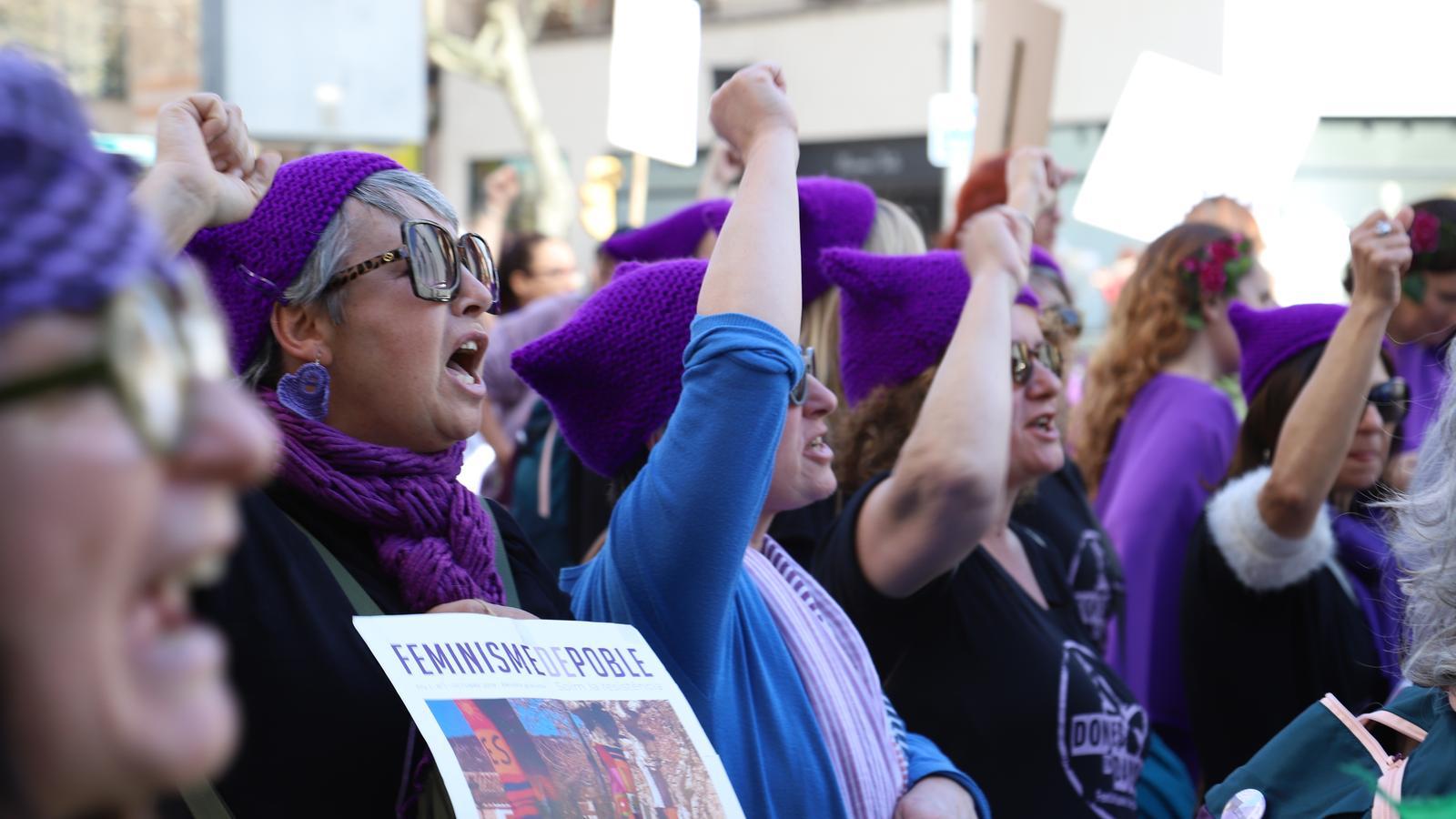
This November 25th there are demonstrations again, two in Palma, to shout loud and clear that sexist violence will not stop on its own if we do not combat it from all areas and that doing so is everyone's responsibility.
The Overton window can shift, but it can also be opened again. Therefore, this November 25th I wish for a public outcry so that sexist violence does not become just another figure, so that institutions do not remain silent, so that voting directions are decided in favor of human rights, and so that no regression makes us accept as normal that which is intolerable.
Women, our right to life and our fundamental rights are not ideology, they are not a quota, they are not a secondary section of an electoral program, they are not proposals or ideas for a specific group. We women are half of the population.
