Migration: the Balearic Islands skyrocket with 32.7% more arrivals while Spain falls by 64%
The increase in the Algerian route places the Archipelago at the center of the maritime migratory phenomenon at the beginning of 2026

-
CAT -
CAST -
GER
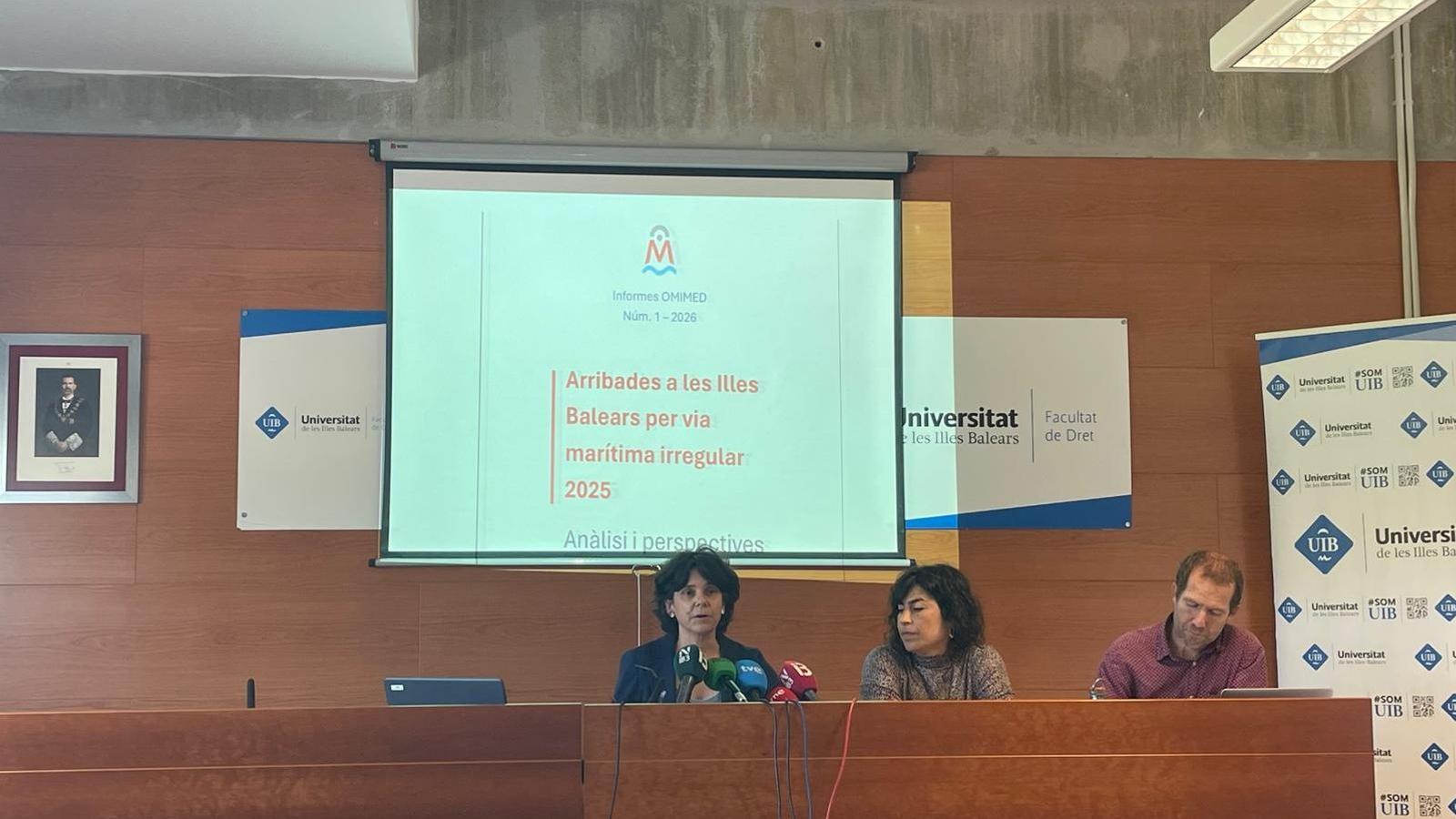
PalmThe Balearic Islands have started 2026 with a sharp increase in irregular maritime arrivals of migrants, in a context of a generalized decrease in the rest of the State. Between January and March, the Islands registered a 32.7% increase compared to the same period last year, while Spain as a whole experienced a 63.8% drop and the Canary Islands, an even more pronounced fall of 85.3%. The data points to a displacement of migratory flows towards the Algerian route, which in recent years has been gaining importance to place the Balearic Islands in a central position.
“The trend is clear: while arrivals in Spain are decreasing, they are increasing in the Balearic Islands, and this responds to the consolidation of the Algerian route over the years”, explained Margalida Capellà Roig, professor of Public International Law at the UIB, during the presentation of the data. According to her, 2025 has already been a key year because “for the first time, disaggregated data could be analyzed” and “a significant change in the profiles of the people arriving and in the system's capacity to respond to it” has been evidenced.

This change in profile is one of the main characteristics of the current phenomenon. Capellà has highlighted that “there are increasingly more women, more minors, and more situations of vulnerability”, a fact that forces a rethinking of the reception model. The figures confirm this: the number of women has gone from just over a hundred in 2023 to more than six hundred in 2025, while the number of arriving minors already exceeds five hundred, most of them unaccompanied. “The system cannot continue to be designed only for a profile of adult men; reality is much more diverse”, he remarked.
The Balearic Islands, a key piece on the migratory map
The growing weight of the Balearic Islands within the State as a whole has also become evident in 2025, when the Islands have already concentrated nearly 22% of arrivals via the Algerian route. “The Balearic Islands have become a key piece within the current migratory map”, pointed out Capellà, who insisted that this role implies both responsibilities and the need for more resources and institutional coordination.
Furthermore, arrivals are not distributed homogeneously within the Archipelago. Despite the general perception, Mallorca is not the main entry point. “There is a clear difference between islands: Cabrera receives fewer boats but with more people, while Formentera receives more boats but with fewer occupants”, he explained. These differences are partly due to the conditions of the journey and the economic capacity of the migrants.
The increase in arrivals has particularly strained the reception system in Mallorca. During 2025, situations of saturation have been registered at the Palma maritime station, where migrants have had to wait several days before being transferred to the Peninsula. “There have been cases of people spending three or four days at the maritime station, in a space without adequate conditions and with very limited access to basic services”, denounced Capellà. With a capacity of around 167 places, the facility is overwhelmed when numerous arrivals coincide, which can be up to a hundred people at once.
The jurist also warned of the human cost associated with this route, difficult to quantify precisely. “The figures for dead and missing vary greatly depending on the source, and this already indicates that a part of the phenomenon remains outside official records,” she pointed out. In this regard, she recalled that while official data speaks of dozens of deaths, other organizations put the figure at hundreds or even more than a thousand. She also alerted to the lack of data on sexual assaults during crossings: “We know that cases exist and that women, being a minority, are more exposed, but there is no systematic registry or sufficient specific protocols.”
In parallel, the coordinator of the Patrones Project, Inés Marco, has focused on the increase in people detained accused of being skippers of pateras, a phenomenon she has described as “European.” “When we talk about detainees, we are referring to people accused of having captained the boat,” she specified. According to the data provided, in 2024 alone there have been 236 arrests in Spain for this reason, in addition to more than a hundred in Italy and more than 200 in Greece.
Marco explained that, in many cases, these accusations are based on basic actions during the crossing. “It is considered sufficient to have steered the boat, to have controlled the GPS, and to have distributed water and food for a person to be accused,” she said. As she denounced, this interpretation broadens the crime to include conduct that does not imply any economic benefit. “This ends up criminalizing migration itself,” she warned.
Regularization in exchange for accusing someone of being the skipper
He has also questioned the guarantees of judicial proceedings. “There are cases where the accusation is based on the testimony of one or two people from the same boat, and situations have even been detected where regularization is promised in exchange for accusing someone”, he explained. According to Marco, these practices can violate European human rights standards. In Spain, since 2020, more than 1,300 people have been prosecuted for facilitating irregular migration, with a very high conviction rate. “The majority accept sentences of about three years to avoid the risk of facing much higher sentences”, he added.
Faced with this scenario, Capellà has insisted on the need for a change in approach. “We cannot continue to address migration as a sum of isolated emergencies; it is a structural phenomenon that requires a stable and coordinated response”, he stated. In this regard, he advocated for the creation of permanent coordination spaces and better resource planning. “What we are seeing these years indicates that this reality will not disappear and, therefore, we must prepare the system to provide a dignified and effective response”, he concluded.
