The metro in Son Espases will pass through flood-risk areas
The environmental study of the project confirms that the route alternatives cross flood-prone areas and warns of possible impacts on drainage and the cost of the work

-
CAT -
CAST -
GER
PalmThe future expansion of the Palma metro to Son Espases hospital, which has already been released for public consultation and represents one of the Govern's most ambitious short-term mobility projects, crosses areas with a high risk of flooding. The project incorporates an environmental impact study that confirms this structural constraint, as it affects all proposed alternatives and could determine both the final route and the environmental viability of the project.
The analyzed action corresponds to the extension of the existing line from the UIB to Son Espases, a short section, of a few kilometers, but with a notable environmental complexity. At this stage, the construction project is not yet decided, but rather the corridor through which the metro must pass, and the hydrological factor becomes decisive. Sources from the Conselleria del Cicle de la Mar i l'Aigua have explained to el ARA Balears that "preferential flows must be respected, as regulations dictate, and the necessary measures must be taken." "But this does not make the project impossible," they said.
Sources from the General Directorate of Mobility explain that "the informative study is a multi-criteria analysis." "It incorporates technical, environmental, social, and economic parameters. The investment for each of the alternatives is calculated, which, among many other technical issues, analyze the effect of water (floodable area or route below or above the water table)," they comment.
According to the environmental study, the Govern's alternatives to extend the line are within the basins of the na Bàrbara torrent and the Gros torrent, and they must cross areas identified with a significant potential risk of flooding. The document indicates that "all must resolve the crossing of na Bàrbara, with the presence of associated areas with a risk of flooding (T=500)," a situation that makes this point the main hydrological obstacle of the project. This implies that, regardless of the chosen route, the metro will inevitably have to pass through an area with a high risk of flooding, with no possibility of avoiding it. "The corresponding measures must be taken, which may increase the project's cost, but do not call it into question in any way," emphasize sources from the Conselleria.
The entire route is conditioned by the fact that it is within an active hydrographic basin and any action may have effects on the global drainage of the area, where scattered populations live, except for some points along the route where the populated area intensifies.
The two route options
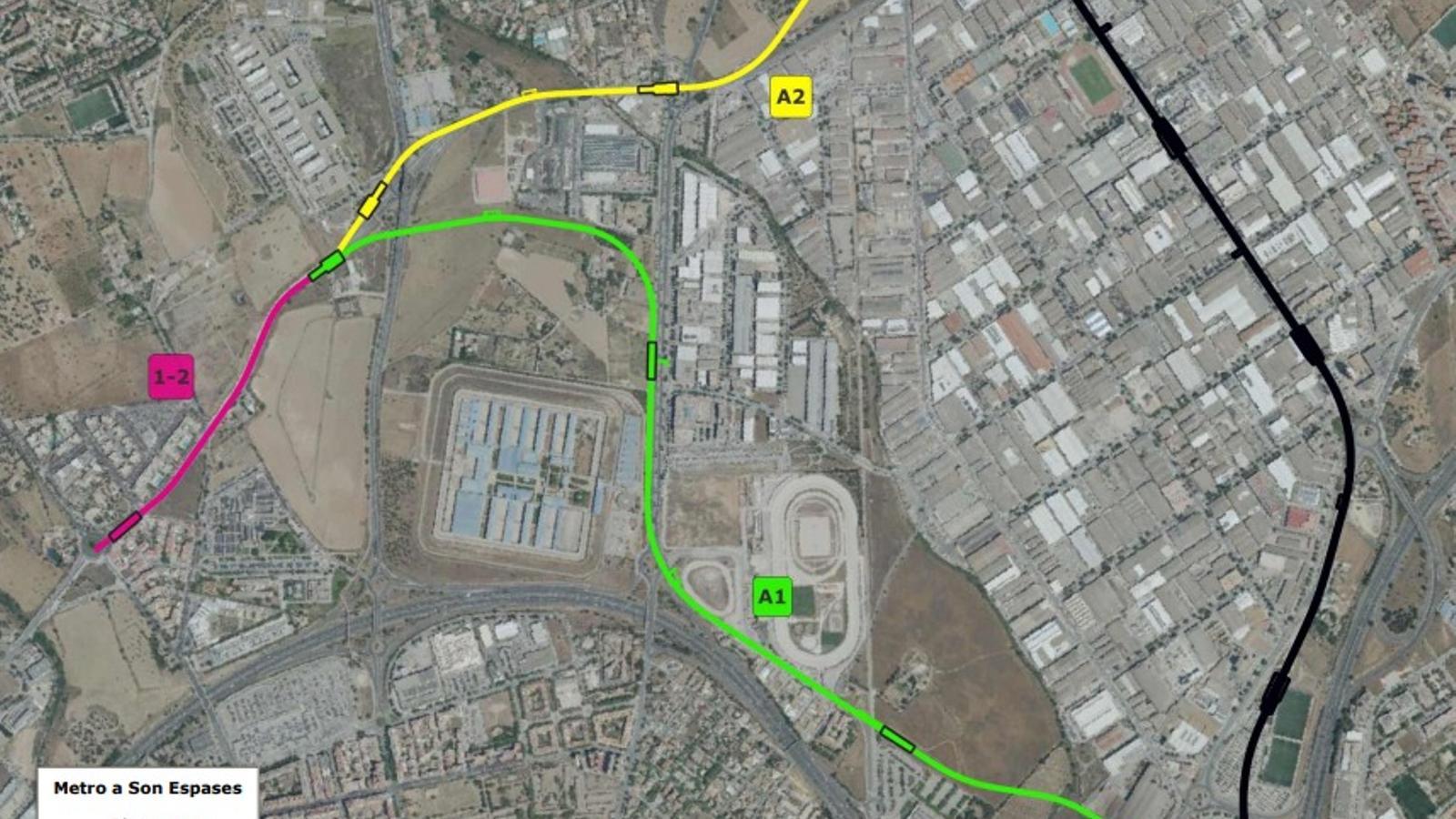
Regarding the itineraries, the study proposes two main alternatives. The first option branches off the current line at the height of Son Fusteret (see the image illustrating the article) and outlines a route with intermediate stops in areas of facilities and activity, with stations in Son Hugo, Son Rossinyol, and the vicinity of Son Espases – and a possible extension to Son Serra Perera. The second alternative follows a more linear path linked to the Camí dels Reis, with stops at the main intersections —such as the Sóller road— and also with stations in Son Espases and Son Serra Perera. Both options run mostly through urban land and aim to connect with the hospital as the main mobility hub, but with differences in the route and the distribution of stops.
The type of infrastructure planned amplifies the risk. Although it is a metro, the study acknowledges that the project may combine underground and above-ground sections. In any case, the underground sections are particularly sensitive. The document warns that ‘routes with aerial components tend to generate more physical presence and potential visual impact, while predominantly underground routes reduce this effect, but concentrate the transformation in specific points’, such as tunnels, stations, and accesses. If underground, the risk of flooding does not disappear, but rather concentrates, with possible direct impacts on the infrastructure, such as water entering tunnels, phreatic level filtrations, and drainage system problems, among others.
A more sensitive context
In this context, especially after the recent episodes of severe floods in the Valencian Country due to the dana, the debate on the implementation of infrastructure in flood-prone areas has gained importance. Environmental and social entities, such as the GOB in Mallorca, insist on the need to apply the principle of maximum precaution in any project affecting these areas.
The impact is not only on the metro, but also on the environment. The environmental assessment document warns that the infrastructure may interfere with "the natural behavior of water", as the implementation of the route "can significantly modify the free circulation of waters, represent an obstacle to the flow of surface runoff or increase the pre-existing risk". This is one of the most sensitive aspects from an environmental and legal point of view, as regulations require ensuring that any action in a flood-prone area does not worsen the existing situation. Therefore, the project will have to pass strict controls and obtain specific hydraulic authorizations, with the need to technically justify that it does not increase the risk.
Detailed analyses are missing
Despite the importance of this condition, the study recognizes that its real impact cannot yet be determined with exactitude, as the project is in a preliminary phase. Key elements such as the construction system, the depth of the tunnels, or specific drainage solutions have not yet been defined, which are determining factors for assessing the final risk. In this regard, the document raises the need for more detailed analyses in later phases, with specific studies on floods, groundwater levels, and extreme rainfall events, in addition to evaluating vulnerability to climate change.
According to the project that the Government is submitting for public information, in a second phase, the aim is to extend the metro beyond Son Espases, to the Riskal roundabout, where the new private medical faculty of San Pablo CEU will be located.
