The Posidonia meadow of Pollença is surviving restored... slowly
The restoration carried out by Redeia and IMEDEA in 2018 currently achieves a high survival rate, up to 93%, but notes slow growth of the meadow and associated ecosystems
-
CAT -
CAST -
GER
PalmaThat oceanic posidonia is one of the greatest treasures of our sea, we could all say we know it. Or that we should know it. We should also know that it is responsible for the incomparable color of our sea and the “mother house” for a whole world of living beings that are and exist thanks to it. Furthermore, it is a natural agent in the fight against climate change, because it captures carbon dioxide: it is the lung of the sea.
The waters that caress our Islands are the luckiest, because they host more than half of the posidonia meadows that inhabit the depths of the Mediterranean in the Spanish State. A total area of 1,150 square kilometers occupied by posidonia meadows is estimated, of which 633 are located in the Balearic Islands.
Having had this luck also imposes on us —or it should— a higher responsibility in the conservation of Posidonia, one of the oldest living beings on the planet. We have a lot at stake. Because everything that Posidonia gives us becomes fragile, mainly due to human interaction: coastal construction, tourist pressure, boat moorings, spills… It is essential to advance in protection and conservation measures that guarantee that Posidonia is safe from anchors, waste, and pollution.
Posidonia is a treasure of more than 100,000 years of life that, once damaged, takes decades or even centuries to recover, even if degraded meadows are actively replanted. It is a marine angiosperm endemic to the Mediterranean with a low capacity for natural recovery due to the slow growth of its rhizomes and a flowering that does not occur every year and is generally scarce.
Red Eléctrica, a subsidiary of Redeia –responsible for energy transport and the operation of the Spanish electrical system–, encountered Posidonia when planning the underwater link between Mallorca and Ibiza in 2014. The need to make the development of an electrical infrastructure compatible with maximum respect for the environment sparked the company's interest in getting involved in research on Posidonia, its conservation, and the possibility of restoring degraded areas of this species.

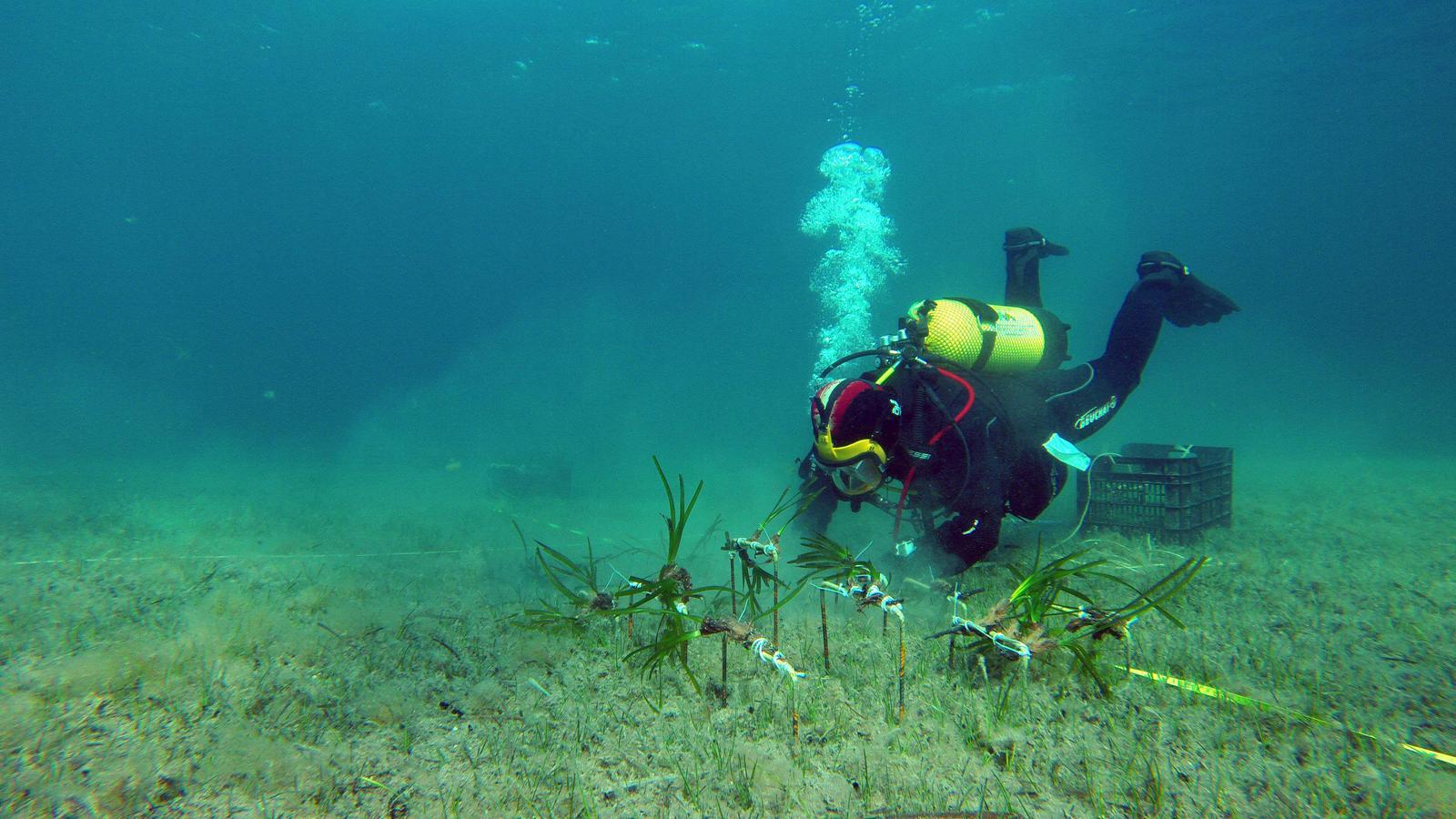
With the Mediterranean Institute for Advanced Studies of the Spanish National Research Council (IMEDEA-UIB-CSIC), Red Elèctrica promoted an R+D project that concluded with the articulation of a planting methodology that has allowed the recovery of two hectares of Posidonia meadow in the waters of Pollença.
Once the system was defined, planting began in 2018 and, today, the project, whose most visible faces have been IMEDEA researchers Jorge Terrados and Inés Castejón, provides its first conclusions. And, as with everything, there is good news and some that is not so good.
First, let's talk about the good news. The planting system – a pioneer in the entire Mediterranean and exportable to other locations – works, because the fragments planted since 2018 have achieved a survival rate of between 78 and 93%. These are survival results that, for now, are considered highly positive compared to other experiences carried out.
However, the growth is very, very slow. So much so that there can still be no conclusive results on the recovery of the epifauna and the ecosystem services of the restored meadow. We must take note of this, because the results highlight the need to be aware of the vital importance of posidonia conservation. It is not worth saying that, since we have a recovery system that works, well, if it gets damaged, then we will fix it. No.
Between 2018 and 2020, 12,800 posidonia rhizome fragments were transplanted in eight planting units, and an annual monitoring – usually in summer – of 20% of the nodes in each unit has been carried out. The monitoring has confirmed that survival rates are between 78% and 93%, with variations in different nodes, with a planting age of between four and a half and six years.
In addition to survival, the development of the transplanted rhizome fragments is monitored annually. The measurements taken in situ for each fragment are the number of horizontal shoots and the number of vertical shoots.
The average size remains similar to that at the time of transplantation, although with a downward trend as the time elapsed since transplantation increases. However, the similarity in the size distribution of the fragments observed in the older planting units suggests that the reduction in fragment size slows down once five years have passed since planting. Despite this general reduction, the percentage of fragments with a size equal to or greater than the initial size reaches 32% in some of the planting units.
An analysis of the biodiversity of epifauna and fish has also been carried out to assess the recovery of ecological functioning in the planted area, comparing it with the natural posidonia meadow near the restored one.
The term 'epifauna' is used to refer to the part of the fauna community that lives in the posidonia meadow and is made up of mobile organisms that live on the leaves or swim among them.
The dominant group in the epifauna are crustaceans and they constitute an important element in the functioning of the ecosystem, as they are a source of food for fish. As of now, no conclusive effect of epifauna abundance has been observed.
Likewise, upon analyzing the presence of fish, it has been found that the total number of individuals is greater in the naturally established meadow than in the replanted area, both in terms of adult fish and juveniles. These results reflect that the response of the ichthyic community to the replanting has not yet occurred, perhaps, a little more in the case of juveniles.
Finally, as it has been shown that the vegetative development of the planted fragments is very slow –with a small living biomass of Posidonia from planting–, it currently translates into a low carbon capture capacity.
How was the restoration carried out?
The objective of seagrass meadow restoration is to recover the structure, ecological functioning, and associated ecosystem services. The technique used includes the phases of collection of leaf bundles from natural fragmentation by marine dynamics, preparation of specimens, planting carried out by divers by anchoring each rhizome fragment to the seabed, and finally, subsequent monitoring and follow-up of the evolution of the planted fragments.
Planting has been done on dead seagrass – it should always be done in a place where there was seagrass before – and the material used is rhizome fragments with a horizontal growth apex and a minimum of two vertical shoots. Rhizomes recovered adrift on the seabed are used, as they are obviously not collected from meadows.
It should also be taken into account that the rhizome fragments require an anchoring system to the substrate before planting. This anchoring allows them to remain in the planting location and in the correct position on the seabed so that the apical leaf bundle with horizontal growth can grow unimpeded and produce new roots that fix the fragment to the substrate.
Each fragment is previously tied to an iron stirrup covered with beeswax in the central part to prevent metal corrosion from affecting the rhizome. It is recommended that the fragment tying system be done with a flexible medium, such as a rope.
The technique devised and used in the Marine Forest of Pollença is described in the Practical Guide. The planting of Posidonia oceanica (2018), of which a second edition has now been made based on the results. It is available to the scientific, public, professional, and business sectors for the development of seagrass meadow restoration initiatives.
The experience of the Marine Forest of Pollença, in addition to being a pioneer in the Mediterranean, has become the seed of the Redeia Marine Forest platform, an initiative of a much broader scope that promotes active and passive restoration projects – always scientifically validated – of posidonia and other marine habitats in other parts of the State, in the Mediterranean and the Atlantic, as well as research and environmental education and outreach activities.Currently, the Marine Forest platform, created in 2024 by Redeia and the Ecomar foundation, is working with the Generalitat Valenciana on the design of an active restoration initiative for posidonia meadows. In addition, Redeia and the Altea City Council, in the province of Alicante, are developing a passive posidonia restoration project through the installation of ecological moorings in sandy areas.Alongside the Amicos association, Redeia has been involved in the conservation and restoration of the seabed in the surroundings of the Atlantic Islands National Park, in the Rías Baixas of Galicia. Specifically, gorgonian populations are being recovered in the Arousa estuary. Also noteworthy is the collaboration with the University of Seville in a scientific study to understand the impact of an aggressive invasive alga that threatens the flora and fauna of Tarifa and the Bay of Algeciras.In the educational field, Redeia and Ecomar will offer 15 workshops in educational centers throughout Spain during 2026 to promote environmental education and awareness about the conservation of marine ecosystems. In this regard, the Balearic Islands have also been pioneers, with the precedent of the Posidonia in the Classroom program, in which more than 1,000 schoolchildren from the Islands have participated.The Marine Forest platform is part of Redeia's comprehensive impact strategy, which develops all its initiatives with an inclusive approach of listening to the territory and always in collaboration with associations, foundations, public administrations, research institutes, and the third sector.
