The Government processes again the photovoltaic park of Son Bonet that the Parliament rejected unanimously
The Department of Enterprise reactivates the file while Marratxí and all the groups of the Parliament demand that Aena renounce occupying the neighborhood space
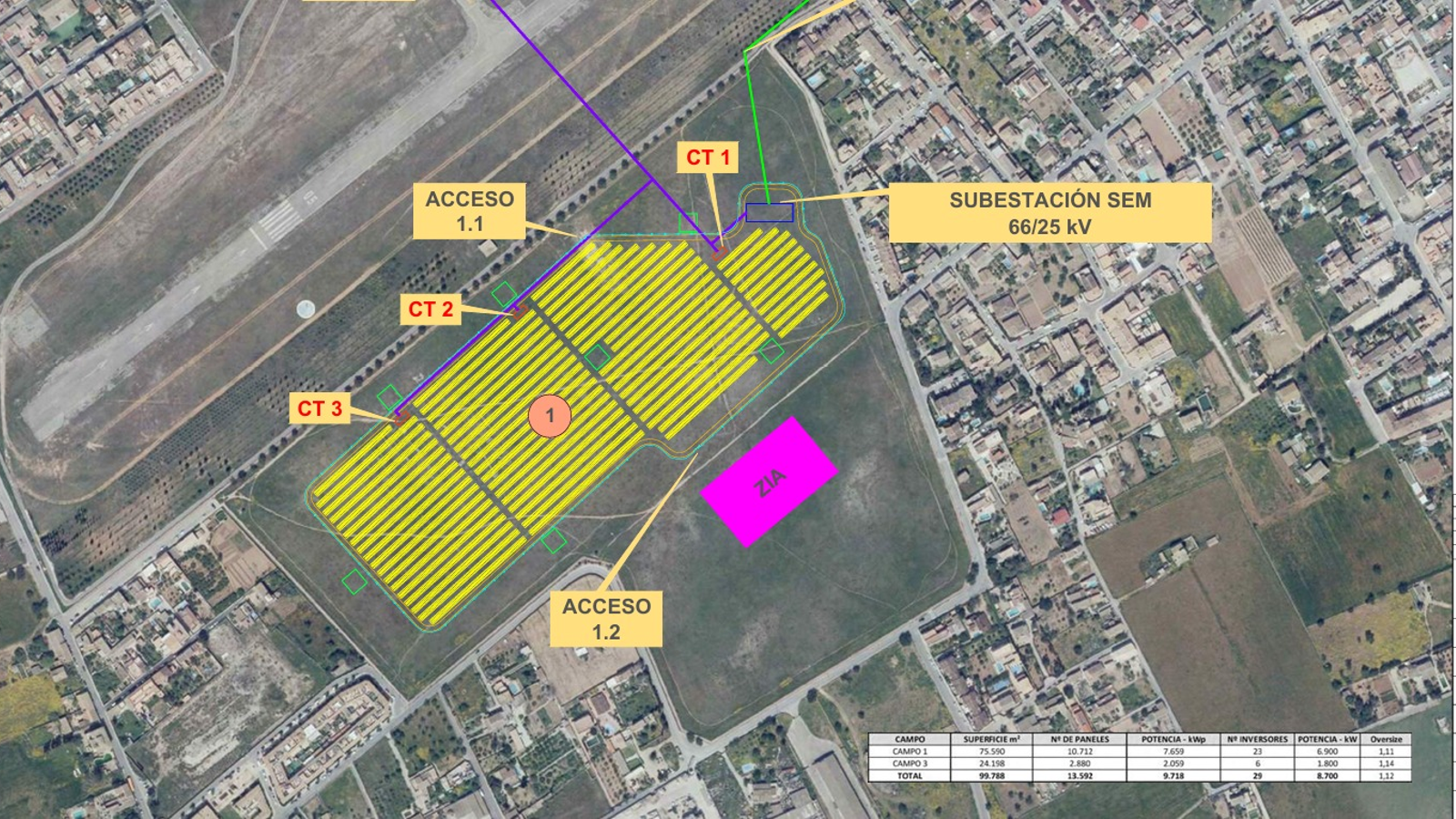

PalmaNeither the frontal rejection by the Marratxí City Council, nor the neighborhood mobilization, nor even a unanimous agreement of the Parliament of the Balearic Islands have stopped, for the moment, the processing of the large photovoltaic park that Aena wants to implement on the grounds of the Son Bonet airfield.
The Ministry of Enterprise, Self-Employed and Energy has now launched a new administrative procedure for the project. On September 1st, it put out for public information the file Son Bonet Airfield - Phase 1, promoted by Aena on the road from Palma to Inca, in the municipality of Marratxí. The procedure includes the request for administrative authorization and the recognition of public utility for the purposes of the declaration of general interest, and it is processed with an ordinary environmental assessment, which is essential to be able to set up the facility.
The Government has not yet authorized the park, but it has not paralyzed its processing either. Aena has put the project back on the administrative table and the regional Executive has opened the corresponding procedure so that it can continue to advance. It seems, therefore, a contradiction that the Executive starts a process without any changes having been noted in Aena's intentions.
Less than three months ago, on June 16th, the Balearic Parliament unanimously approved urging the Government to convey to Aena the need to renounce the installation of the photovoltaic park planned in Son Bonet. The same initiative demanded that the Executive facilitate a space for dialogue with the affected neighbors and with the Marratxí City Council to seek alternatives. The PP, PSIB, MÉS per Mallorca, Vox and the rest of the groups present in the Chamber agreed on this point. Three months later, however, the project has not only not disappeared, but is fully entering the administrative machinery once again.
Marratxí had said “no” only a few weeks before
The paradox is even more evident if we review what had happened during the previous months. On May 6, the Marratxí City Council met with senior Aena officials and communicated their “total rejection” of the photovoltaic park. The mayor, Jaume Llompart, assured that the municipal position was “clear and non-negotiable” and that there was no room to reach any agreement that would involve executing the project at this site.
“The park will not be accepted under any circumstances and we will continue to work actively to prevent its execution,” stated Llompart after the meeting. Aena, therefore, was perfectly aware of the municipal opposition when it continued to push the project forward.
The conflict is not new either. Son Bonet has become, over the last few years, one of the main focuses of territorial mobilization in Marratxí. Residents grouped around Son Bonet Pulmó Verd claim that a significant part of the affected land is not perceived simply as an area attached to an airport, but as an open space used for decades for walking, exercising, and connecting neighborhoods such as Pla de na Tesa, Cas Capità, and Pont d’Inca.
The rejection has been accompanied by allegations, signature collections, and the support of environmental organizations. This same year, 2026, the platform announced more than 2,300 new signatures to demand the protection of the space. The GOB, for example, has once again demanded this year that the project be definitively discarded and advocates for Son Bonet to become a large green space or urban forest. The organization does not question the need to deploy renewable energies, but rather the location chosen by Aena and the territorial and social cost it considers it entails.
A history of projects, modifications, and files
The Son Bonet park has already accumulated years of difficult processing. Aena initially tried to have the installation considered a strategic industrial project, a path that the Government ended up discarding in 2021. Subsequently, the project continued through energy administrative authorization, but the previous file ran into the expiration of the access and grid connection permits, and the prior administrative authorization was denied in 2023.
The project has been modified several times and the company has proposed different distributions of the panels within the Son Bonet grounds. In previous versions, it was anticipated that a part of the space most used by the neighbors would remain free of panels, after the strong protests generated by the initial proposal.
The environmental documentation processed so far provided for an installation of nearly 20 hectares, with a power situated around 19 MWp and tens of thousands of solar panels. But the determining question now is to know exactly what the new version that Aena has presented under file RE024/25 contains and to what extent it maintains or modifies the commitments incorporated in previous phases.
The very name of the file, which now identifies the project as 'Phase 1', also opens a question that Aena will have to clarify: whether this first phase is part of a subsequent action of greater extent or power.
What will happen to the neighbors' space?
This will foreseeably be the main battlefield during the new public information period. During the previous processing, municipal reports already warned of the effects that the installation could have on a space qualified as a general system of open space, but they also raised questions about the landscape impact, the drainage of rainwater, and the need to properly study the acoustic effects of the new surface of panels.
The Son Bonet conflict summarizes, in fact, what the neighbors consider incoherent. In the words of the Pulmó Verd spokesperson, Manel Gomáriz, "you cannot defend clean energy by stealing space from the neighbors, who have been enjoying and taking care of it for years and years. There are many places to put panels, thousands and thousands of square meters of Aena's own built-up area where panels can be placed. Leave a collective place that belongs to everyone in peace," he told ARA Balears.
