The Government sent a minor to the Prosecutor's Office to make a post against mass tourism
The publication, disseminated at a moment of tension due to saturation, reached the Presidency and resulted in an investigation for an alleged hate crime that has been shelved.

PalmWhat could have been an anecdotal social media post ended with a minor from Mallorca declaring as investigated before the Juvenile Prosecutor's Office. Guillem (a pseudonym to protect his anonymity), who was 17 years old at the time of the events, found himself involved in a judicial process as a result of an Instagram story in which he denounced tourist overcrowding.
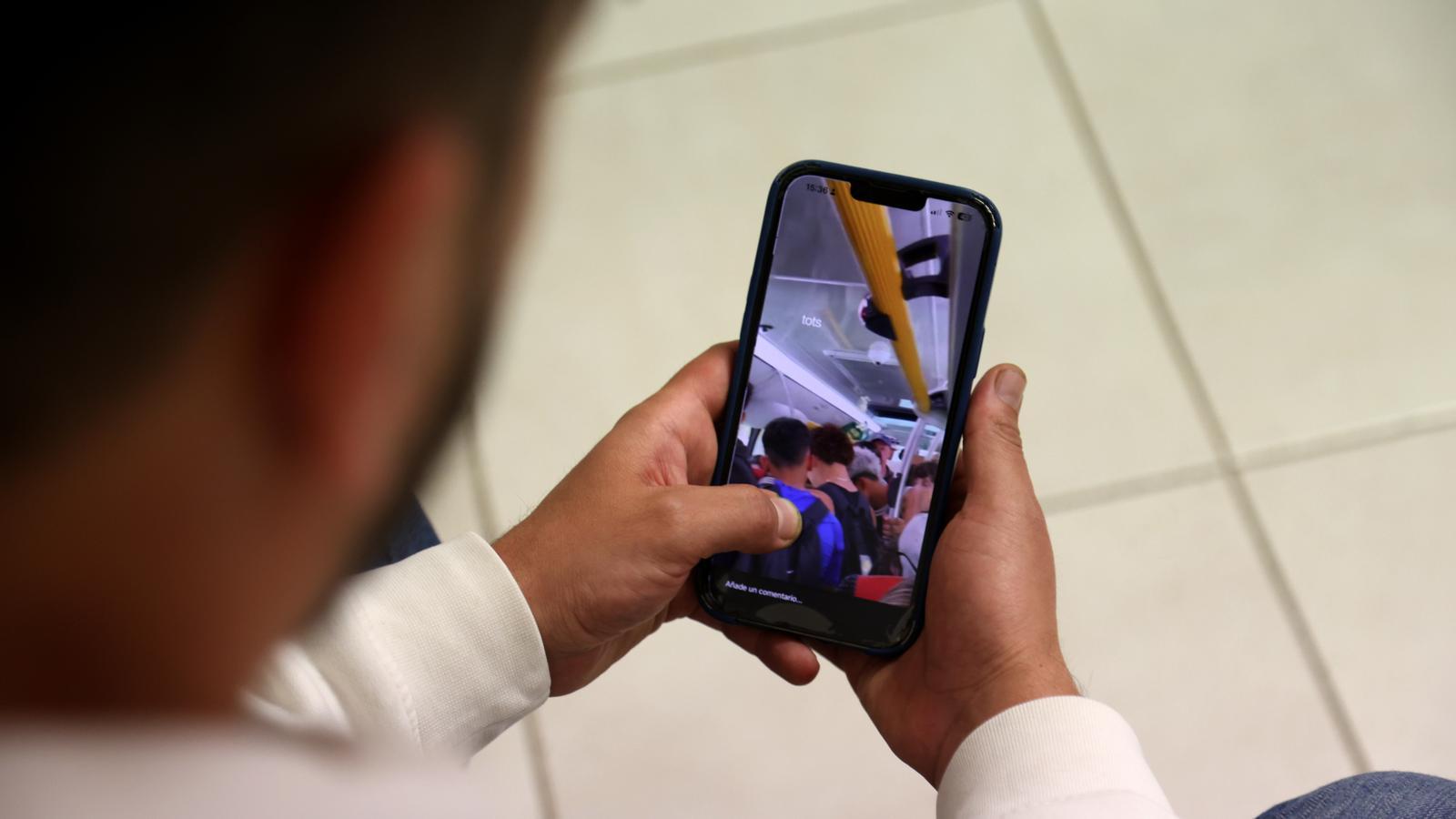
It all started one spring day last year, when the young man, an avid hiker, was trying to return with a group of friends from Banyalbufar to Palma by TIB bus. After waiting for hours and having seen several buses pass by that they couldn't board due to the large number of people – especially tourists – Guillem recorded a video with dozens of people crammed together.
Those images were published as a 'story' – which disappears after 24 hours – on his Instagram account, which has just over 200 followers. The content denounced the tourist saturation and was accompanied by a literary phrase that hinted that, if residents got tired of the situation, there could be violence, even with the possibility of using weapons.
Without being aware of it, the young man had posted the message in the midst of social tension. The Government was going through a period of nervousness due to the start of the tourist season, with increasing overcrowding that had led to two massive demonstrations in just two months.
In this scenario, the publication went far beyond his circle. Profiles with thousands of followers, such as SOS Residents, which are dedicated to disseminating problems arising from tourist saturation, shared the content until it reached the Government.
According to the family, the complaint allegedly came from a person "very important within the Autonomous Community" and, subsequently, an official from the Juvenile Prosecutor's Office confirmed to them that it came from the Presidency of the Government. At the end of last year, the minor's parents received a poorly worded SMS in which their son was summoned as investigated by the Juvenile Prosecutor's Office. Initially, they thought it was a scam, as they considered it was not the usual way to notify a judicial summons scheduled for a few days before Christmas.
The family, who professionally works in the legal field, initially paid little attention to the message until, a few days before the indicated date, the father received several insistent calls from a number that apparently belonged to the Administration. An interlocutor, identifying himself as a civil servant, informed them that Guillem had to appear the following day for an alleged crime that did not formally appear anywhere.
After insisting, the father managed to get them to explain that the events were related to an alleged hate crime linked to turismofobia, meaning, against tourists.
At that time, the young man was already in his first year of university studies in Barcelona, which is why the family requested a change of date so as not to interfere with his exams. The request was accepted after providing his enrollment and academic justification.
The judicial process
Finally, Guillem declared as a suspect, accompanied by a criminal lawyer, without having been formally notified beforehand of the crime or the accuser.
The young man recalls the process and the day of the statement as a “surreal” experience and assures that he felt in a hostile environment, “as if he were an Al-Qaeda terrorist”. He explains that he had to testify standing up before a microphone, without knowing very well how to act. “With time, I am aware that I was able to handle it because of my way of being and because I like to talk, but I know other people my age who would have started crying or wouldn't have known what to say at that moment”, he states.
Among many questions, the young man assures that they asked him if he was part of any political entity or organization. The entire procedure was carried out in Spanish, and he did not dare to speak in Catalan for fear of possible reprisals. “I didn’t know where I was and they didn’t make it easy for me at any moment. When we entered, I sat next to my lawyer because I didn’t even know where to stand; it was he who told me I should stand in front of the microphone,” he explains.
For the family, the process has been “hard and unnecessary”. They assure that the published content had no real intention nor was it directed against any vulnerable group, and they consider it a waste of time by the Administration and ideological persecution. “We know our son and he is not a violent young man nor has he had any behavioral problems, he is a good student and does not belong to any radical group. But like any young person with concerns and who appreciates the territory, he is aware of the discomfort arising from the saturation in Mallorca," they explain.
According to the family, the prosecutor in charge of the case did not question whether it was reasonable to consider that a 17-year-old, with no prior record and a normalized academic and social profile, could represent a public danger, and decided to continue with the procedure. For months, the family received no clear information about the status of the case. Not even the lawyer passed on any news; until, after insisting, it was learned that the prosecutor had decided to dismiss it, almost two months after making this decision. In total, about six months passed until there was clear communication.
A dismissal with personal consequences
The process had consequences beyond the judicial sphere. In the academic sphere, some exams did not go as well as expected. The family also highlights the constant stress, the repeated calls, the uncertainty about possible sanctions, and the fear that the case could have serious consequences.
In the economic sphere, the procedure entailed a significant expense, in addition to a cost in time and "mental space". "I was fortunate that my family never doubted me and could cover the travel expenses from Palma to Barcelona and the lawyer's fees, but not everyone could afford that, or even understand the process," reflects Guillem.
In the resolution of the case file, it is concluded that it is a minor infraction with no economic prejudice, and it is stated verbatim that "the minor has shown his repentance, given that it is understood that with the investigations carried out he has already been sufficiently chastened".
Despite this outcome, the family considers that the process has been a punishment in itself, with a strong emotional, academic, and economic impact. They regret that criminal law is used for coercive and deterrent purposes, instead of focusing on truly serious cases, and they denounce a disproportionate use of judicial tools.
The minor, for his part, expresses feelings of sadness, fear, and anger. He assures that the experience will not change his ideology – he believes that mass tourism is suffocating the territory – but he does believe that the procedure had a clear deterrent intention. "It's not my case, but this same thing in another person with a different economic or social situation could make them live in fear of expressing themselves or protesting for life," he states.
He also acknowledges having learned that "people with power or with more resources can initiate processes of this type and it can change your life", and recalls cases like those of Pablo Hasél and Valtonyc. He defends that freedom of expression has limits, but considers that he did not overstep them and criticizes the lack of clarity about where those limits are. "If instead of messing with tourism I had done it against migrants or against the LGTBI collective, surely nothing would have happened to me, because it happens every day on social media and no prosecutor summons them as investigated," he maintains.
From their point of view, this contributes to a context in which “the one who has money always wins” and in which political debate is trivialized, especially on social networks like TikTok. “Then people complain that young people are not interested in politics and that we are depoliticized; perhaps events like these do not help people to express themselves, think and become politicized, because they can end up badly,” he reflects.
The case has ended without criminal consequences, but Guillem and his family will never forget the irreparable damage from nothing, as they consider that the process has caused them unnecessary and unjustified suffering, with a clear deterrent effect on the minor's freedom of expression in a context of institutional tension due to mass tourism.
