The majority of UIB students live with their parents, use AI and aspire to be civil servants
51.2% of students would prefer to receive classes in Catalan, compared to 40.4% who opt for Spanish
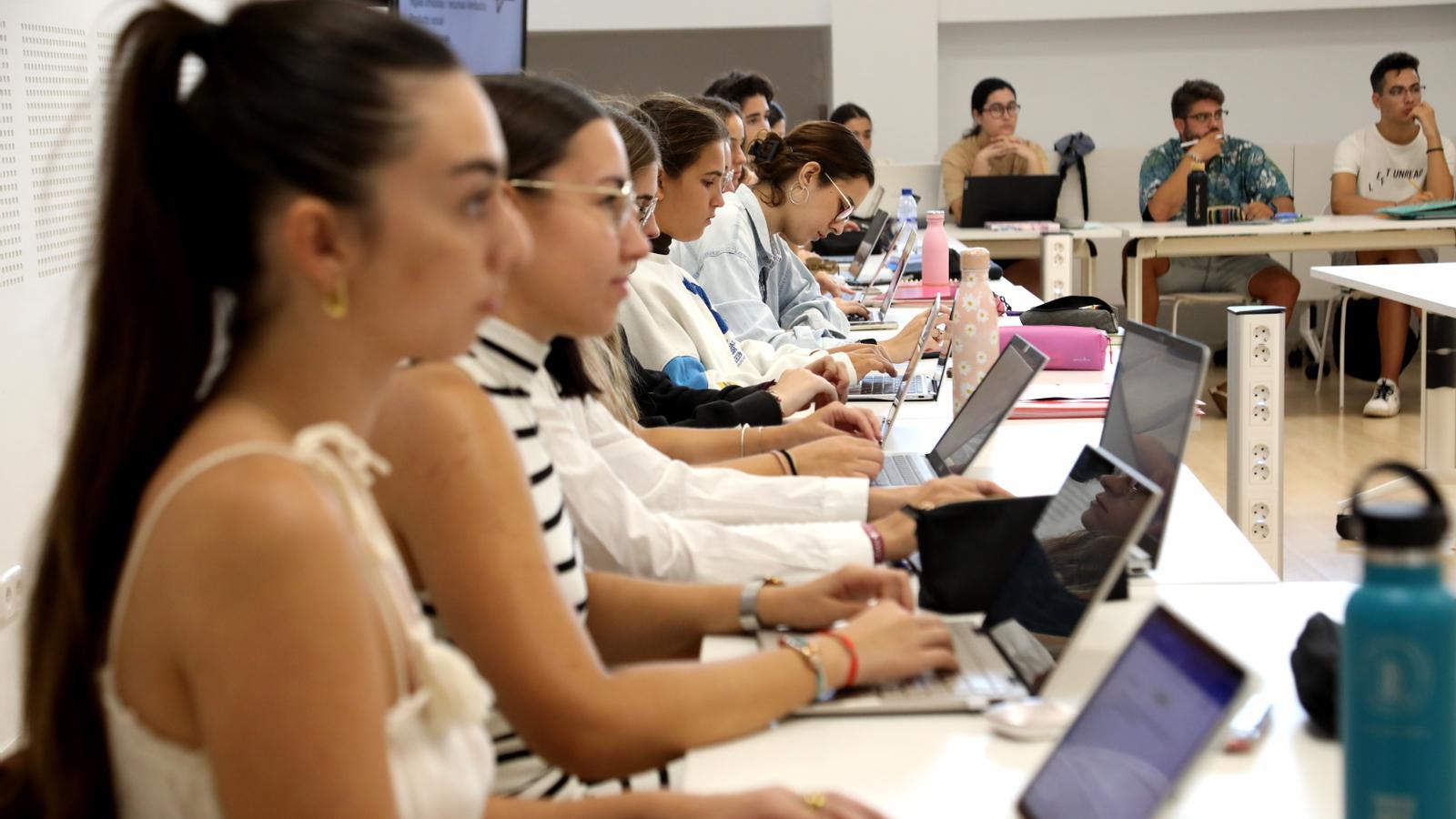
PalmStudents at the Universitat de les Illes Balears (UIB) mostly live in their family home, choose their studies out of vocation, intensively use artificial intelligence (AI) for academic purposes, and see themselves working in the public sector. This is the conclusion of the first Barometer of the UIB Social Council, based on a sample of 2,067 students, comprising 36.8% men and 63.2% women, as detailed this Monday by the director of the Balearic Institute of Social Studies (IBES), Gonzalo Adán, with the president of the Social Council, Antoni Bennasar.
This study, to which 14.5% of enrolled university students have responded, allows for the creation of a profile of UIB students, with strong territorial roots and conditioned by economic factors such as the cost of living and access to housing, which are the main concerns declared by 35.6% and 21.8% of the surveyed students, respectively.
"The UIB student is not very politically engaged, they are little interested in politics," commented the president of the Social Council, who added that the extremes of left and right are "very far" from the political ideology of those surveyed, although there is "a trend more towards the center that leans slightly to the left."
65.7% of the student body lives with their parents
According to this analysis, 65.7% of students live with their parents, compared to 21.5% who share an apartment and 8.2% who live alone. Commuting to campus is mainly done by car, either individually (38.4%) or shared, followed by the subway (32.2%), which shows a significant dependency.
In the academic sphere, as Bennasar has indicated, 79.4% say they chose their degree out of vocation, especially in degrees like Medicine and Education, while the main final reason for enrollment is the proximity of the educational center (67%), compared to the prestige of the studies (56.7%).
The Balearic public university obtains an overall rating of 6.7 out of 10, which rises to 7.3 when the specific degree is evaluated, and 54.8% assure that they would choose UIB again.
52.3% aspire to be civil servants
Regarding job expectations, the report indicates a clear inclination towards public sector employment: 52.3% of students see themselves working in the public administration, compared to 41.4% who opt for the private sector. According to Bennasar, this is due to the current circumstances of future planning and greater stability.
When choosing an occupation, the factors most valued by students are salary, work environment – especially in healthcare settings – and flexible hours.
Respondents also point to widespread use of artificial intelligence (AI) in academia: 81% of students use it to clarify doubts, 44.4% to organize their studies, and 25.7% to do assignments, while only 8.6% claim not to use it.
Regarding lifestyle habits, the report indicates that most students eat at home (77.2%) or bring prepared food (58.2%), do not consume alcohol or smoke in more than 90% of cases, and 40.2% play sports between three and five days a week, mainly in gyms.
In the cultural sphere, 30.1% read between one and two books per year, and music is the topic of most interest (48%), followed by culture (45.5%), and 18.2% are interested in economics.
51.2% prefer classes in Spanish
The study also highlights a low utilization of sports facilities, laboratories, and technological resources on campus, compared to a better evaluation of the virtual campus (7.6) and spaces such as classrooms and cafeterias (5.9).
From a linguistic point of view, something "curious", according to Bennasar, is that Spanish predominates in the private sphere – at home (42.1%) and with friends (48.7%)–, while in the academic environment a balanced use between Catalan and Spanish is observed. Nevertheless, 51.2% of students would prefer to receive classes in Catalan, compared to 40.4% who opt for Spanish.
