The tribute to the II Republic in Porreres warns of the global crisis of democratic values
-
CAT -
CAST -
DE
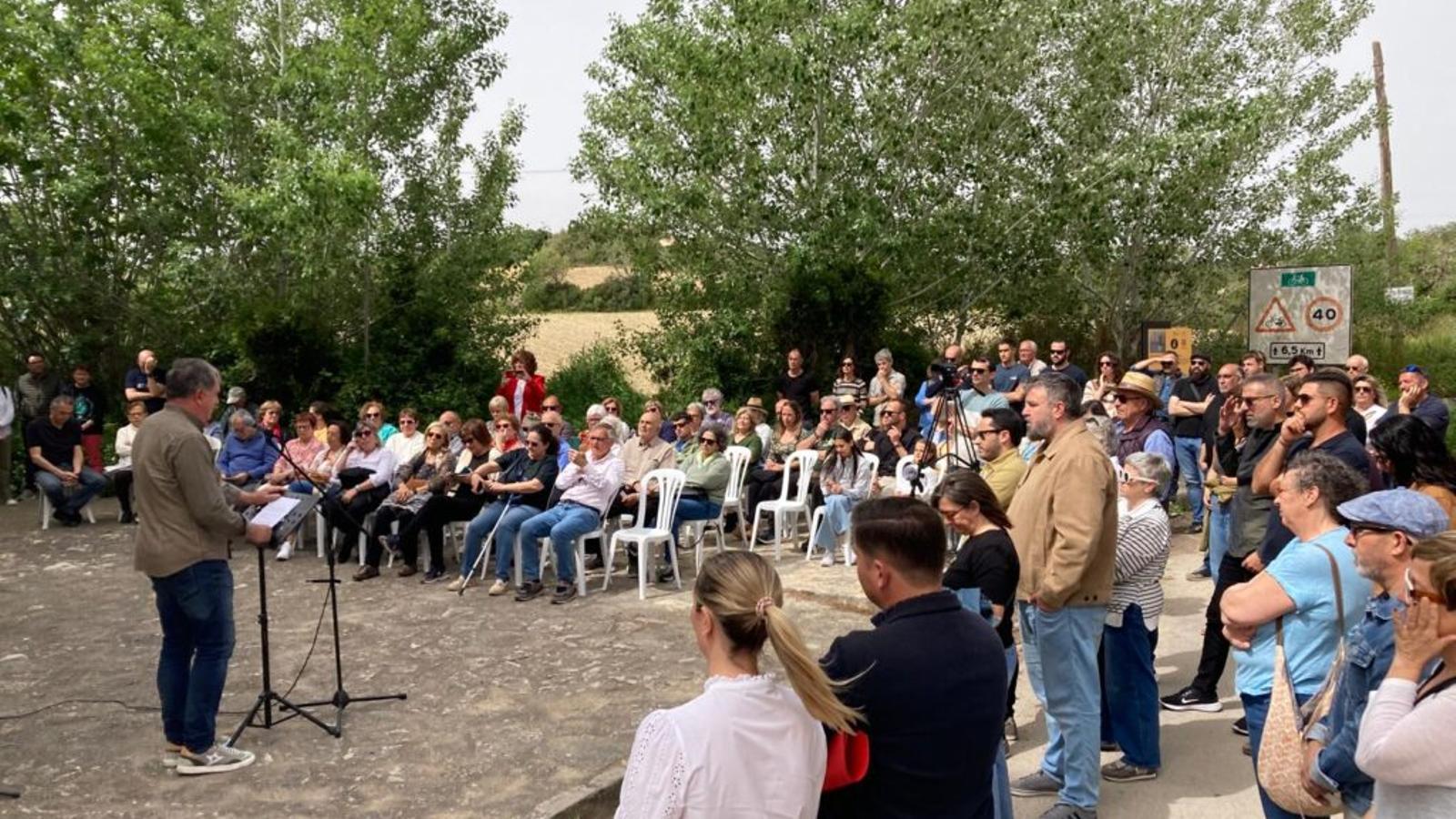
Porreres has once again demonstrated its commitment to justice and the recovery of historical memory with the commemoration of the act of remembrance of the victims who fought for the Second Republic, in an event organized by the municipality's Memory Commission and the City Council.
For some years now, the tribute begins in the Plaza de la Vila where dozens of residents gather in an initiative by the Cultural Association to start the “Memory Walk”. It is a protest route that goes from the urban center to the Memory Corner. The walk serves as a preamble and fills an institutional act with symbolism, mixing doses of protocol with a lot of emotion.

The president of the Cultural Association and professor at IES Porreres, Francesc Melià, was the person chosen to present the event. In his initial speech, he pointed out that, as a teacher, he perceives a “generalized uprooting of youth towards our environment, our landscape, our culture, our language, and our history”. Apart from this concern, he also referred “to children or grandchildren navigating for hours and hours in a virtual world where a very powerful far-right bombards them with a multitude of messages, generally without any historical rigor, extremely simple, repetitive, which gradually instill thought and opinion”.
He gave way to the person in charge of giving the speech this year, who was Bernat Bauçà, former councilor and former mayor of Porreres, a social, cultural, and youth facilitator through multiple associations and entities with which he has collaborated and led.
Bauçà advocated for historical memory and made political criticism and social reflection, with the aim of honoring the victims of Francoism, warning about the dangers of forgetting and intolerance, advocating for democratic values, and he made a call to foster collective commitment to the future of Porreres and society.
Thus, he alluded to “a global, regional, and local context” that “does not give us much hope of having a better land”, warning that “unscrupulous people, those same ones from ’36, those who do not respect the ideas of others, do not stop acting”.
In the regional sphere, he warned of “an extreme right, dangerous and unprincipled, which attempts and succeeds in conditioning and does condition the party in power”. In this regard, he recalled that it carries out “atentados in the urban, social, educational, cultural spheres and has trampled on our language” and lamented that “in the meantime, it seems there are no forces to be able to bring 100,000 green shirts back to the street”. In this regard, he referred to the repeal of the historical memory law, saying that “they can repeal the laws, but not history”.
Finally, he also reviewed the steps taken in the recovery of memory in Porreres. He made a call for the social and cultural integration of “newcomers from Mallorcan lands” and also from further afield who “come nowhere near”. He also claimed and lamented the disappearance of local commerce, called for limits on tourism, and criticized that the language which “has lost a lot of ground on the island and in Porreres as well”.
Despite the critical tone, he wanted to close with an optimistic message: “It is a message towards hope, towards encouraging people to continue working for dignity and commitment”.

In his speech, Bauçà recalled the episodes experienced by Josep Roig and Francesc Sastre at different times who received threats from the local far-right while they were mayors of Porreres. The first when the tribute to Aurora Picornell was to be held in 1978, and the second when he removed the Francoist street names in 1980.
He also mentioned Maria Ripoll Garau, who died last December 2025, a regular in the front row of the tribute event. Ripoll was the goddaughter of Climent Garau Juan, Marió, the last republican mayor of the municipality, murdered in 1936 in Palma. He recalled her phrase "Tell what happened because they will say it and they will not believe it".
A phrase that her daughter, Francisca Garcias, also mentioned in the open turn for interventions of what was the first act of remembrance in her absence: “Her legacy does not end here because I will continue and my children who are here also will, together we will move forward”.
As usual, attendees have gone to the microphone to publicly read the full names of the people shot on the Creu wall, a silent witness and symbol of pain and memory. One by one, the names resonate in the silence of the Racó, breaking for a few seconds the oblivion imposed by the dictatorship.
Continuing the ceremony, the traditional offering was made, accompanied by music provided this year by Tomeu Ramis and Pere Estrany. The mayor of Porreres, Maria Angès Sampol, councilors, and other members of the municipal parties laid wreaths at the wall and the door where the executions took place.
As a new feature this year, Antoni Rigo read a manifesto from the Comissió de Memòria Històrica of Porreres, referencing the repeal of the historical memory law by the Parliament, an initiative that “has generated concern and defenselessness,” he says, while also highlighting “the importance of maintaining legal instruments that guarantee the recognition of victims, support for their families, and the promotion of research, identification, and dissemination policies.”
During the voluntary interventions, Sebastià Lliteres spoke to acknowledge the steps taken in the municipality's memory, but, among other things, he called for the signage of the part of the cemetery where the mass graves were found, in order to dignify them.
The president of the Commission of Memory, Miquel Àngel Veny, intervened to close the event, who, in reference to the repeal of the Memory law, pointed out that “the extreme right calls the shots”, from the PP Government.
The mayoress, Maria Agnès Sampol, closed the event, highlighting “the firm commitment of the Porreres City Council to dignity, justice, and reparation to preserve collective memory and to prevent episodes in the future where brothers, friends, and families confront each other for political reasons”.
Finally, the attendees, accompanied by the music of the Xeremiers de Porreres, walked to the common grave in the cemetery that was exhumed, where a floral offering was made to close the event.
