Andreu Galmés Rosselló: There are people who had been told that they would never run again and now they run marathons
-
CAT -
CAST -
DE
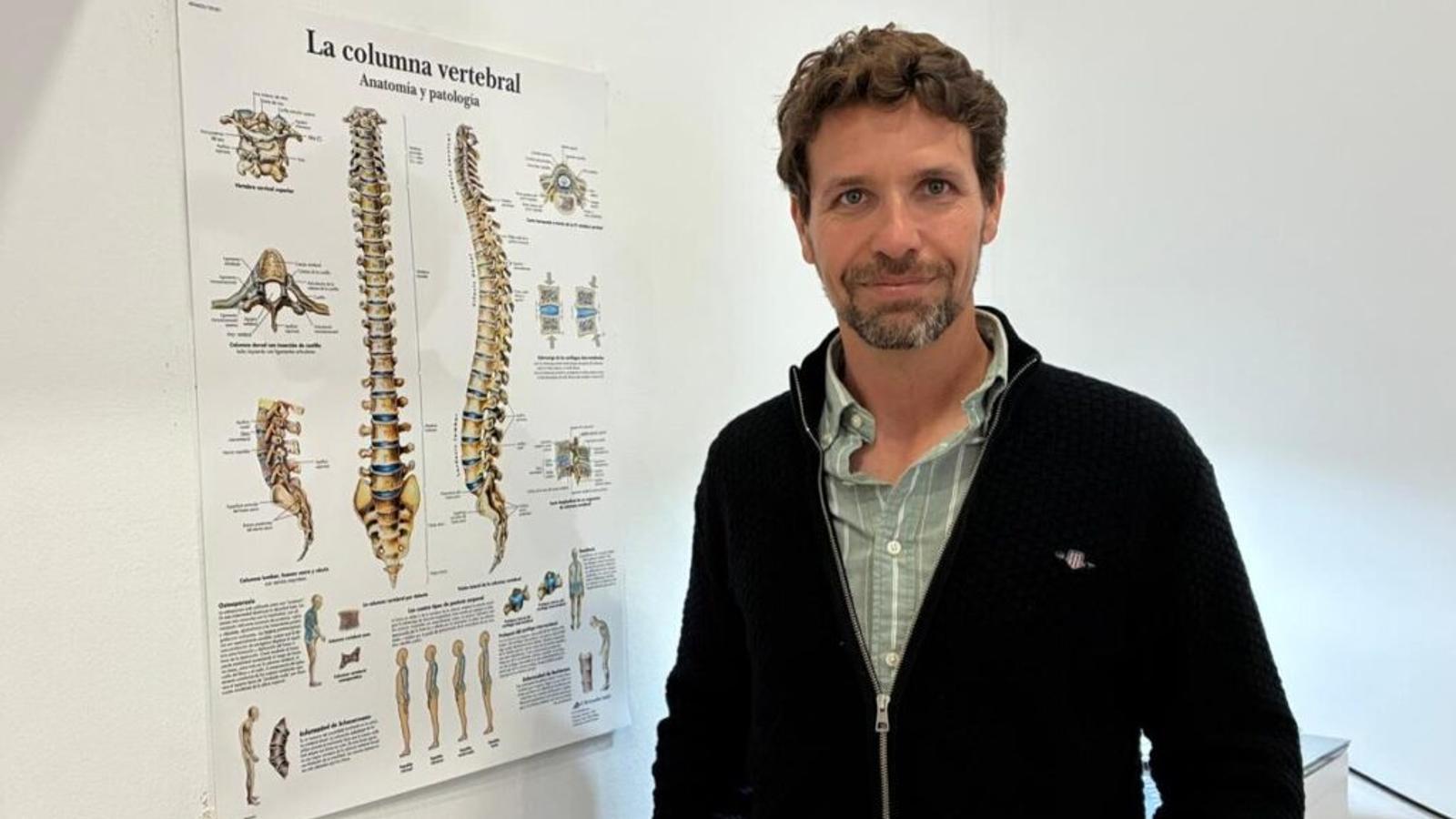
VilafrancaAndreu Galmés Rosselló (Vilafranca, 1984) has one foot in two towns of the Pla de Mallorca and has them well-rooted. In fact, he was very connected to his grandfathers, 'amo' Andreu Sobrassada from Sant Joan and 'amo' Montserrat Fosc from Vilafranca, both farmers and thanks to whom he lived and walked the fields of the Pla, to which he remains very attached. In fact, he conceives the functioning of the body as a unit linked to nature, and it was this entire legacy that led him towards the world of physiology, to graduate in Physical Activity and Sports Sciences, and, in the long run, to do a job he is passionate about. Andreu is an optimist—also by nature—and he transmits this to his patients at the Balearic School of the Back, which he directs. When they arrive at his practice, many have given up or are about to throw in the towel in their fight against an ailment that affects more than 600 million people worldwide.
The million-dollar question, what is back pain?
Defining back pain is a long question to answer, as it is an experience that can have many causes and does not always reflect the state of the bones, discs, or joints. One of the things worth understanding is that having an alteration or an injury does not necessarily mean having to experience pain. And, conversely, we can have pain without there being any significant damage. That is why, when a test shows wear or a herniation, we should not automatically think that we have a fragile back or that we will no longer be able to live a normal life. Often, we can live with these changes without pain or limitations. Here, movement plays an important role. An active and prepared musculature helps to provide support and stability to the back, and allows us to face daily activities with more confidence. It is not just about having strength, but about recovering capacity and security to move. However, not everything depends on muscles or structure. Rest, stress, worries, beliefs, and the family and work environment also influence it. Therefore, we must look at the whole person, not just their X-ray. The goal is to take care of the back without living dependent on it, to stay active, and to seek help when pain conditions us.
And how is it explained that someone has pain without having any injury?
— Because pain is not a photograph of how the tissues are, but an experience that usually helps us protect them. It pushes us to modify a movement, reduce a load, or stop when there might be danger. But this alarm can sound without there being an injury, and when it persists, it can cease to be useful. The body has receptors that detect potentially harmful stimuli, such as intense pressure, extreme temperatures, or certain substances related to inflammation. This information passes through the spinal cord and reaches the brain. The nervous system processes it together with information about the context, previous experiences, and the person's state; there are mechanisms that can amplify or dampen these signals. Sometimes, this system becomes more sensitive: it is like an alarm that is activated too easily. Thus, a daily movement can hurt without causing damage. This does not mean that the pain is imaginary: it is very real. Sleeping poorly, stress, fear of getting hurt, or worries can increase this sensitivity. Rest, support from the environment, and progressively regaining confidence in movement can help to reduce it. For this reason, we do not only look at the back: we also look at what that person is experiencing.
And can these factors be controlled or modulated?
— I like to create something like three drawers. There are some you can avoid, for example by not eating certain foods that you know do not sit well with you, or by avoiding certain types of jobs or tasks that you know are harsh for you. Then there are the factors you can modulate, which are things we cannot avoid, but we can make them have a less aggressive impact. For example, doing the work in a way that affects you as little as possible or, for example, I have to consume carbohydrates, but I can choose a type of carbohydrate that sits better in my stomach. Finally, there are the things that must be accepted because they are part of your environment and cannot be modified, and must be assumed by trying to create the best possible situation for the person. The things that you can do well you must do, and the others must be accepted.
What is the key to recovering from back pain?
— The key is to start with a good assessment: listening to the person, examining them, and understanding what is happening to them, how it affects them, and which factors may influence their pain. This diagnostic phase allows us to know where we are starting from and to choose the most appropriate treatment. Not everyone needs the same thing. From there, it is fundamental that the person actively participates in their recovery. To do this, they must understand how their body works, how the injury behaves—if there is one—and how pain works. They must also know what we are working on, why we are doing it, and how they can apply it to their day-to-day life. It is not just about receiving treatment, but about having tools to get involved in the process. This includes learning to manage efforts, progressing with exercise, and keeping in mind rest, stress, worries, and family and work circumstances. It is not a matter of controlling everything, but of identifying what influences it and what we can gradually improve. Our job is to explain, guide, and accompany, not to leave the person all alone facing the problem. We seek for them to recover capacity and confidence, and for them to know how to act if they have discomfort again. It is a shared task, with the person as the protagonist.
Nowadays, if we put back pain into an online search engine, thousands of exercises and options to treat an injury will appear... This can carry a certain risk of frustration when seeing that you are doing those exercises but not improving. What do you propose, and what is the difference compared to the more conventional exercises?
— It often happens that in the search for solutions we turn to the network "internet" and many options for exercises and treatments appear that supposedly cure injuries. But the reality is that it is not specific exercises that cure back pain, and that is why it is easy to try these strategies and fall into frustration when seeing that they do not have the expected result. The problem is not necessarily the exercise we find on the internet, but how we apply it. An exercise may be suitable, but if we do not make the appropriate adaptations to the profile of each case and to the moment in which the body is, it will not be able to assume it and it may increase the discomfort. And this can generate frustration: “If I do what they tell me is good, why don't I get better?”. It is a bit like with nutrition. Telling a person that they must do physical activity is like telling them that they must eat: we need to specify what, how much, how, and with what frequency. It is the same with exercise: it is not enough to have a list of movements. We propose starting from an assessment and adjusting the tasks to each person's situation: their capacity, symptoms, goals, and also their fears and circumstances. Afterwards, we must observe how they respond and introduce changes at the appropriate time. Sometimes it is necessary to increase the load; other times, reduce it, modify a movement, or give more recovery time. Therefore, the difference is not in having secret exercises or ones necessarily different from the conventional ones. It is knowing how to select, dose, and adapt them throughout the process, so that they represent an achievable stimulus that allows for progress. In short, the exercise model must adapt to the person, and not the person to a closed model. We do not seek for everyone to do the same thing, but for everyone to be able to advance from their own starting point
And what would you recommend?
— I would always recommend doing physical activity because the risks we assume have a smaller long-term impact than the risks of inactivity, which are much greater. That said, obviously if the symptoms are aggressive, it is necessary to put yourself in the hands of professionals who help you learn how to do it, and when you manage it correctly is when sport really works. Not just any sport in any way works. You can choose many ways to stay in shape, there is not one that is specifically better than another. You will not be better off for going running, cycling, or going to the gym; the key is what management you are capable of doing for that process.
And that is where your methodology comes in, right? What have you introduced that moves away from traditional exercises for curing back pain such as doing crunches or other strength exercises for the back?
— Exactly. What we have done is to take the individualization process a step further. Because a person does not improve just because they are doing a specific exercise. It is about being able to apply an input that physiologically triggers a specific adaptation. But here we have to take into account what structure that person has, what damage the structure has, how their symptoms behave, and what you are trying to build. Therefore, our work involves a process that is somewhat the reverse of the usual one. Normally, work methods are found, which are totally valid and coherent, that propose evolutions and progress, but that person has to adapt to these methods. We do it totally the other way around and adapt the work model to the person and not the person to the method, and that is what makes the person always manage to evolve regardless of the context they have
And what about back surgery? It seems there are cases where surgery used to be performed and now it is sought to be avoided. What do you think?
— In these situations, we take a conservative approach, moving from the least aggressive to the most aggressive or invasive. However, there are types of injuries that strictly must be operated on because, regardless of the muscular balance you may manage to create, the structure is in danger and is compromised; this must be determined by the doctor or neurosurgeon. Then there are others where it would be convenient to intervene, but it is not possible due to the type of structure. In these cases, we try to alleviate the symptoms with physical activity and complementary treatments such as, for example, injections, medication, etc. This person must try to maintain muscle tone to support and protect, and follow a mechanics of using the body that is not aggressive towards that structure. Finally, there are structures that have damage that could be operated on, but it is not strictly necessary or relevant to do so. These are the majority. Within this range, in more than 90% of cases, if a correct exercise program is carried out, well-adapted to each case and with appropriate monitoring, the success rate with a well-directed exercise program is very high. That is to say, surgery is not the devil, but the conservative path must be exhausted first.
This applies both to the clinical part and the physical preparation part, I understand.
— Exactly. Nowadays, the clinical side has a much more open vision regarding the importance of physical activity and good management, but this must be very concrete and precise for each type of case. I, obviously, if I could not guarantee this part of medical monitoring, I would not dare to prescribe physical activity. In fact, when I started doing this type of work, there were doctors who told us not to do this because you will hurt yourselves, because back then we did not have such a well-defined process. Therefore, if you tell a person that they must do an activity, you must be convinced that what happens to them will not be detrimental to their health. These fifteen years of evolution have given us the credibility to be able to say that what we do is safe and provides real benefits to people's health.
Do you have results statistics?
— Yes. At the time, we conducted validation tests on back pain perception, and in people with three months of specialized physical activity, more than 93% of the cases improved in a very concrete way. That is to say, they reached a situation of stability. This means that there is a significant reduction in the symptom, better physical condition, correct biomechanics, and most importantly, a capacity for self-management. In other words, understanding your body, how it works, and how you have to handle it in different situations. That is to say, taking control.
You don't use social media very much... Is it not necessary for you or are you not interested? How do you reach people?
— The project has been growing and we want to adapt to the demand organically and we have not wanted to force promotion on social networks so as not to lose control of the demand and reduce the quality of the service. We prefer to maintain an excellent quality standard rather than grow massively. Right now we are developing internal training and monitoring tools to be able to attend to more patients without losing this quality. Because it happens that in this type of profile and symptoms the margin of error is very small and there are mistakes that cannot be made. In fact, it often happens to us that people come and tell us that they have tried to exercise and have hurt themselves and think they did it wrong, but the problem is that their margins of error are different and they have very particular characteristics and that is what cannot be lost within a process.
Can we say that this is what differentiates you from the more traditional aspect?
— Yes. Everything is designed totally adapted to that profile and that type of behavior, to those symptoms, to the structure. It evolves and is redesigned according to the adaptations. We carry out an initial assessment that tells us the starting point, and we know the end point we want to reach, and this process is redesigned as the person makes adaptations. The process is particular and evolutionary, and for us, this is the most exciting part. It is not about giving a fixed list of exercises with an order and saying, 'come on, this will work.' No, that does not work. You have some inputs, you apply them, some improvements happen, some things occur, and then the rules change again, and you must know how to keep changing and adapting. Therefore, a task that does you good today might do you harm. A task that you do well might hurt you because you do it well, but this task places a load on a specific point where you should not have that pressure, and you will make a mistake; you remove the load from there and start improving by doing it poorly. And this is the management that must be known so that people can evolve correctly. This requires very well-trained instructors who have an orderly structure and have good monitoring from us, and who know how to have that point of creativity and vision to know how to manage this process and adapt the task according to each case.
Forty or 50 years ago there was less back pain than now, when in theory we have a better quality of life?
— It is different. Back pain has always existed, but it wasn't recorded as much before because people had a different attitude or did not go to the doctor as often. People worked, it bothered them, and they kept on working. What happens is that there is back pain from doing too much work and there is also back pain from doing too little. A while ago, there was surely more due to abusing weights, lifting a lot, overexerting oneself, lack of rest, and being very demanding with work, and today, due to the lifestyle we have, the opposite happens to us: there is back pain because we sit for so many hours, the musculature deteriorates, and the pressure on the spine increases. We have more sedentary jobs. Therefore, today at least, there are many more recorded cases, but that does not mean that there weren't any before, but rather that people did not make it known.
Can you tell us about any notable success case?
— There are many. After all these years, around eight thousand patients have passed through here. It is very rewarding to see people who were told they would never be able to run again and now they do marathons or mountain races. Or someone who was told they would not be able to work as a stonemason again and they are working. There have been many satisfactory cases. In any case, we must keep in mind that zero pain sometimes does not exist, but it is not the same to have debilitating pain as it is to have certain discomforts that any healthy person has and that do not limit you in what you can go on doing.
You said, but there are no magic formulas for that?
— The thing we must be clearest about above all is that in order to achieve this success, things cannot be delegated, but rather the patient must assume them. They must become a participant and be responsible for doing this work and managing it. And it is a physical, emotional, and behavioral aspect. The final goal is to take control of the situation. You have to understand your limitations and play the game well. And that is the key. People come here to learn how to play the game against back pain. In any case, there is no need to go to extremes: success is also achieving that a person can carry out their daily life without pain limiting them.
— So is there a part that involves in a certain way losing the fear of pain?
— Of course. Within these processes there is a motor component, but then there is a knowledge component, and here we must keep in mind that whoever wants to understand the body separated from the head will not understand anything. Therefore, there are physical aspects, cognitive aspects, and affective aspects related to what we know about the cognitive and the motor, and this chain must be managed jointly throughout the process. It is important that a person can understand what is happening to them, so that they can have the correct emotion in relation to what is happening and have the correct behavior in relation to what they know and the emotion they feel.
And you must do sports...
— I have done many sports throughout my life. I don't remember a week where I haven't done five days of sport. When I was young, I played soccer in Vilafranca, in a team called Es Pla with boys from Vilafranca, Montuïri, and Petra. Later, I spent some time with martial arts, and I have also always been very drawn to the mountains and nature. In the end, what I am doing now is horse riding; it is a very complete sport and has many similarities with a spinal recovery program, as it requires postural control and constant effort. I also really like trail running, and in parallel, I always do physical preparation and specific conditioning to ensure I have a balanced body and thus prevent injuries.
