Gregorian chant for dancing under the moon in Mallorca
The Moon in Verse programs Gregotechno which fuses Gregorian chant, electronic music, visuals and movement in an immersive experience this Friday at the Puig de Consolació in Sant Joan

-
CAT -
CAST -
GER
PalmaThe initial intention of this project was to “make accessible” a repertoire that had profoundly struck Marc Vilajuana. Approximately ten years ago, he discovered Gregorian chant and was fascinated by this sonic universe. “Beyond the spiritual aspect, it is the foundation of Western music. It is with Gregorian chant that musical writing begins in the West, as until then music had been transmitted orally,” he points out.
From this idea, Gregotechno is born, formed by Marc Vilajuana and Alejandro Narés, as well as all the other collaborators in their shows, such as Xavier Arqué, in charge of the visuals. The objective, however, was not to combine two languages that coexist in parallel, but “to build a real dialogue between the two.” In live performances, there are pieces where electronics – produced by Narés – accompany Gregorian chant – performed by Vilajuana – and the entire sound production is born from Gregorian melodies and texts. In others, electronic music takes a leading role, but always drawing from the imaginary of the chant. Their latest live proposal arrives in Mallorca this Friday, August 7, at the puig de Consolació de Sant Joan, within the La Lluna en Vers festival, in an evening shared with the artist Paco Pecado, who will also present his latest album.
Narés explains that, before joining the project, “he practically did not know Gregorian chant.” It was precisely Gregotechno that allowed him to discover it and expand this musical context. “With the project, we are interested in bringing this repertoire to spaces where it does not usually reach: clubs, venues, and festivals, making it accessible to very diverse audiences.”
Mystery
Mystery is one of the key words of Gregotechno. From the outset, its creators decided that they did not want to give answers to the public, but rather to ask questions. During the concert, questions appear that invite reflection, such as Ubi est Deus? (Where is God?). This mystery is also built visually. “The lights, the shadows, and the hidden spaces are part of the experience, they encourage introspection and allow each spectator to interpret what they are experiencing”.
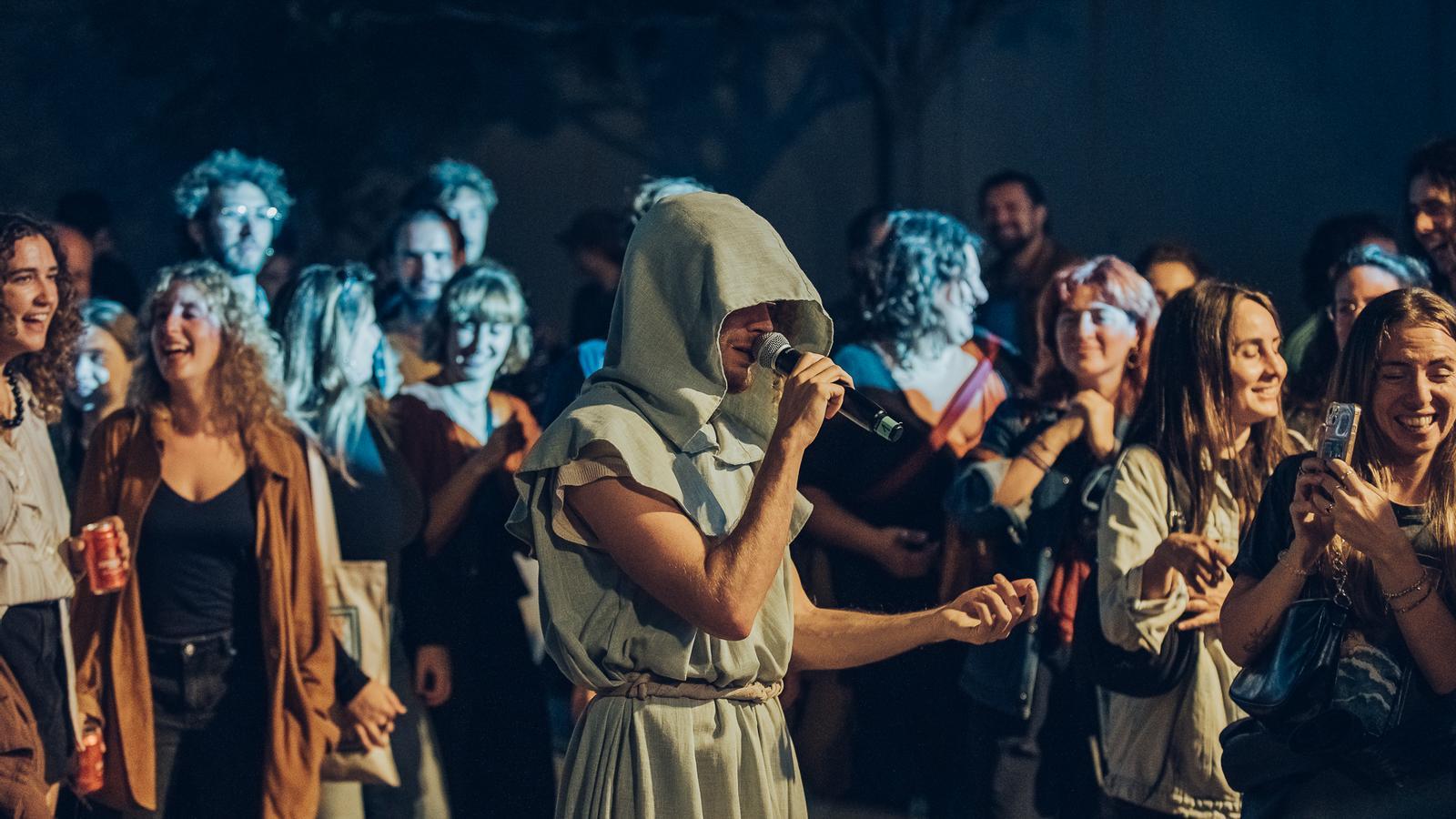
Gregotechno premiered in Mallorca two years ago at Casa Blai Bonet. They remember it and say that now they arrive with a much more elaborate live performance thanks to the joint work with Àgata Tantiña, in charge of the stage direction. “It is no longer just a concert, but an immersive experience where music remains the center, but it dialogues with other scenic languages: text, dramaturgy, light, visuals and movement,” explains Vilajuana. In fact, the group members explain that they do not feel comfortable defining Gregotechno as a concert, a show or a performance. “The live performance functions almost like a contemporary liturgy. It begins from what we traditionally identify as sacred: solemnity, contemplation and ritual. It progressively evolves towards a more corporal, popular and festive experience,” he reflects.
Meditation
Vilajuana and Narés explain that one of the things they like most is observing the audience's reactions. “They are very diverse: there are those who listen with their eyes closed, those who experience the concert almost like a meditation, those who dance, and those who leave with an expression of surprise. We love that,” they say.
Also, the tone and atmosphere of each concert change depending on the space where they perform. It’s not the same to play in a monastery, in a hall, or outdoors. “Each context modifies how the audience receives the proposal.” Furthermore, the audience is markedly intergenerational. Narés explains: “There are young people who are drawn to the project by electronic music and dancing, while older people come interested in liturgical singing. This mix of profiles continues to surprise us.”
One of the most impactful concerts they remember is the one they offered during the Night of the Museums at the National Museum of Art of Catalonia (MNAC) last May. They gave three performances there in front of nearly 5,000 people each. “It was impressive to see such a large mass of people in front of us,” recalls Narés. “It’s a very different experience from what we usually have in venues with less capacity for attendees.”
