From the 19th century, peasants who did not conceive of working without singing were incorporated into the industrial fabric of Mallorca and Menorca. This practice ended in the 60s with the generalization of the radio
6 min
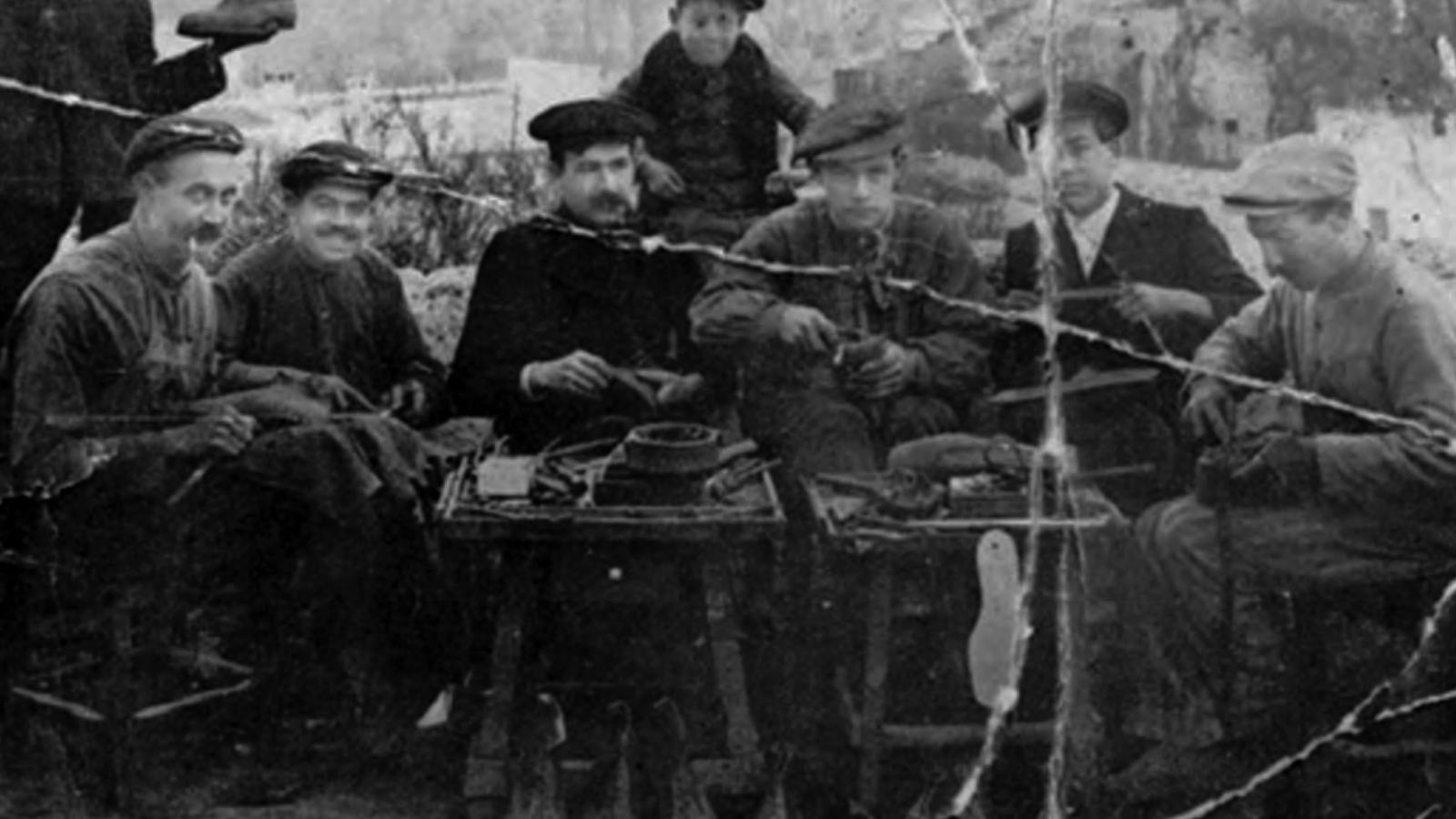
Group of shoemakers in Ciutadella around 1900.Arxiu Grup d'Història de la sabata de Menorca
PalmaThe Catalan economist Ernest Lluch, murdered by ETA in the year 2000, noted that, before the boom in tourism, Mallorca and Menorca were the only industrial islands in the entire Mediterranean. Starting in the second half of the 19th century, the Balearic Islands jumped on the bandwagon of the Industrial Revolution, which had begun a century earlier in Great Britain. Mallorca would stand out in textile products (Palma, Bunyola, Esporles, Santa Maria, Sóller, and Pollença), furniture, jewelry (Manacor), and footwear (Raiguer region and Llucmajor). In these last two sectors, Menorca would also excel. Ibiza, on the other hand, would have a more modest manufacturing production centered in Can Ventosa, dedicated to the production of hosiery.
That new economic engine relied mostly on peasant labor, who could not conceive of working without singing. This was already noted by the Palma-born musicologist Baltasar Samper, who between 1924 and 1932 led research missions in the Balearic Islands for the Obra del Cançoner Popular de Catalunya. This is explained by his biographer, the ethnomusicologist Amadeu Corbera: “In Mallorca, the singers he recorded could not recall the tunes without reproducing with their bodies the precise action of the agricultural task. Some would take a stick and slide it along the ground as if it were a plow, and as soon as this simulation began, they would start singing.” On his missions, Samper also realized that, in the 1920s, in some more industrialized Mallorcan towns, there were explicit prohibitions against singing in the factories. In Alaró, he encountered a sign that said: El buen obrero entra puntual y trabaja sin cantar. “However,” the researcher asserts, “most entrepreneurs were quite permissive regarding the musical streak of their workers.”
Sewers on the assembly line at the Gavino Sintes factory.Shoe History Group Archive
Singing in voices
Between 2015 and 2016, Corbera became interested in radiographing the old soundscape of the islands' factories. Due to logistical issues, however, he only dealt with those in Menorca with the help of fellow ethnomusicologist Eulàlia Febrer, a native of Ferreries. Thanks to a grant from the Institut Ramon Muntaner (IRMU) and the Institut Menorquí d'Estudis (IME), both interviewed more than fifty active and retired workers from the footwear and jewelry sectors. The results were captured in the report Popular Music and Industrialization in Menorca. The work is framed within the field of industrial musicology, which was initiated in the 70s in Ireland by the American anthropologist Betty Messenger. In Catalan-speaking lands, the path was opened in 2001 by the Valencian Josep Vicent Frechina with the article Allà a la fabriqueta. In 2008, Jaume Ayats, from Vic, took up the baton with the book Cantar al coro, cantar a la fàbrica, focused on the mid-Ter basin.
In Menorca, before the implementation of factory capitalism, domestic production prevailed in small workshops known as "fabricons." Shoemakers worked in groups of about thirty men distributed around low and wide tables called "banquetes." Up to four shoemakers and their respective apprentices could coincide at the same table. "In these environments," Corbera points out, "singing was a form of entertainment that also served, however, as a reaffirmation of belonging to the same labor community. Workers sang in voices according to hierarchy. The same happened in the fields, where, at threshing time, whoever directed the beasts from the middle of the threshing floor sang, while those who turned the straw with a pitchfork were limited to shouting orders to encourage the animals."
The practice of singing in voices was also followed by women, who worked separately. This was the case of the "embauladores" (box packers/cleaners), who were in charge of cleaning the shoe at the end of the process. "The fact of finding a man singing with a female collective," the researcher assures, "was seen as a way of courtship that could not take place if he was married. Thus, through singing, the limits of labor relations were constructed within the workplace."
The musical tastes of the island's working class included boleros, habaneras, and, above all, Spanish zarzuelas. In Menorca, opera had a strong tradition. Inaugurated in 1823, the Principal Theatre of Mahón is the oldest opera house in the Spanish state. However, records of opera performances in the city date back to the end of the 18th century. Furthermore, throughout the 19th and 20th centuries, smaller theaters were opened across the island in casinos and mutual aid societies, where working-class choirs performed other pieces of lyrical music. “At the beginning of the 20th century –the ethnomusicologist explains– many Menorcan farmers began to sing these same pieces to replace the traditional folk songs of the countryside, which, on the other hand, were maintained in Mallorca because it was a larger and more populated island.”
Towards the end of the 50s, Menorca moved from a more artisanal and small-scale production model to a Fordist, assembly-line, and mass-production type. “In the new iron cages,” points out Corbera, “each worker was isolated and in charge of a specific step in the manufacturing process. From working from sunrise to sunset in the fields, the new wage earners with fixed salaries moved to submitting themselves to the dictatorship of the clock, in most cases with an operator called a timekeeper who marked the time they had to perform the task.”
The film Modern Times (1936), by Charles Chaplin, masterfully describes that new capitalist model that burst forth with the slogan ‘time is money’. “It is memorable,” says the scholar, “the scene of the worker, played by Chaplin himself, who absurdly tightens the bolts on the assembly line, without a minute to rest or to be distracted. At the end of the sequence, Chaplin is literally swallowed by the machine, quite a metaphor for the dehumanization of progress.” The factory industry displaced forever the habit of working the land following the rhythms of nature. “Singing, conceived as a social act, ceased to have meaning as a form of group interaction in the context of a new individualized labor model and one of assembly-line and timed manufacturing. Divided in space, the workers could not hear each other because of the noise of the machines and often could not even see one another.”
Workers at the former Mascaró factory, in Ferreries.Damià Pons Allès ArchiveShoe packers from Alaior.Shoe History Group Archive
However, there were workers who were not willing to suppress their musical beats. “Some –states Corbera– started singing following the rhythm of a machine. Others opted to do it in silence, moving their lips or, as if they were deaf, through signs, communicating the songs to the rest of their colleagues with expressive gestures”. Even so, the researcher makes one thing clear: “If the workers sang in the factories it was not because they were happy at work. They did it to be happy in a rather hostile context”.
Transition to passive listening
From the 60s onwards, the well-known process of silencing took place. The arrival of the radio in industrial warehouses meant the transition from singing to passive listening. “In Menorca –highlights Corbera– there were workers who began to bring their own radios to work. Many listened to the most popular program of the time, Verde Campo, dedicated to workers and farmers. It was broadcast from Radio Popular de Menorca, the embryo of COPE, based in Ciutadella. People wrote to the host, Juanita Roca, requesting popular songs (rancheras, boleros, zarzuelas) to dedicate to a friend or relative”.
Soon, individual radios would be replaced by centralized broadcasting systems, just as, since the 40s, had already been implemented in British and North American factories. Speakers distributed throughout the premises allowed for the songs playing not only on radios, but also on record players, to be heard. “Back then –asserts the ethnomusicologist– workers and employers negotiated the music that was to be played. In many cases, the workers could bring records from home or chose which ones they wanted to hear, and they changed them themselves”.
That community decision was not free of controversy. “The tastes of the older staff and the younger ones did not always coincide. While the former opted for the operatic genre, the latter preferred the great hits of the moment, both national and international: Lluís Llach, The Beatles, Bob Dylan... It was not common for women to be allowed to choose the music, so their favorite melodies, songs and romantic boleros, were excluded from the industrial repertoire”. Corbera regrets the loss of the sonic heritage that the silencing process in the factories meant: “A whole aesthetic of singing and a way of understanding the voice was lost”. Now, to escape reality, workers who can continue to cultivate passive listening with discreet wireless headphones attached to their ears. No one remembers anymore that there was a time when singing was an act consubstantial to work.
The word folklore was born in the 19th century from the English roots folk and lore ('wisdom'). In the Balearic Islands, a prominent folklorist was the Franciscan Rafel Ginard (1899-1976), a native of Sant Joan. Between 1966 and 1975, he published the Cançoner Popular de Mallorca (Majorcan Folk Songbook) in four volumes. It is the most extensive compilation of traditional songs in the Catalan language, with nearly 20,000 records and numerous variants.
On the occasion of the 50th anniversary of Ginard's death, musicologist Francesc Vicens has just published Quan cantava la terra. Les músiques del Cançoner Popular de Mallorca (When the earth sang. The music of the Majorcan Folk Songbook) (Edicions UIB). The book recovers the sonic dimension of the Franciscan's monumental work, which could only collect the texts of the songs without the melodies. He does so based on two documentary sets preserved in the Franciscan's ethnopoetic legacy: 32 tunes recorded in a folder and 21 musical transcriptions from the booklets of the Calendari Folklòric de Mallorca (Majorcan Folk Calendar), which Ginard prepared in the 1950s. The repertoire includes ballads, work songs—for plowing, reaping, threshing, pruning, and shearing—children's songs, party tunes, and other musical expressions linked to the daily life of traditional Mallorca.
In Quan cantava la terra, Vicens has not limited himself to reproducing the located manuscripts. He has created a musical edition and organized them using a very precise cataloging system. The book is born from the desire to recover not only melodies, but the cultural environment that gave them meaning. “Ginard,” explains the musicologist, “had grown up in the rural world of Sant Joan and his first musical memories were tied to the landscape and the peasant way of life: work and reaping tunes, threshing floor songs, the bagpipes of festive days, and the shepherds' flutes. For him, singing was part of daily life and traditional music was a way of expressing and transmitting collective experience.” In 1934, Ginard wrote: “When you walk through the countryside and hear a folk song, that is the genius of the earth singing; it is the music that the earth has produced.”
In Ibiza, the task of collecting the musical heartbeat of the people fell to another clergyman, Father Isidor Macabich (1883-1973). In his case, however, he focused on ballads, sung narrative poems. In 1954, he gathered 26 of them in the Romancer tradicional eivissenc (Traditional Ibizan Ballad Book), 11 of which had already been included in the Romancer popular de la terra catalana (1893) by the Palma-born linguist Marià Aguiló. Given his status as a cleric, Macabich discarded ballads with erotic or risqué content. In Menorca, the sounds of the earth were reclaimed much earlier than in Mallorca and the Pityusic Islands. Dating from 1912 is the work Folklore menorquí: de la pagesia (Menorcan Folklore: of the peasantry), by the physician and folklorist Francesc Camps i Mercadal, from Es Migjorn Gran, known by the pseudonym Francesc d'Albranca.