General Riera: the soldier who saved lives
On November 16 it makes one hundred years of the death of this reformer of healthcare in Mallorca

PalmaOne of the longest streets in Palma bears his name. And he deserves it, unlike other figures to whom public thoroughfares have been dedicated. The physician Bernat Riera Alemany, General Riera, dedicated his life to saving lives. He did so by trying to promote the latest medical advances and hygienic practices in Mallorca, urging the authorities to take measures in this regard, and concerning himself with women, children, and the sectors of the population in the worst situation, in addition to being a forerunner of tourism and self-government. We remember him as the hundredth anniversary of his death approaches, on November 16, 1926.
He was born in Andratx on August 26, 1864, the son of the physician Josep Riera, and he maintained this bond with his hometown throughout his life. He was president of the Andratx Atheneum and also has a street dedicated to him there. His portraits show a certain resemblance to illustrious contemporaries Antoni Maura and Joan Alcover, with a well-trimmed mustache and goatee. He was, according to the press of the time, a man of "fluid, easy, ingenuous, affectionate, correct, elegant speech"; "tender in the fight, strong in tenderness," "intelligent," and "good."
The adolescent Bernat studied at the Balearic Institute of Palma, the current Ramon Llull Institute, the first to be created in the State. At that time, its director was Francesc Manuel de los Herreros, and other illustrious figures taught there, such as Josep Lluís Pons i Gallarza, Francesc Barceló i Combis, and Joaquim Botia.

He studied medicine in Barcelona –there was no university in the Archipelago at the time, centralism had done away with it–, with the immense good fortune that, at that time, a handful of young professors had occupied the classrooms, transmitting innovations arriving from abroad, advances that Riera would later apply in Mallorca. That restless spirit that the future general was, did not limit himself to learning the lessons: he served as secretary of the Student Interns' Athenaeum, which organized activities not only on medicine, but also on art and literature, and attended Wagner's operas in the 'roost' of the Liceu with his classmates. At the same time, he did internships at the Academy and Laboratory of Medical Sciences of Catalonia. And even so, he graduated in 1884 with an excellent grade.
His first assignment as a doctor was Andratx, alongside his father. In his hometown, he had to face a cholera epidemic, for which the Provincial Health Board designated him as a delegate to the town. The study of epidemics, with records and statistics, and how to face them, was one of the essential activities of his career.
The young Riera also joined a new entity recently founded in Palma: the Medical-Pharmaceutical College, which also published the Balearic Journal of Medicine, Pharmacy and Veterinary Science, where his articles began to appear. He went on to become president of that entity and, as such, host to Santiago Ramón y Cajal in 1910, when the Nobel laureate received the honorary presidency. He would also be president of the Royal Academy of Medicine and Surgery of Palma and a volunteer for the Red Cross, just like his wife, Empar Pou, and his daughter, Concepció. Furthermore, he bequeathed his books and instruments to this organization.
The Cuban War
The young doctor was twenty-four years old when he made a decision that would mark the rest of his life: to sit for a position in the Military Health Corps, which, of course, he obtained. Why the army? As Josep Tomàs Montserrat observes, at that time becoming a soldier—or a priest—was “a means of social advancement.” Be that as it may, from that moment on, Riera would act as a soldier and a doctor at the same time, in an inseparable way: “The military art,” he stated, “cannot consist only of leading men into combat, but of ensuring that the armed contingents live in good health.”
The rotation of postings, common in the military, led him successively to Valencia and Cartagena. In the Valencian capital, he encountered a cholera epidemic, and his dedication was so intense that he received the gratitude of the captain general and the appointment as an honorary member of the Medical Institute.
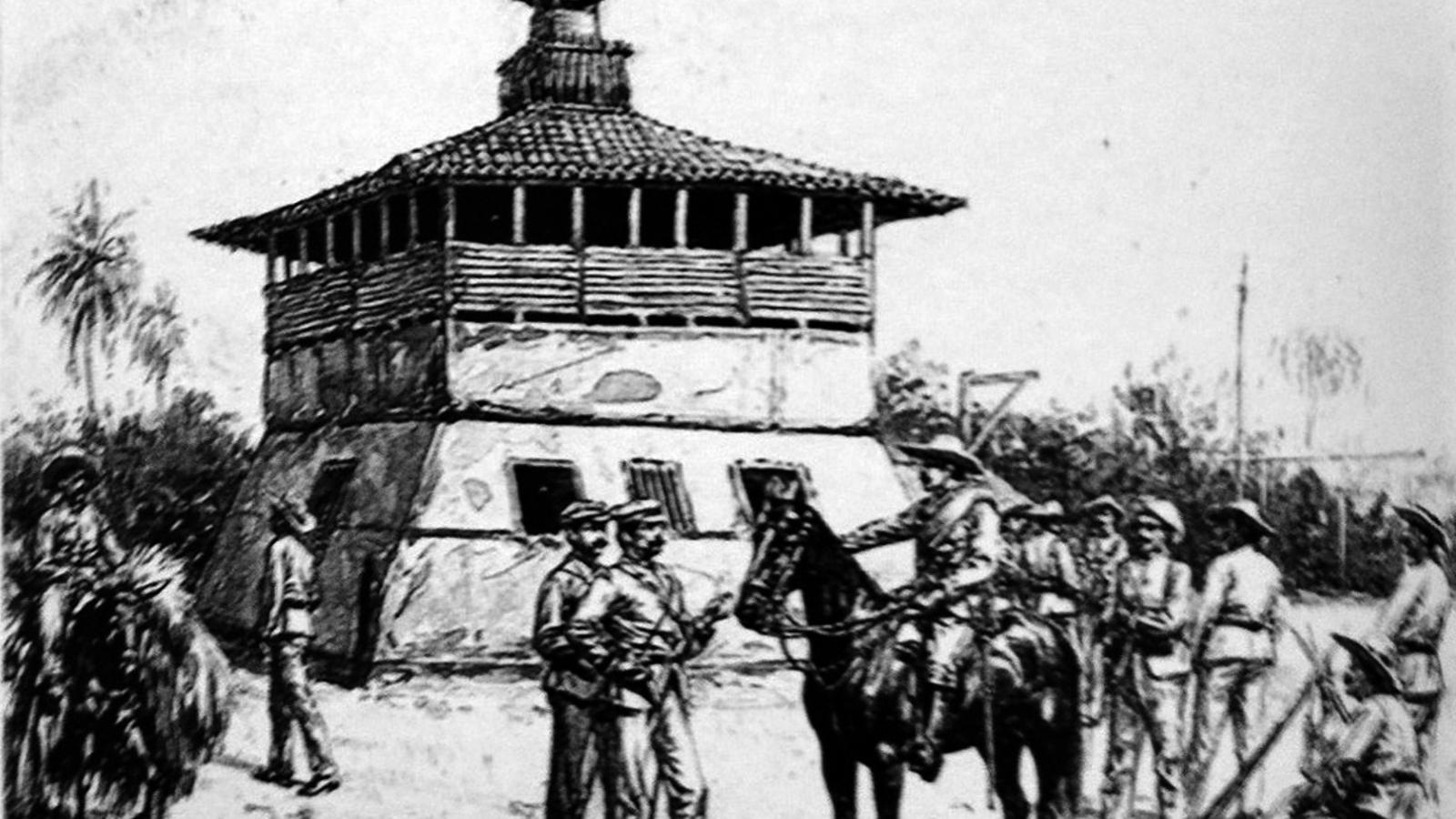
The problem with being a soldier is that you can be sent to a war, and that is exactly what happened in 1895, when the revolt broke out in Cuba, which was then still a Spanish colony. He had been assigned a much more pleasant posting, close to home: Menorca. Instead of that, he had to leave for another island, much further away, much larger, and much more problematic. The College offered him, and two other doctors who were to leave for Cuba, a farewell banquet—who knew if it was the final one—at Cas Català.
The doctor from Andratx was assigned an activity quite different from his usual one, but predictable as he was a soldier: having to fire shots. It was at Rebancadón, on October 7, 1895. A few days later they engaged in another combat, and Riera went to the front line to attend to the wounded. For those actions, he would be awarded the Red Cross of Military Merit and the Maria Cristina Cross First Class.
But Riera's essential work in Cuba was carried out in the field hospitals, taking charge of some of those facilities. He himself fell ill with yellow fever. It is not in vain that epidemics caused more casualties than the conflict itself. He wrote journalistic chronicles of the war and took the opportunity to study wounds caused by firearms. In 1897 he returned to Mallorca, where he would work at the Military Hospital of Palma, of which he would eventually become director.

It was then that Bernat Riera began a task to which he would dedicate the following two decades: improving the lives of the islanders by implementing measures to care for their health. Above all, for the least favored: workers, women, and children. He saw, as Tomàs Montserrat notes, "it as the doctor's obligation to influence the political and public opinion sphere to improve the woeful quality of life of the most needy classes."
Preventing three hundred deaths every year
It was the time when the urban reform of Palma was being proposed, promoted by the engineer Eusebi Estada, the spearhead of which was to be the demolition of the city walls that were suffocating the old City. Riera gave, in 1900 at the Medical-Pharmaceutical College, the lecture Public Hygiene of Palma, in which he raised such scandalous deficiencies as the overcrowding of dwellings, the erroneous location of septic tanks, and an insufficient sewage system, among others. Palma needed a doctor's hand, never more aptly put.
Just from typhus, calculated Riera, the equivalent of 12,500 working days were lost in the City. By correcting those disasters, it was feasible to save the lives of three hundred citizens of Palma every year. He was situated in the same line of renovator doctors that the mayor Emili Darder would later be a part of.
Riera continued his battle with successive public interventions, in which he did not shy away from criticizing that ancestral apathy, nor the practices of some colleagues. He demanded a better supply of drinking water and opposed the location of the new municipal market in the Plaza Mayor, a space he considered insufficient, unless, he added ironically, the architect possessed "some secret of magic or enchantment" to make it larger.
Prevention as a premise
The military doctor gave a lecture on how to prevent diseases for the workers of Palma –tuberculosis was wreaking havoc among them– and he grasped the thirst for knowledge of those men. He was concerned about the children and the need to protect them. He was very harsh about the “abuse” of wet nurses, “turned into a matter of productive industry”, and requested that a four-month leave for pregnant workers be regulated by law and that a specific clinic be created for infants and their mothers. He highlighted the “place of honor” of mothers in the education of their children, before school, and demanded that the State intervene where private initiative did not reach –he would be delighted with the public healthcare of current times.
In 1926, upon reaching the rank of general, he received a tribute from his neighbors in Andratx. On October 31st of that year, he made what would be his last visit to the town: he commented that “wherever I have found an Andratx inhabitant, a fellow countryman, I have seen a friend, a brother, and as such I have considered, treated, and served him”. He died on the following 16th, at 62 years of age, this fighter for a better society: a man who was much more than a couple of streets.
In an environment of rigid centralism and the imposition of Spanish, Bernat Riera, when giving a lecture in Palma in 1899, did so in Catalan, convinced that, by using it, as Tomàs Montserrat says, “he could express all the nuances of scientific thought and contribute to increasing the social prestige of his own language.”
The year before, he had described Catalan as “a native and beloved language, capable of expressing all progress and all happiness,” and denounced that it had been “despised” and “removed or almost removed from school.”
Riera was a regionalist through and through, probably influenced by the proposals of his friend Miquel dels Sants Oliver. Like him, he also bet on tourism—at that time, practically non-existent in Mallorca—as a door open to progress. The influence must have been mutual: in his plea in favor of the “tourist industry,” Oliver stated that the humidity in Palma “is due, according to the vote of very expert people, to the deplorable state of the city's subsoil, without an impermeable sewerage system.”
As a good soldier, Riera was a firm supporter of the unity of the State, but not of uniformity. For him, regionalism was something scientific, and centralism quite the opposite: just as living beings evolve towards diverse forms, so do peoples, according to their circumstances. A state, yes, but with “multiple nations,” what would now be called a plurinational state. His commitment was to the “autonomous ideal.”
Information prepared based on texts by Josep Tomàs Montserrat, the Official College of Doctors of the Balearic Islands, Juan José Negreira and José Luis de Mesa, Antoni Marimon Riutort, Miquel Alenyà, Margalida Mestre and Joana Maria Pujadas Mora.
