

The book L’emigració andritxola a Cuba written by Rosa Calafat with four other researchers collects testimonies from deceased emigrants. Their lives in that ‘promised land’ were not easy. This is how Tomàs Salvà recounted it: “I never knew any Sundays. We only had Christmas Day off. That’s why there were few Cubans who worked with the Mallorcans. [The Cubans] didn’t work much”. Racism on the Caribbean island did not go unnoticed among the people of Andratx. This is how Jaume Pujol recorded it: “There was a promenade for whites and one for blacks”. He himself, however, also denounced linguistic racism against the Mallorcan community: “The Cubans laughed at us and made us speak Mallorcan in front of them. They told us ‘you sound like barking dogs’”. Upon arriving on the Caribbean island in 1900, Pujol did not know how to speak Spanish, “not at all. And, of course, they didn’t understand me. To ask for water, I would say: ‘This is a well and here there is water’”. In his case, he had learned Spanish songs in Mallorca without knowing their meaning much, just by heart. One day he dared to recite them at a party. Hearing him sing in that language, the Cubans thought he had been fooling them until then. As revenge, they beat him up. Pujol had to stay in bed for eight days and couldn’t chew anything for a month. Upon learning that his brother planned to emigrate to Cuba as well, he gave him the following warning in the form of a ‘letter-glosa’: “You, brother Sebastià, / if to Havana you want to come, / you must learn to read / and to speak Spanish, / because otherwise you will suffer / what happened to me”.From 1920 onwards, reporting on all these migratory flows, there was the weekly newspaper Andraitx –closed in 1971, it would be the third longest-running publication in Mallorca. Very few fulfilled the dream of ‘making it in Havana’, that is, of making a fortune. Some didn’t even manage to raise money for the return trip to Mallorca. This is confirmed by the following exchange of ‘letters-glosas’ between a mother and a son: “[...] Remember sometimes – said the mother– / when I kept you in my lap / and gave you sustenance / and I had nothing for myself [...]”. And the son’s reply was: “[...] that there is no understanding there. / And you who say I don’t have any, / get a boat specifically / and send me back to Spain”. Emigration would eventually change sides. “In the seventies – points out Calafat–, when I was little, three cousins of mine came to live in Andratx from Cuba fleeing Fidel Castro’s dictatorship”. For years, every summer the municipality of Andratx has organized a singing of havaneras to remember its close relationship with the other side of the Atlantic.
The little Andratx people who 'made Havana'
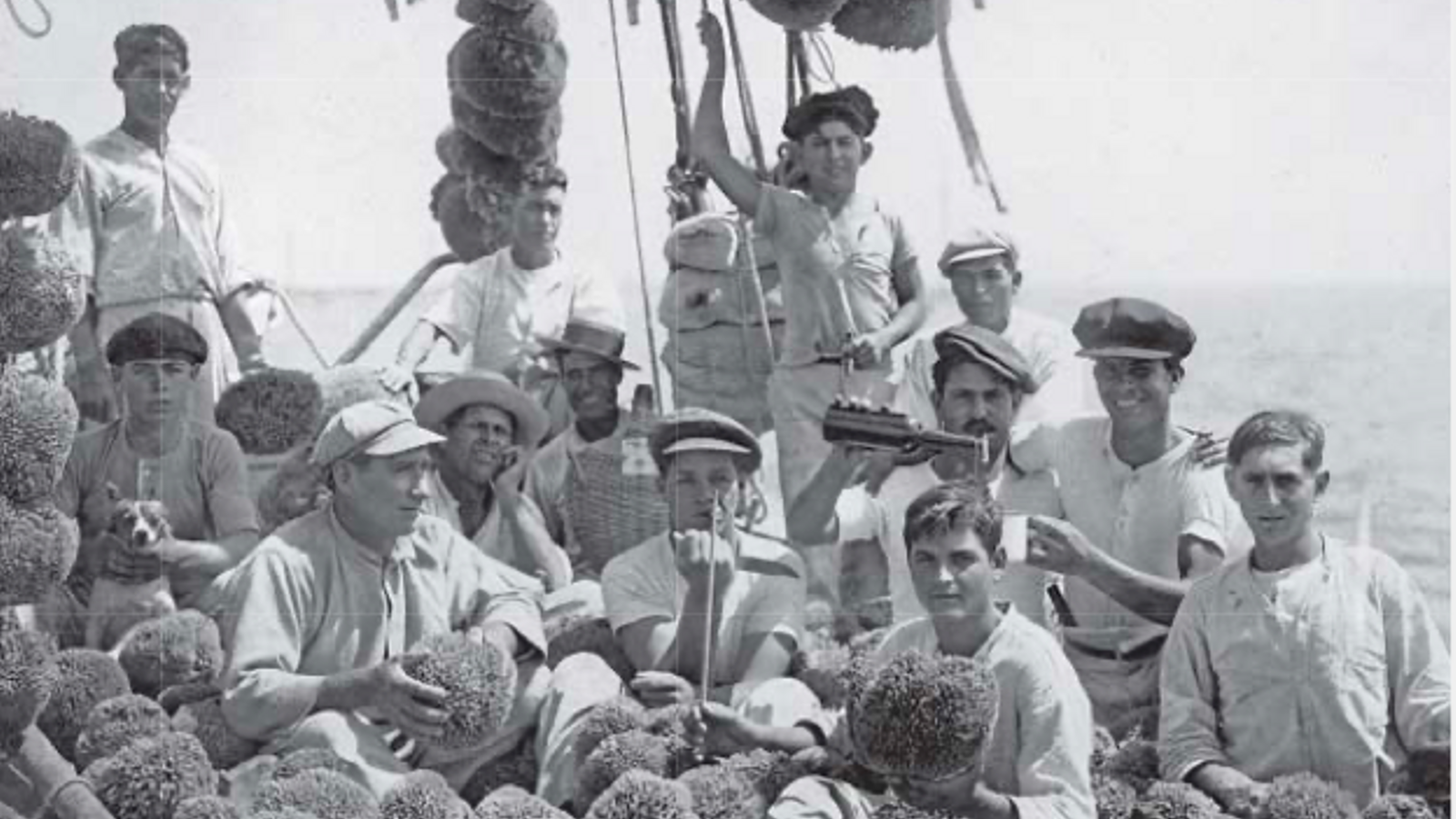
The people from Andratx were the largest group of islanders who, between 1850 and 1950, driven by necessity, emigrated to Cuba, where they dedicated themselves mainly to sponge fishing. The majority went and returned to Mallorca to get married and have children. During their absence, the municipality became a true matriarchy.

-
CAT -
CAST -
DE
PalmaThe Havana cemetery is full of tombs with very local surnames: Pujol, Roca, Moner, Ensenyat... They are the testimony of the Majorcans who in the 19th century left to 'make the Americas'. According to chronicles, in 1889 there were about 10,000 (4% of the population). Many from Andratx went to Cuba. Among them were the paternal and maternal grandparents of Rosa Calafat Vila, professor of Catalan Philology at the UIB. “In the eighties, during my youth – she says –, I dug into the oral memory of the municipality and I was pleasantly surprised. I discovered a large number of 'gloses' related to the Caribbean island”.
Now, forty years later, that project has been expanded with the publication of Andratx Emigration to Cuba (Nali Edicions), which Calafat has co-written with researchers Gabriel Covas, Maria José Bordoy, Magdalena Esteva and Rafel Oliver. “Three years ago we called on the people of the town to send us their family photos to compile the book. The response has been impressive. In Andratx there is almost no one who does not have some relative who went to 'make Havana', which was the expression commonly used”. That emigration lasted a century, from 1850 to 1950. “Here, at the port, there was a soap factory that exported to different countries, including Cuba. It is likely that, trading there, the people from Andratx realized that the Caribbean was a good place to make money. In Mallorca, the economic situation was very delicate. They left with nothing”.
The Havana prison
From the first decade of the 20th century onwards, the presence of Andratx people on the Antillean island increased, which in 1898 had ceased to be a Spanish colony. In 1896, it had been a Majorcan, Valeriano Weyler from Palma, who, in his capacity as captain general, devised the first concentration camp of the modern era, which was called a 'reconcentration' camp. Thousands of Cuban peasant families were confined in fortified cities to prevent them from supporting the guerrillas fighting for independence – it is estimated that, as a result of this measure, about 170,000 civilians (10% of the island's population) died from hunger and various diseases. In 1900, the entire municipality of Andratx had nearly 6,500 inhabitants and, according to the census, there were about 1,100 who were abroad. Of this figure, about 800 were in Cuba and the rest were distributed among France, Argentina, Uruguay, and Puerto Rico.
The people from Andratx usually left at 14 years of age, which was the minimum age to be able to work at the destination, where they made sure to have some contact. Beforehand, they had to request an application from the Registry of Convicts at the court of Andratx. This body was responsible for issuing them a document certifying that they had no criminal record. It also issued parental or marital authorizations for sons and wives. The ships sailed from the port of Palma towards Barcelona, from where they then headed towards the Atlantic. At first, the journeys lasted three months, later, only one month.

Upon arriving in Cuba, all emigrants were taken to a kind of prison camp called Triscòrnia, on the outskirts of the port of Havana. The conditions of the enclosure were entirely deplorable. The inmates stayed there until someone claimed them as labor. Otherwise, they were returned to their countries of origin. Many people from Andratx were able to escape that hell thanks to the humanitarian work of a fellow countryman, Gabriel Pujol Mir, en Tiona, who gave them work at his hotel-restaurant La Marina Balear. After having been in Catalonia, Pujol arrived in Cuba in 1906 at the age of 26. He was one of the few who settled there as an entrepreneur – he died in Andratx in 1965, at the age of 84.
Sponge divers
In Cuba, the andritxols who came from farming were able to continue working in the fields, hauling coal, firewood, cane, or plantains to Havana and Cienfuegos. On the other hand, those who were fishermen found the opportunity to retrain in Batabanó, a town about 55 kilometers from Havana. Its port, Surgidero, was one of the largest centers for sponge export. For a month, it didn't matter if it was Saturday or Sunday, winter or summer, the sponge divers worked sixteen to eighteen hours a day without docking. They anchored the boat at sea and then, in groups of two, set off in small boats to extract the sponge with a five-meter-long fork-shaped pole – they looked at the seabed through a bucket with glass. In 1917, nine andritxols lost their lives as a result of a devastating cyclone.
In that 'promised land' of the Caribbean, there were also people from Andratx who did not stop exploiting their culinary vein – Andratx would be known as the 'town of chefs'. Among them were Macià Ensenyat Nero, Gaspar Alemany Castell, Antelm Pujol Pujol, Gabriel Ballester Pujol Pastoret, Antoni Miquel Alemany and Guillem Pujol Moner. In 1885, the Sociedad Balear de Beneficiencia was founded in Havana, which in 1901 would be reconverted into Centro Balear. There was also the Quinta Balear, which offered medical assistance, a library, and all sorts of recreational activities.
Dazzled by freedom
The Andratx people were fascinated by the exoticism that Cuba represented. This is how Salvador Ensenyat Balaguer (1910-2008) stated in an interview in 2000: “It was common that when we were given rest days, the fishermen took the opportunity to have some fun, and the main entertainment of that time in Batabanó was Cuban women. The Andratx people spent a lot of money there, on the other hand, the price of things was very cheap, you could have a great time with little money. You could go to the Cabaret or other dance halls. Many of these Andratx people, dazzled by the freedom that was given there, decided to stay there”.
“Four years after their departure – assures Calafat – the men returned to Andratx to do their military service and to get married. The mothers chose the daughter’s fiancé, according to the money he had obtained. If the young emigrant did not obtain the established economic minimum, the engagement was broken. The expression ‘Havana pumpkin’ referred to infidelities between fiancés for economic reasons. If the woman became pregnant, the man could go to Cuba again. It was what was known as ‘eixida’”. Those ‘eixides’ were repeated until the marriage had two offspring, preferably male. At most, the Andratx people had three. The maximum stay in Cuba could be about 30 years. “There were those who returned already old, others did not return, they remained there living with a Cuban woman and forming another family. Some, a minority, broke the tradition and married a Cuban woman and brought her to live in Andratx”.

‘The village of women’
Women kept in touch with their husbands with the ‘carta-glosada’, an epistolary genre typical of a time when illiteracy prevailed. It was a message that the husband, from Cuba, would ‘sing’ to a companion returning to Andratx, who would learn it by heart to recite it later to his wife. He thus acted as a postman with an invisible letter of spoken words. Written missives were reserved for ‘paperets en punta’, which was the name given to letters accompanied by money. Due to the absence of the male population, Andratx would be known as ‘the town of women’. The typical phrase among the women of Andratx was: ‘Men that way and money this way’. “Matriarchy – assures Calafat – was not just a word, but a fact. They were the ones who distributed the money sent by their husbands or sons. They organized the structure of the town, only seeing their husband for a couple of months during their youth.”
The flow of people from Andratx to Cuba began to decrease in 1930. Faced with the economic difficulties suffered by the Antillean island, a law was passed to curb a type of emigration qualified as undesirable for “extracting a sum of money from the country that should remain in its own hands”. In 1933, another law stipulated that 50% of company workers had to be of Cuban nationality. Added to all this was the strong competition from other sponge-producing markets. Labor opportunities in the Caribbean ‘El Dorado’ vanished completely in 1959 with the revolt led by Fidel Castro against the dictatorship of Fulgencio Batista.
From the 1950s onwards, upon returning to Mallorca, the people of Andratx would gladly embrace the nascent tourist industry. This is confirmed by the following anonymous verse: “I won’t go to Havana anymore / With the tourism we have, / At least now we live / Better than before. / I don’t miss the oil lamp, / We have fun with the light.” In 1994, a twinning ceremony took place between Andratx and Batabanó. Today, three streets in the town commemorate its immigrant past: Cuba, Havana, and Batabanó. There are also some imposing houses built with the fortune of the well-known ‘indians’. “However – recalls the UIB researcher –, there were not that many.”
